

Secondary Losses in Grief: Why Loss Changes More Than You Think
Secondary Losses in Grief: Why Loss Changes More Than You Think
Secondary Losses in Grief: Why Loss Changes More Than You Think
Grief is rarely about just one loss.
When someone dies, we may also lose routines, identity, security, future plans, and the roles we once held. These are called secondary losses — and they can make grief feel overwhelming and confusing.
In this episode, Nicole Lee joins us to explore:
Why grief feels like more than one loss
Emotional overwhelm and “energy in motion”
Identity changes after death
The idea that loyalty does not require ongoing suffering
How growth can coexist with pain
Grief is deeply personal — and it evolves over time.

What Actually Happens in the First Year of Grief and Why Nobody Warns You
The first year after a loss is full of things nobody prepares you for — grief brain, grief bursts, the exhaustion, the firsts. Grief specialists Kelly Daugherty and Karyn Arnold explain what's actually normal and what helps.
The first year after a loss is unlike anything else you will experience. And yet most people go into it completely unprepared because nobody talks honestly about what it actually feels like. That's not because people don't care. It's because grief is still one of the most underdiscussed experiences in our culture. We show up for the funeral. We bring the casseroles. And then, as Kelly Daugherty often says: "By the time the casseroles have been eaten, the phone has stopped ringing, and the funeral is over, then it really hits them." And when it hits, many people ask the same question: Am I grieving, or am I going crazy? The answer, almost always, is: you are grieving. And this is what grief actually looks like.
What Is "Grief Brain" and Is It Real?
Yes. Grief brain is real, and it affects more people than most realize. When you are in early grief, your nervous system is under enormous strain. Stress hormones are elevated. Sleep is disrupted. Your body and mind are working overtime to process something that has no quick resolution. As a result, many grieving people experience significant cognitive changes — including difficulty concentrating, forgetting things they would never normally forget, struggling to read or retain information, and feeling mentally foggy or scattered. This is why Kelly Daugherty and Karyn Arnold — co-hosts of the GRIEF Ladies Podcast and co-authors of The First Year After Loss — designed their new Grief Brain Reader series with the grief brain specifically in mind. The books are intentionally short and digestible. Because handing a grieving person a 300-page book isn't helpful. It's another complication. "Your grief brain can handle this" is the message behind the series. It was written for exactly where you are right now.
The Firsts Nobody Prepares You For
The first year of grief is filled with firsts you didn't ask for. The first birthday without them. The first holiday. The first time someone asks how you're doing and you genuinely don't know what to say. The first time you reach for your phone to call them — and remember. Each of these firsts carries its own weight. And many people are surprised to find that certain ones hit harder than they expected — sometimes months later, sometimes on a completely ordinary Tuesday with no obvious trigger. This is not unusual. This is grief doing exactly what grief does.
Grief Bursts: When It Comes Out of Nowhere
One of the most disorienting experiences in grief is what clinicians sometimes call a grief burst — a sudden, intense wave of grief that arrives without warning. You might be in the grocery store, driving to work, or sitting quietly at home when something — a smell, a song, a phrase — brings the loss rushing back with full force. Kelly Daugherty, an LCSW-R and grief specialist with over two decades of experience, is open about her own experience with this. Her mother has been gone for 32 years. And grief bursts still come. "I had a grief burst the other day about my mom. It's been 32 years. And it still hit me. Because grief doesn't have an expiration date." This is not a sign that something is wrong. It is a sign that you loved someone deeply. And it is completely normal.
What the First Year Actually Needs
The first year of grief deserves focused, intentional support. Not a timeline. Not a checklist. Not someone telling you that you should be further along by now. What helps, according to decades of combined clinical experience from Kelly and Karyn, is this: Finding your people. Co-regulation — the nervous-system science of being around safe, calm people — is one of the most powerful tools in early grief. You need people who can sit with you in it. Who don't need you to perform being okay. Normalizing what you're experiencing. Knowing that grief brain is real, that grief bursts are normal, that the first year is hard for a reason — this alone can reduce the shame and confusion that makes grief even heavier. Short, digestible resources. When you can't concentrate, when reading feels impossible, when your brain can't hold a lot — you need resources that meet you there. Not resources that add to the overwhelm.
The First Year After Loss — Coming Soon
The First Year After Loss, the first book in the Grief Brain Reader series by Kelly Daugherty and Karyn Arnold, will be available now on Amazon on June 16th. It is short. It is honest. It is written for the grief brain — on purpose. And it is for anyone in their first year of loss, anyone who loves someone in their first year, and anyone who has been carrying grief longer than a year and never had a resource that truly met them where they were.
Want to hear more about this book, check out the GRIEF Ladies Bonus Podcast Episode: https://open.spotify.com/episode/0VR2fwgmnguI6P3Yl9qGx2?si=L_jbfIT_Rw6pJymenTAn_g
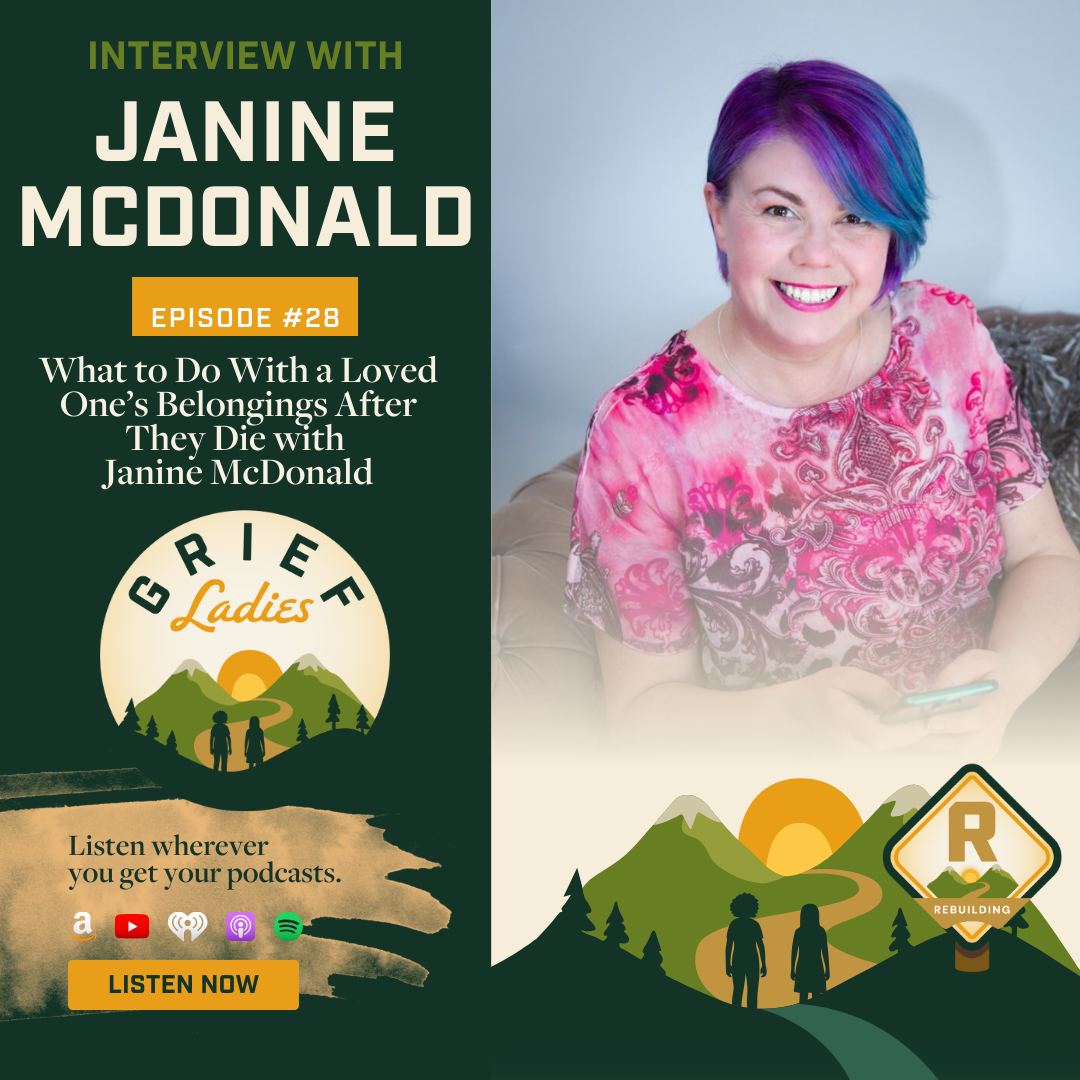
What Do You Do With a Loved One's Belongings After They Die?
What to do with a loved one’s belongings when they die?
Sorting through a loved one's belongings after they die is one of the hardest parts of grief — and one of the least talked about. The short answer: start with the stories behind the things, not the things themselves, and give yourself permission to go at whatever pace you need. In this episode of the GRIEF Ladies Podcast, Kelly and Karyn sit down with decluttering specialist Janine McDonald to explore the emotional and practical realities of going through someone's stuff.
Why Is This So Much Harder Than It Sounds?
It's rarely the furniture that stops people in their tracks. More often it's the small things — a pillbox, a well-worn hat, something that seems insignificant to everyone else but holds an entire relationship inside it. Janine explains that objects carry stories, and those stories are what make this process so emotionally complex. Her approach isn't about tidying up — it's about understanding what something meant before deciding what to do with it.
Research from the American Psychological Association identifies decision-making as one of the most cognitively taxing tasks during bereavement, as grief significantly affects attention, memory, and executive function — which helps explain why even small choices about belongings can feel impossible.
How Do You Move Forward Without Feeling Like You're Letting Go of the Person?
This is where the episode gets really good. Janine shares specific, compassionate strategies for when you want to keep everything, when family members disagree, when there's no sentimental meaning but releasing something still feels wrong, and how to repurpose items that can't be used the way they were intended. She also offers one practical gut-check question that Karyn said she'll be thinking about for a long time.
The through-line of everything Janine shares: the memories live in you, not in the objects.
Listen to the full episode (https://youtu.be/9OXwDgETf6E?si=Ky5BkdP1RfvObfWI) to hear Janine's step-by-step approach, her real client stories, and her advice for anyone who feels completely stuck on where to even begin.
What Actually Helps: 5 Practical Grief Coping Tools from Real People
What Actually Helps: 5 Practical Grief Coping Tools from Real People
Nobody hands you a manual when someone dies.
You're just supposed to figure it out. And most of the advice out there?
It's vague, it's generic, and honestly — it doesn't help.
That's why I love asking our GRIEF Ladies guests to share one practical
coping tool that has actually made a difference in their grief journey.
Not theory. Not platitudes. Just real, actionable steps from real people
who are living it.
5 Guests. 5 Real Coping Tools.
I pulled the actionable steps from five recent episodes and put them
together in one video — because sometimes you just need something
concrete to try.
💛 Featured guests:
- Kelly Myerson (Ep. 22)
- Kat Farace (Ep. 23)
- Charlotte Shuber (Ep. 24)
- Cori Myka (Ep. 25)
- April Hannah (Ep. 26)
Watch it here: https://youtu.be/qpig6OP0Uvk
Your Turn
After you watch, comment on the video. What is one coping tool that has helped you in your grief? Drop it in the comments — your answer
might be exactly what someone else in this community needs today.
And if you want to hear the full story behind each coping tool, the complete episodes are linked below.
🎙️ Full Episodes:
Watch the full episodes:
Link to Ep. 22: https://youtu.be/Oj5HF0xuHhU?si=MU5oBHHuILkhZt6
Link to Ep. 23: https://youtu.be/xRevq_ZcDYo?si=9Pl3DTUQXpJa20Ww
Link to Ep. 24: https://youtu.be/5OEe88S1Sk4?si=ZhPOnLbf6OJr0BXN
Link to Ep. 25: https://youtu.be/aiLqrtJuFI8?si=PuS0JThk4BY43s1m
Link to Ep. 26: https://youtu.be/bTayMPCvKYY?si=gMWPaAyvhobg_VJH
You're not alone in this. And you don't have to figure it out by yourself. Join the Facebook Community: https://www.facebook.com/share/g/1Ak2yus1cW/
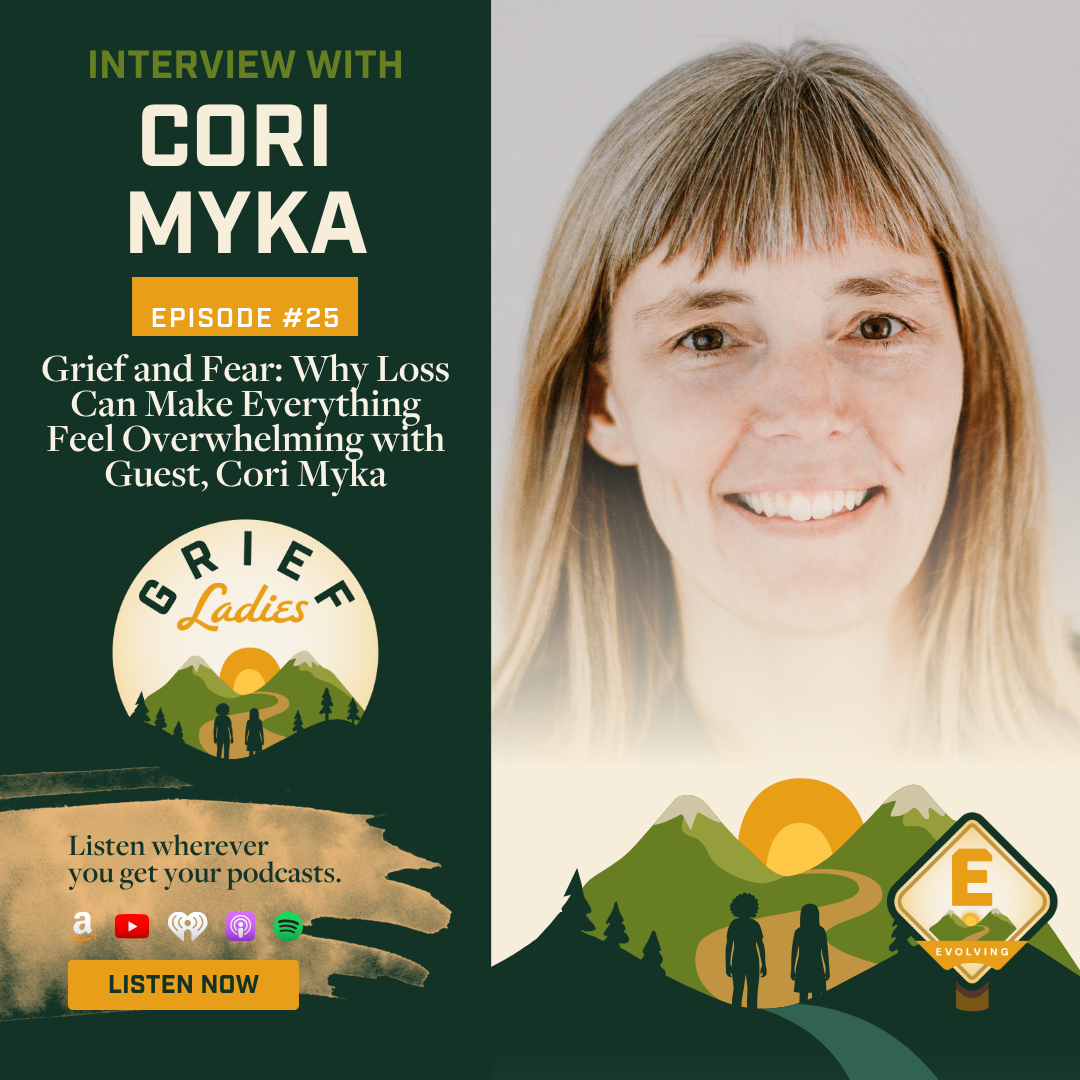
What Learning to Swim Taught Us About Grief — with Cori Myka | GRIEF Ladies Ep. 25
what-learning-to-swim-taught-us-about-grief-cori-myka
What could learning to swim possibly have to do with grief?
More than you'd think.
In Episode 25 of GRIEF Ladies: A Guide to What Comes Next, we welcomed Cori Myka, founder of Calm Within Adult Swim, and the conversation took
a turn we didn't expect — in the best possible way.
Fear. Overwhelm. Not Knowing What Comes Next.
Cori works with adults who are terrified of the water. And as she started describing what her clients experience — the fear, the overwhelm,
the pressure to get it right — we couldn't help but notice how much it sounded like grief.
Because grief puts you in a whole new world too. One where you don't know the rules, you don't know what's coming, and everyone around you
seems to expect you to just figure it out.
Cori shared a powerful framework for slowing all of that down — and it turns out it works whether you're standing at the edge of a pool or
standing at the edge of a whole new life without someone you love.
The Takeaway You Can Try Right Now
One of our favorite moments in this episode was when Cori shared a simple, practical tool you can use anywhere — in a meeting, in a grocery
store line, at a family gathering — when a grief wave hits and you need to come back to yourself.
It's small. It's tangible. And it just might help.
You'll have to listen to get the full details. 🎧
Plus — Cori Shares Something Personal
We also asked Cori how she celebrates those who have died in her own life. Her answer was beautiful, unexpected, and something that stuck
with us long after we stopped recording.
Listen to Episode 25 here: https://youtu.be/aiLqrtJuFI8
Connect with Cori:
📲 @CalmWithinAdultSwim
Have you ever found an unexpected connection between something in your life and your grief? Tell us in the comments of the video — we'd love to hear it.
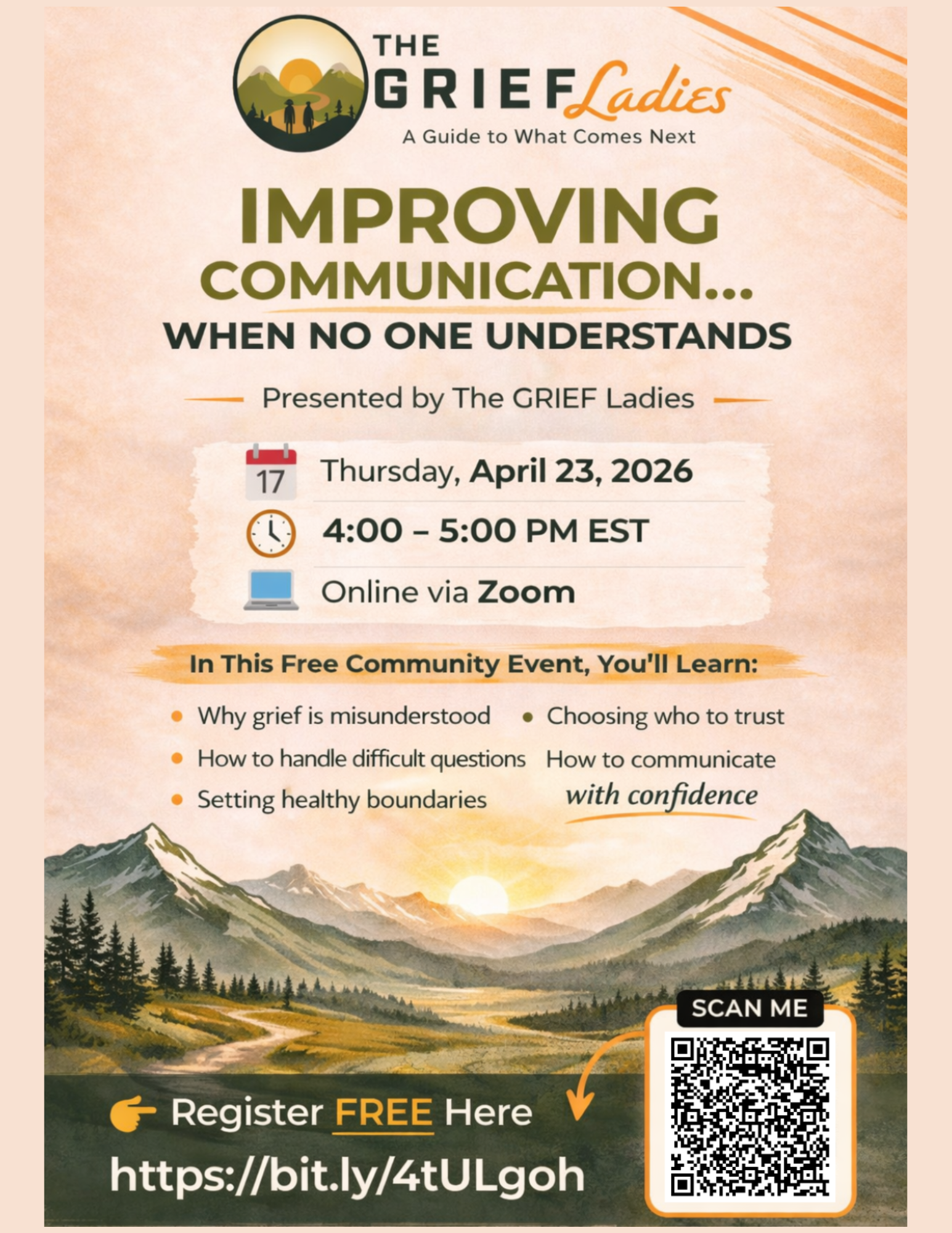
Improving Communication When No One Understands...
Improving Communication when Grieving
A Free Online Workshop from the GRIEF Ladies
You have people in your life who love you. And somehow, you still feel completely alone in your grief.
They say the wrong things. They move on too quickly. They ask how you are doing, and you say "I'm fine" — because what else are you supposed to say? Because explaining it feels exhausting. Because you're not sure they can really handle the honest answer.
If any of this sounds familiar, we want you to know: this is one of the most common and most painful parts of grief. And it is exactly what Kelly Daugherty and Karyn Arnold are tackling in their upcoming free workshop.
What This Workshop Is About
On Wednesday, April 23rd, from 4 to 5 PM EST, the GRIEF Ladies are hosting a free one-hour online event focused on one of the most frustrating parts of loss: communicating with the people around you when they just don't get it.
They will help you understand why the people who care about you still manage to say all the wrong things — and more importantly, what you can actually do about it.
What You Will Walk Away With
In just one hour, you will gain practical tools to help you:
Understand why grief makes communication so hard — and why that is not your fault
Know what to say (and what not to say) in the conversations that feel impossible
Figure out who is actually safe to confide in — and how to protect your energy with everyone else
Navigate the comments that sting, even when they come from a good place
Move forward in relationships that have felt strained or disconnected since your loss
You will leave with real tools you can use immediately — no matter how recent or long your grief has been.
Who This Is For
This event is open to anyone grieving any type of loss — a partner, parent, child, sibling, friend, or any meaningful relationship. Whether your grief is fresh or has been with you for years, this session is for you if you have ever thought:
"Why doesn't anyone understand what this is like?"
"I don't have the energy to explain myself anymore."
"I wish I knew what to say — or what not to say."
About the GRIEF Ladies
Karyn Arnold and Kelly Daugherty are the founders and facilitators of the GRIEF Ladies, and between them they have spent over 50 years walking alongside thousands of grieving individuals. Their approach is practical, direct, and built around one core belief: that grief is not something you just have to sit with. Actionable steps make all the difference.
Their GRIEF Framework — Grounding, Rebuilding, Interacting, Evolving, and Finding — is the guide they use to help people move from grieving with pain to grieving with love, while staying connected to the people they have lost.
This workshop focuses on the I: Interacting — because how we communicate after loss matters more than most people realize.
Event Details
Date: Wednesday, April 23, 2025
Time: 4:00 – 5:00 PM EST
Cost: Free
Register: https://app.acuityscheduling.com/schedule/85af7470/appointment/89553879/calendar/2617012
Reserve Your Free Spot
Space is limited. Register now to receive your link to join.
https://app.acuityscheduling.com/schedule/85af7470/appointment/89553879/calendar/2617012
Questions? Reach us at griefladies@gmail.com
More resources at www.griefladies.com
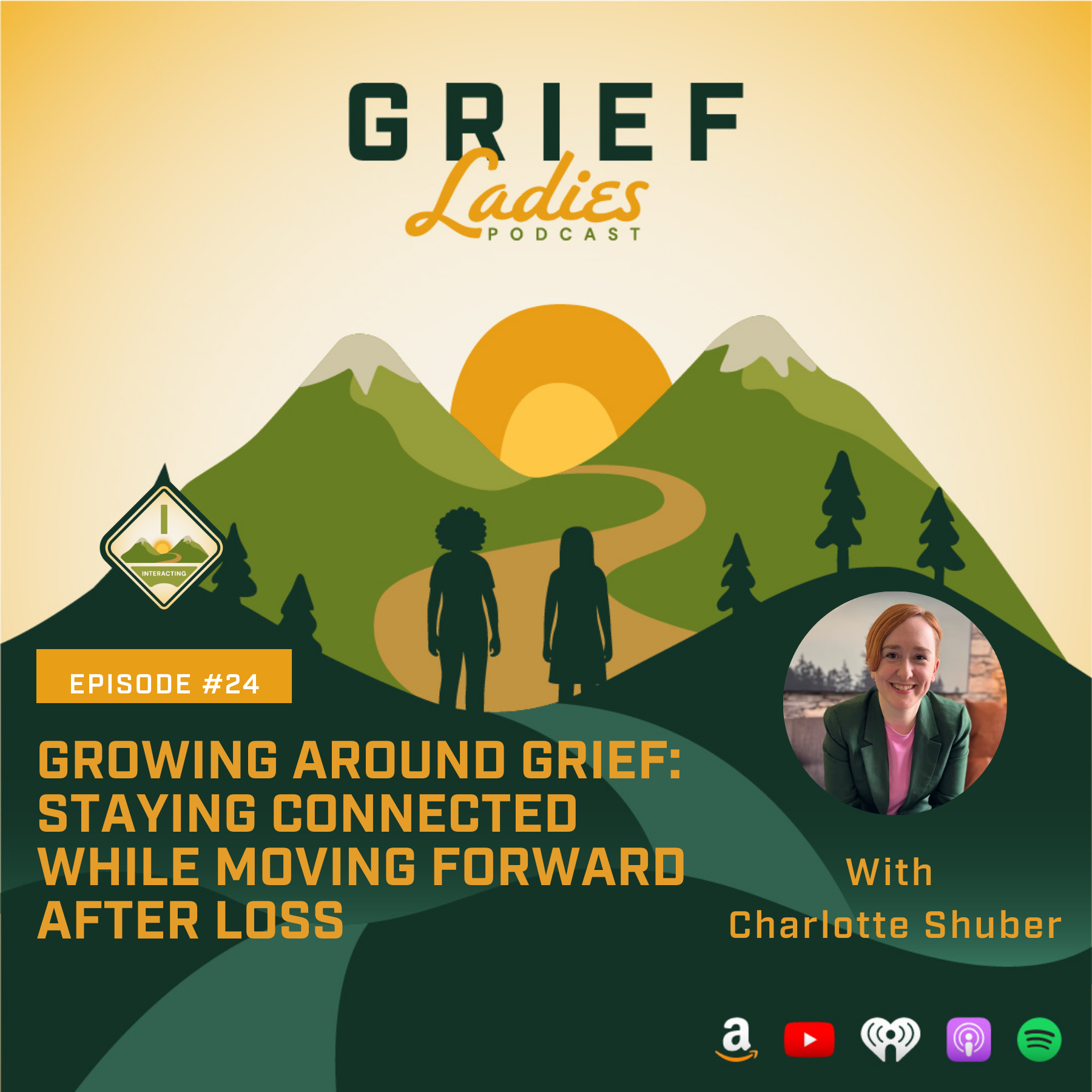
Growing Around Grief: Staying Connected While Moving Forward After Loss
Growing Around Grief: Staying Connected While Moving Forward After Loss with Guest Charlotte Shuber
Have you ever wondered if it's okay to still feel close to someone who has died? If holding onto their memory somehow means you're not healing — or moving on the "right" way?
You are not alone. And the answer might surprise you.
In this powerful episode (24) of the GRIEF Ladies Podcast, licensed clinical social worker Charlotte Shuber flips the script on what grief is supposed to look like — and gives grieving women permission to carry their loved ones with them, not leave them behind.
You Don't Have to Let Go to Move Forward
One of the most damaging myths about grief is that healing means detaching. That at some point, you pack up the memories, put them away, and "get back to normal."
Charlotte's message is the opposite: staying connected to someone who died is not only healthy — it's part of how we grow.
Rather than moving on, she invites us to move forward — with our loved ones woven into who we are becoming.
What You'll Take Away from This Episode
Why "letting go" is the wrong goal — and what to reach for instead
How to interact with your emotions and memories in ways that fuel healing, not avoidance
Charlotte's personal story of loss and how it shaped her clinical approach
Practical tools for maintaining a connection with a loved one while still fully living your life
Why grief is not a problem to solve — it's a relationship to tend
The GRIEF Framework: Interacting
This episode falls under the I — Interacting category of the GRIEF Framework, which focuses on how we engage with our inner world: our emotions, our memories, and the ongoing relationship we have with those we've lost.
Charlotte's approach reminds us that grief is not passive. It requires us to show up — to sit with what hurts, to speak the names of those we love, and to let that love continue to shape us.
About Charlotte Shuber
Charlotte Shuber is a licensed clinical social worker who specializes in grief and loss. She works with children, teens, and adults, combining professional expertise with her own lived experience of loss. Charlotte is passionate about creating a compassionate space where people can explore grief openly, adapt to life changes, and discover meaningful ways to stay connected—with loved ones who have died, with others, and with themselves.
Connect with Charlotte: https://www.creatingspacetherapy.com/charlotte-shuber-lcsw
Ready to Listen?
🎙️ Tune in to this episode of the GRIEF Ladies Podcast wherever you listen to podcasts or on YouTube— and share it with someone who needs to hear that staying connected is not a weakness. It's wisdom.
Because you don't have to choose between honoring them and living fully. You were never meant to.
The GRIEF Ladies Podcast is dedicated to supporting grieving individuals through loss with real conversations, expert guidance, and community.

Self-Esteem & Grief: The Hidden Loss
Self-Esteem and Grief
Self-esteem. Insecurity. Doubt. Just the mention of these words can make us think of a very specific time in our life. Perhaps the teenage years or young adulthood – when how you feel about yourself and your place in the world can be so uncertain. But as time goes on and you settle into your adult life, self-esteem may not seem so important, and it’s not something you may have paid much attention to. In other words, if it’s not great, it’s at least good enough.
It’s also not something you hear spoken about in grief. And yet significant loss can completely drain and deplete any self-esteem you may have, making it feel impossible to move forward in a healthy or purposeful way.
So why does confidence take such a hit after loss, and how do we begin to improve this invisible symptom of grief?
Before we talk about why it’s so common to lose self-esteem in grief, perhaps it’s a good idea to explore why it’s important, and how it serves us in life.
Most of us think of self-esteem as just a set of (hopefully) good feelings that we have about ourselves. It can be confidence in a skill, talent, career, or perhaps the role we play in the lives of the people around us. We know that self-esteem should probably come from within. But it’s most likely to be raised by compliments from others, or lowered if we think someone doubts our character or abilities. It could be tempting to write off self-esteem as no more than shallow window-dressing, but the truth is it serves a much greater purpose than that.
Self-esteem is a motivator
Whether we are aware of it or not, we are quite regularly monitoring our own self-worth. Whatever conclusion we come to is going to determine the actions and steps we take. Before we embark on a task we’re deciding, can I do it? Will I succeed? Will it turn out okay? The less confident we feel, the less motivated we become.
So where does self-esteem come in and how does grief take it away?
Signs & Symptoms of Grief
For starters, let’s talk about the symptoms of grief. Loss of focus. Feeling exhausted. Feeling scattered. There’s so many changes that can happen after we’ve had a loss. When we add them all up we can be left thinking, “what happened to me? I used to have it so together”. While I talk about the individual signs and symptoms of grief quite a bit, it is the accumulation of these changes that leads to such a deep and significant dip in self-esteem. After all, we’re talking about a loss of almost every good adjective we would have used to describe ourselves in the past. Organized, motivated, optimistic. Our resume of emotional health may not seem to have a lot to offer anymore and a sudden dip in confidence can be attributed directly to it.
Who We Lost
This one may be easier to see. First, let’s think about the loss of our parents. The people who loved us unconditionally. Or the spouse or partner who had a way of making everything feel okay. Who loved us physically, intellectually, and provided a safe and intimate sense of security. Who am I without these people to tell me I’m good? Or beautiful? Or smart? Did I ever really believe it in the first place or did I just like the way I looked when reflected in their eyes? The level of confidence our loved ones may provide us isn’t something we necessarily recognize as acutely when they’re here. But there’s no doubt it’s something that we can feel the sharp and painful absence of when they’re not.
Feeling worthy
Most of our routine gets thrown off balance in the wake of loss, but the simple act of eating brings with it unseen complications. In loss a lot of grievers find they struggle to eat anything of substance. After all, they’ll say, “It’s just me”. Recently a widow I spoke with put it a little differently. “I just feel that I’m not really worth it”. I can’t tell you how much this statement surprised me. In the most matter-of-fact way, she simply stated that she just didn’t see the point. Cooking and eating well was worth it when her husband was alive. But now that it was “just” her, eating wasn’t a priority. She didn’t feel that she, or the actions it would take to nourish herself, were worth it.
Making decisions
EVERYTHING feels like a decision after loss, and often we’ve lost the person who helped us make them. Add to that the fact that we are feeling forgetful and scattered in grief. Can I really trust myself to be making the right decision? And what if I’ve made a mistake already like forgetting to pay a bill, or missing an important appointment? Suddenly we don’t trust ourselves the way we used to, and that can create a cycle of fear, indecision, and uncertainty that sends our confidence spiraling even further.
So how do we break the cycle of low self-esteem and insecurity in grief?
First (and this is my answer for a lot of things if I’m being honest) – by recognizing it. Recognize that on the very long list of things that have been lessened, depleted or stolen in grief, self-esteem needs to be added. And not only does it need to be recognized for the hit it’s taken, we need to realize that it’s worth bringing back. As I mentioned before, I am often educating people on the signs & symptoms of acute grief as I strongly believe it’s the validation that helps. To know that you’re not crazy. That you’re not alone. Your thoughts, feelings, and responses to this grief are “normal”, common, and to be expected.
Expectations count for a lot.
When expectations are too high, we get impatient, frustrated, and restless. When they’re too low, we feel hopeless, helpless and useless. It’s a terrible cycle to find yourself in and it will only cause self-esteem to be negatively impacted further.
Understanding and validating the experience of grief allows us to manage our expectations better. While the losses we face are permanent, the changes we see in ourselves don’t have to be.
Take a step back and re-enter this grief, ready to define the way you see yourself in a whole new way.
Feeling lazy?
Grief is exhausting. There is so much mental energy used to process loss and a griever can become immobilized by it. We can accomplish so much less than we’re used to, and still feel more tired than ever. Quite simply, you’re not lazy: you’re grieving.
Feeling forgetful?
Our memory has one very important requirement in order for it to work well: focus. If we want to remember something, we have to be able to focus and concentrate on it in the first place. Grief, and especially “new” grief takes all of our focus. As one griever once said to me, “focus isn’t my problem. The problem is I can ONLY focus on the person I lost”. That’s going to make it hard to be paying attention to (and therefore committing to memory) anything else.
Feeling like you’ve slipped in another important role in your life?
Let’s say you’ve lost your spouse, and no longer feel that you’re able to be the parent you want to be. Or someone who has lost a parent, who is struggling to be upbeat, or engaged with your spouse or kids. Or anyone who has a job or family or friends who has had a loss and feels they have nothing left to give to the work, life, and people who are still here. I really could go on and on. There’s just too many changes and we’re just too hard on ourselves to realize that we are expecting to be everything to everyone… even when everything has changed.
In the end, it’s not about excuses, it’s about forgiveness and altering our expectations of how we should be feeling, or how soon we should be getting better.
Raising self-esteem in grief can be as “simple” as being able to validate that GRIEF IS HARD.
We’ve never done this before, there’s no manual to get through it, and every day we’re trying to do just that: get through it. I often say that in grief, we are operating in crisis mode. And the rules are very different in crisis. For example – if someone is ever critically injured and brought to the emergency room, the nurses and doctors may use scissors to cut through their clothing to try and save them. No one cares about a piece of clothing in the middle of crisis. Getting this person better is the only thing that matters in that moment. But if we go to the doctor for our regular check up, we would be stunned and outraged if they pulled out a pair of scissors to cut through our shirt!
Our expectations for “normal” life are very different then they are in times of high stress and trauma. And I think every griever can agree that nothing feels normal after loss. Our expectations need to change to reflect that.
The rules of crisis are very different.
Allowing yourself to understand that should also help you know that the expectations should be different too. What we have to do to get through, get by and survive, especially in early grief – should not be an indication of who we are right now and it certainly doesn’t have to define us in the long term.
Be gentle to yourself. Be kind to yourself. Celebrate the small victories (like mowing the lawn for the first time or cooking a meal) by realizing that they’re not small at all. Congratulate yourself for every single thing you accomplish in grief, and forgive the times when you feel you’re not accomplishing enough.
The hope is to eventually string enough victories and good feelings together to restore and rebuild your spirit. And hopefully along with it…your self-esteem.

Perfectionists, People Pleasers & Grief
Perfectionists, People Pleasers & Grief
Perfectionists. People Pleasers.
Some will immediately relate to these labels, and some maybe not so much. Yet most people I work with exhibit at least some of these traits, whether they are consciously aware of it or not. For the perfectionists, it may come as an almost badge of honor. A commitment they’ve made to themselves to do everything the best they can, without fail, in every single category of their life. The people pleasers may not be as satisfied with that title. But they also understand it as a necessary skill to function in their lives, and as a way to get along with the people around them.
But what happens when life falls apart? Expectations for ourselves often remain the same, but how can they when EVERY SINGLE THING in life has changed? Do these old habits and old roles still work?
Let’s start by understanding what it really means to be a perfectionist or a people pleaser. While I work with (and know personally) plenty of people who possess both tendencies, there’s nothing saying that one has to go with the other. In order to understand where you may fit, it’s important to explore each on their own first.
There are a lot of perfectionists in this world.
It can show up in the way a person interacts with others, or how they keep themselves or their home. As a result, a standard and expectation becomes set and it can be very hard to do anything without having to do it really well, all the time.
People pleasers are a little different.
This behavior often comes from childhood, and is a learned response to safety and inclusivity with the world and people around us. People pleasers put others’ needs ahead of their own and for the most part, they’re doing this to the extreme.
So why does it matter in grief?
First: it’s not sustainable. The old habits and old ways of doing things only work when everything else in life is going okay. Next, competing with your “old self” will only create a greater contrast of who you are now, compared to who you used to be. This can add to the intense pressure, unfamiliarity, and uncertainty that a griever is feeling on a daily basis.
The problem with perfectionists and grief.
If you have always tried to do everything “right”, you may already be used to some of the pressure and stress that comes with it. But now you’ve had a significant loss, and you’re likely experiencing a level of stress that you never have before. You can barely think straight. How can you be expected to do the “right thing” when NOTHING feels right anymore?
In grief, being a perfectionist can actually equate to something that most would feel is far from perfect = procrastination. Decision making is a huge task in grief and if the old habits of perfectionism continue, a griever may find themselves making no decisions at all. The fear of doing the “wrong” thing may leave you feeling stuck, even hopeless.
Diminished self-esteem is also a huge concern for any griever, and if you feel that you are constantly falling short, your image and self worth will only sink lower.
The reason why people-pleasing tendencies can’t continue.
Unlike the perfectionists who are trying to make things just right in their own lives, people pleasers are trying to do it for everyone else instead. Here’s the problem when it comes to life after loss – a griever doesn’t even know what they need or how to make themselves feel any peace. So how can they be expected to anticipate the needs of anyone else?
It doesn’t help that some of the biggest challenges in grief come from those around you. Whether it’s in the form of real or perceived expectations, most people feel very disconnected from their loved ones following loss. Managing the emotions and needs of others takes the kind of higher-order thinking that a person in grief just doesn’t have access to. And for most it’s not a case of not wanting to be a help or support to others. They just may feel that they no longer can.
How to stop being a perfectionist or people pleaser today.
I often make comparisons to physical health when describing grief. When it comes to our physical health, we are much more understanding of what we can and can’t do. If you have a broken arm, you would never expect to be able to help a friend move their couch. And your friend wouldn’t ask you to.
But what about the brokenness that comes with grief? Can we take a more honest look at what we actually can and can’t do emotionally? And can we start reframing our interactions with ourselves and others accordingly?
This is where change begins.
First, in observation. Watch yourself and your thoughts. What are your expectations for yourself? Consider what old instincts are kicking in and how often you are telling yourself that you “should” be doing something. And then consider the reality of whether you really can (or want to).
Next, in practice. You’ve got to start somewhere. If you’re a perfectionist and worried about how clean the house is (or isn’t), consider changing your standards. For now. Maybe at some point you’ll decide to go back to having the cleanest house on the block. But for now that just may not be something you have the energy for. Grief is exhausting. Use your energy wisely.
What about my friends and family?
How will they react if I’m no longer a perfectionist or people pleaser? We all know what we expect from ourselves, but we can’t deny that the people in our lives are probably expecting a lot too. Especially with the passage of time. It’s all well and good for me to give you permission to put a greater focus on yourself and your needs, but will the people around you allow for the same grace? Especially with each day that passes since your loss?
Start by giving yourself permission and know that in a lot of ways, that will be the hardest part. Validate every single reason why you can’t or don’t want to hold yourself to the same expectations as before. And give yourself permission to only do or commit to what you can.
The people around you may need time to adapt, and that’s okay. Communicate. Don’t apologize. If they’re asking, let them know what this process is like for you. And why you need to make some changes in order to survive.
In the end, this grief is your business.
No one else gets to decide what you need in grief. It’s important to remind yourself (regularly!) that you’re doing the best you can. And when you’re feeling like that best isn’t so great, know that how you feel now isn’t how you’ll always feel. Grief is always changing and your needs, wants, limitations, and abilities will all change with it.
For all the perfectionists and people pleasers in this world, I leave you with this. If you’re going to please anyone right now, try pleasing yourself first. Find peace and comfort in little moments whenever you can. And remember that these tendencies were never good for you to begin with. There’s some real growth that can come out of the brokenness of loss. Start today by resetting the expectations you have for yourself, and find growth and perhaps a new strength, in the healing that follows.
Want to read more of Karyn’s blogs visit Grief in Common

Why am I still grieving so intensely months/years later?
Why am I still grieving so intensely months/years later?
Many people quietly wonder:
Why does this still hurt so much?
Shouldn’t I be feeling better by now?
Is something wrong with me?
Why am I still grieving years later?
There’s a lot of pressure in our culture to “be okay” after a certain amount of time. But grief doesn’t follow a calendar or timeline. Grief is not something you get over. It’s something you learn to live with.
Intensity Doesn’t Always Mean Something Is Wrong
Even months or years later, grief can feel intense. Grief waves can still show up unexpectedly. Certain dates, memories, or life events can bring everything back to the surface. This just means your loss mattered.
Grief can feel especially intense or long-lasting when:
The death was sudden or traumatic
There were complicated relationship dynamics
You didn’t get closure
You were very closely connected
The loss significantly changed your daily life or your identity
When a death was traumatic, some people don’t just miss the person, they relive aspects of how the death happened. They may experience intrusive memories, mental images, or a sense of being pulled back into the moment they found out. That kind of grief can feel more challenging and difficult to move forward with.
Over time, many people find that grief shifts. It may not dominate every hour of the day. But it doesn’t vanish.
You might function well most days and still have moments when it feels raw. You might laugh more and still miss them deeply. You may build a full life and still carry the absence.
Both things can be true.
Growing around grief doesn’t mean it’s gone. It means your life has expanded enough to hold it.
When to Consider Additional Support:
There is no “correct” timeline. But it may be helpful to seek professional support if:
The intensity feels constant with little relief
You are frequently reliving the death itself
Intrusive memories or images feel overwhelming
You feel stuck in guilt, anger, or despair
You are unable to function in daily life
You feel hopeless or unsafe
Seeking support is not about labeling your grief. It’s about helping you carry it in a way that feels more manageable. Check out Grief in Common with Karyn Arnold for additional resources, including grief groups or grief coaching.
What Does Grief Feel Like? (Emotionally & Physically)
What Does Grief Feel Like?
Grief is not just emotional. It affects your thoughts, your behaviors, your body, and sometimes your spiritual or existential beliefs. Many people are surprised by how physical grief feels. If you’re wondering whether what you’re experiencing is normal, you’re not alone.
Grief Is More Than Sadness
People often expect grief to feel like sadness. But many describe it as a bundled-up box of emotions, multiple feelings happening all at once.
You might experience:
Sadness and anger in the same hour
Relief and guilt together
Numbness followed by intense emotion
Anxiety, fear, or irritability
A sense of meaninglessness or questioning your beliefs
Grief is rarely one emotion at a time. It can feel layered and unpredictable.
The Cognitive Effects of Grief
Grief can impact how you think. Many people report:
Brain fog
Forgetfulness
Trouble concentrating
Difficulty making decisions
Re-reading the same sentence multiple times
This is often called “grief brain,” and it’s a common reaction after a significant loss.
The Physical Symptoms of Grief
Grief is stored in the body. It can feel heavy, almost like you’re physically carrying something.
Common physical symptoms of grief include:
Extreme exhaustion
Sleep disruption
Headaches
Stomachaches or digestive changes
Muscle tension or body aches
Tightness in the chest
Changes in appetite
Research shows that stress levels increase during grief, and inflammation in the body can rise. This can make you feel run down and more susceptible to illness. You’re not imagining it. Grief can truly be physical.
Behavioral and Spiritual Shifts
You may also notice changes in how you behave or see the world:
Withdrawing from others
Losing interest in activities you once enjoyed
Avoiding certain places or conversations
Questioning your faith or long-held beliefs
Feeling different from who you used to be
Loss has a way of shaking the foundation of how we understand life.
If this sounds familiar, it's because grief can feel overwhelming, as it impacts so many areas at once. It isn’t “just” emotional. It’s a full-body, full-life experience.
If you want to hear real conversations about what grief actually feels like, including grief brain, physical symptoms, and emotional waves, we talk openly about this on the GRIEF Ladies podcast, as well as tools to help you with these feelings and symptoms. New episodes come out every Wednesday as we go through our GRIEF Ladies Framework- Grieving, Rebuilding, Interacting, Evolving, and Finding.

How to Live with Loss
How to Live with Loss from the death of a loved one
Many people search for this in the middle of the night:
How do I get over this?
How do I move on?
How do I make this stop hurting?
The truth is, grief is not something you get over. It’s something you learn to live with.
In the Beginning, Grief Can Take Over Everything
In the first few days, weeks, and even months following the death of a loved one, grief often feels overwhelming. It can impact:
Your sleep
Your focus
Your relationships
Your work
Your sense of identity
Your ability to plan for the future
It can feel like grief is touching every part of your life at once. When you're feeling that it’s common to want relief and fast.
As you move forward, grief often looks and feels different. It may not dominate every moment of your day. The waves may become less constant. You may find ways to function, to laugh again, to engage in life. That doesn’t mean the grief is gone.
It means you are growing around it.
Some people describe it this way: your grief doesn’t necessarily shrink, but your life begins to expand. You grow bigger than your grief. There is more room inside you for joy, connection, purpose, and memory alongside the pain.
The love is still there. The loss is still real. But it isn’t consuming every breath.
So What Actually Helps?
You don’t “get over” a loss by forcing yourself to move on. You learn to live with it by:
Developing coping skills for when waves hit
Rebuilding routines and structure
Learning how to talk about your grief
Finding ways to stay connected to the person who died
Allowing both hard emotions and moments of relief
This is the kind of practical, real-life approach we focus on inside the GRIEF Ladies Facebook Community, a place where people share what it’s really like to live with loss and support one another through it.
There is no deadline for healing. There is no requirement to “be done” with your grief. Learning to live with loss is a gradual process. And it’s okay if you’re still in the part where it feels heavy. You are not behind. You are grieving.