
Why Does Structure Matter When You're Grieving?
Why Does Structure Matter When You're Grieving?
When someone dies, your daily routine often disappears with them — and the empty space that's left can feel just as disorienting as the grief itself. Structure is not about keeping busy or moving on; it is about giving yourself something to hold onto when everything feels chaotic. In Episode 3 of the GRIEF Ladies Podcast, Karyn and Kelly dig into Rebuilding — the R in the G.R.I.E.F. framework — and why creating even small, predictable anchors in your day can make a real difference.
Why does grief destroy your sense of routine?
Grief does not just take the person — it takes the shape of your days. If you lived with someone, made decisions with them, or structured your time around caring for them, their absence leaves a gap in the ordinary fabric of your life. Karyn describes it well in the episode: many grieving people find themselves at three or four o'clock in the afternoon with no idea where their day went. The calendar is empty. The momentum is gone.
Grief brain compounds this. The mental fog, the difficulty concentrating, the forgetfulness — these are not signs that something is wrong with you. They are what happens when your brain is overwhelmed. And without some structure to fall back on, days can pass in a blur that leaves you feeling worse, not better.
Grief activates the brain's stress response systems, impairing function in the prefrontal cortex — the area responsible for planning, decision-making, and focus. Structured routines reduce cognitive load by making certain decisions automatic, which helps preserve mental energy during bereavement. (Sources: neuroscience of grief literature; Harvard Health Publishing)
The goal of rebuilding is not a rigid schedule. It is a few predictable anchors — a morning routine, a consistent mealtime, a designated time to lean into grief rather than avoid it — that make the day feel less like something happening to you and more like something you are moving through.
What does "structuring your grief" actually mean — and why does it help?
One of the most counterintuitive tools Karyn and Kelly talk about in this episode is intentionally making time for grief rather than letting it ambush you. Karyn shares the story of a client who walked every day and used that time to cry, think, and process. When illness interrupted her walks for a couple of weeks, she fell apart at the grocery store — grief that had no outlet finally found one. The lesson: grief is patient. If you do not make space for it, it will make space for itself.
Setting an intention matters too. Kelly shares something Karyn told her shortly after her father died — that there is a difference between collapsing in front of Netflix because you feel guilty doing nothing, and choosing to watch Netflix because you need three hours of rest. That small shift in framing changes everything. Grieving people need permission to rest, and sometimes the permission has to come from themselves.
Hear Karyn and Kelly talk through what this actually looks like in practice — including the daily structure ideas they share with their own clients: Listen to Episode 3 of the GRIEF Ladies Podcast → https://youtu.be/wbJVX3Q2iv8?si=RDMeAnz56crw8hih
Other GRIEF Ladies Podcast Episodes:
Why Does Taking Care of Your Body Matter When You're Grieving? → LINK: https://youtu.be/vgcyjbdDAkc?si=HB99vcD1fFdu7s0E Episode 2 covers Grounding, the foundation beneath Rebuilding: eating, sleep, and movement after loss.
How Does Grief Change Your Relationships? → LINK: https://youtu.be/ZK6kiFNrImw?si=bFiPev8UeOy0b_xM — Episode 4 moves up the framework to Interacting: navigating communication, family dynamics, and connection after loss.
What Is the G.R.I.E.F. Framework and How Does It Work? → LINK:https://youtu.be/_0ld4dnUT7I?si=89da5nbDXHa9KOmZ — An overview of all five pillars and the thinking behind this approach.
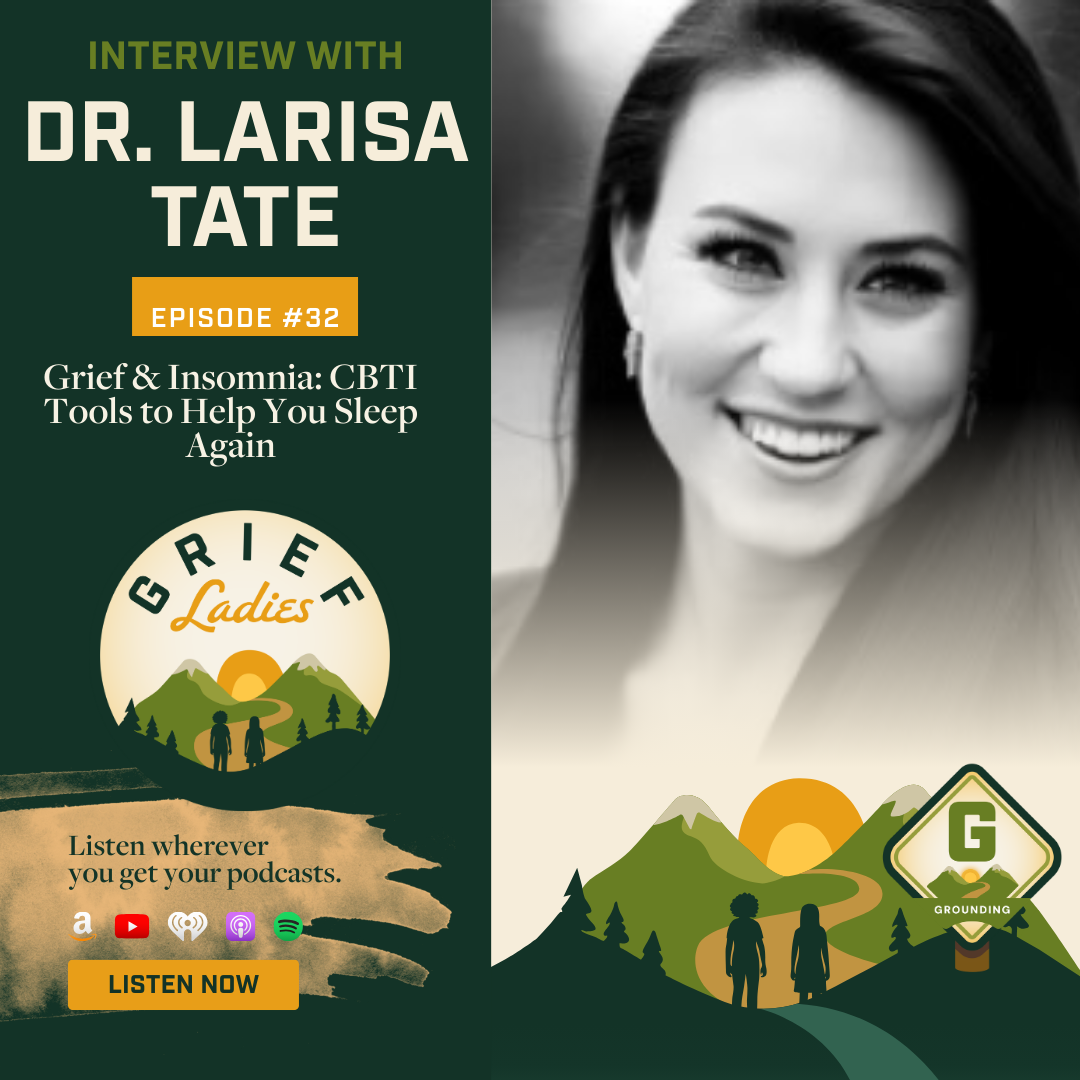
Grief & Insomnia: CBT-I Tools to Help You Sleep Again
Grief & Insomnia: CBT-I Tools to Help You Sleep Again
Grief & Insomnia: CBTI Tools to Help You Sleep Again
If you’ve been lying awake at night since someone died, you’re not alone.
Grief often disrupts sleep, making bedtime feel anxious, frustrating, or emotionally overwhelming. For many people, insomnia becomes one of the most exhausting parts of loss.
In this episode of the GRIEF Ladies Podcast, we’re joined by Dr. Larissa Tate to explore how Cognitive Behavioral Therapy for Insomnia (CBT-I) can help. CBTI is an evidence-based approach that helps rebuild healthy sleep habits — even during grief.
We talk about:
Why grief interferes with sleep
How nighttime anxiety develops
What CBTI actually involves
Sleep hygiene myths
The role of medication
Why napping can worsen insomnia
Small, manageable steps to improve your sleep
Sleep struggles during grief are common — and they’re treatable.
As always, we close with practical tools you can try this week, because grief changes your life — and you deserve support that helps you live inside that change.
Listen at: https://open.spotify.com/episode/0mJXiHNcn53FF6ipIz5eaN?si=MGSQEUD5S86F_xWP7CNiyw
Related topics: grief and insomnia, CBTI for sleep, sleep problems after loss, nighttime anxiety during grief.
Why Does Taking Care of Your Body Matter When You're Grieving?
Why Does Taking Care of Your Body Matter When You're Grieving?
Grief is not just emotional — it is physical. The exhaustion, the brain fog, the heaviness you feel in your chest are real, measurable effects happening in your body. Taking care of your physical basics after a loss is one of the most direct ways to give yourself the capacity to move through grief. In Episode 2 of the GRIEF Ladies Podcast, Karyn and Kelly break down what Grounding — the G in the G.R.I.E.F. framework — actually looks like in practice.
What is grounding in grief, and why does it come first?
Grounding is what Karyn and Kelly call the basics: eating, sleeping, and moving your body. These are usually the first things to go when someone dies — and they quietly make everything harder. Grounding is not about being healthy in the traditional sense. It is about giving your nervous system enough to work with so grief does not take everything from you.
When you are not eating enough, the brain fog that already comes with grief gets worse. When sleep is disrupted — and grief almost always disrupts sleep — your emotional regulation suffers, your immune system takes a hit, and the simplest decisions feel impossible. When your body is completely still, grief tends to stay stuck in it.
Grief is associated with elevated inflammatory markers including C-reactive protein and interleukin-6, which increase vulnerability to physical illness during bereavement. Twenty minutes of walking has been shown in multiple studies to be as effective as an antidepressant for mood. (Sources: Kiecolt-Glaser et al.; exercise and depression research literature)*
The reframe Karyn offers in the episode is worth sitting with: these basics are some of the only things you still get to have a say in. When grief makes you feel swept along by a life you didn't choose, what you eat, how you protect your sleep, whether you move your body — those are things you can still control. That is not a small thing.
What can you actually do this week if you're barely functioning?
Karyn and Kelly are not asking you to overhaul anything. The action step from this episode is simply to observe — track your eating, sleep, and movement for three days. Not to judge what you find. Just to notice it. What time did you eat, and how did you feel after? What got in the way of sleep? Did you move at all, and what did that feel like?
Awareness without judgment is where momentum begins. Small, consistent steps build on each other — and sometimes a small shift in one area quietly improves the others. Moving your body a little makes sleep slightly easier. Sleeping better makes it more possible to eat something real. These basics are intertwined, which is exactly why Grounding comes first.
Hear Karyn and Kelly go deeper — including their own personal experiences navigating this after loss: https://youtu.be/vgcyjbdDAkc?si=bPsxl5H0B9-bVsl6
Other GRIEF Ladies Podcast Episodes:
What Is the G.R.I.E.F. Framework and How Does It Work? → https://youtu.be/_0ld4dnUT7I?si=89da5nbDXHa9KOmZ An introduction to all five pillars and why this approach is different from traditional grief models.
Why Rebuilding Structure After Loss Matters More Than You Think → LINK:https://youtu.be/wbJVX3Q2iv8?si=RDMeAnz56crw8hih — Episode 3 covers the R: how routine and daily structure help grieving people regain a sense of footing.

Anticipatory Grief & Alzheimer’s: Coping While Caring for Someone Still Alive
Anticipatory Grief & Alzheimer’s: Coping While Caring for Someone Still Alive
Anticipatory Grief & Alzheimer’s: Coping While Caring for Someone Still Alive
Grief doesn’t always wait for death.
When you’re caring for someone with Alzheimer’s — especially younger onset Alzheimer’s — you may find yourself grieving ongoing changes long before the end of life. This is anticipatory grief, and it can feel confusing, exhausting, and deeply isolating.
In this episode, we explore:
What anticipatory grief feels like
The emotional realities of caregiving
Why building a support community matters
Self-care strategies that are actually realistic
Finding moments of connection and joy along the way
Caregiving is love in action — and caregivers deserve care, too.
As always, we close with practical steps you can try this week.
Watch this powerful episode at: https://youtu.be/UPgVDR284-w?si=w9lhcyCPS-zU4KPF

Grief Support That Actually Helps: Meet the Grief Ladies
Grief Support That Actually Helps: Meet the Grief Ladies
Most people who are grieving have heard the same things: there’s no right way to grieve, give it time, let yourself feel it. And while there is truth in all of that, it leaves out the most important question — what do you actually do?
That is the question behind The Grief Ladies podcast. Hosts Kelly Daugherty, LCSW, and Karyn Arnold bring over 50 combined years of experience supporting grieving individuals — and in Episode 1, they introduce themselves, share what drew them to this work, and lay out the GRIEF framework that will guide the entire series.
Kelly’s path into grief work began at 14, after the death of her mother, when she walked into a hospice grief group and finally felt less alone. Karyn found her way in through bereavement work with seniors in her mid-20s — and never looked back. Together, they share a belief that grief is not something to simply endure. There are real tools, practical steps, and small shifts that can make a meaningful difference.
In this episode, you’ll hear about the GRIEF framework — a step-by-step approach covering Grounding, Rebuilding, Interacting, Evolving, and Finding — and why moving forward does not mean leaving your loved one behind. It means taking them with you.
▶️ Listen to Episode 1: https://youtu.be/_0ld4dnUT7I?si=89da5nbDXHa9KOmZ

Grief in the Body: Somatic Tools for Healing After Loss
Grief in the Body: Somatic Tools for Healing After Loss
Grief in the Body: Somatic Tools for Healing After Loss
Grief doesn’t stay in your thoughts — it often shows up in your body.
In this episode, we explore how loss can affect your identity, self-esteem, and physical health. Joined by somatic coach Jay Moon Fields, we talk about embodied grief, why physical symptoms like tension and stomach aches are common, and simple tools to help process emotions safely.
You’ll learn:
Why grief can impact your body
How loss reshapes self-identity
Practical somatic tools for emotional release
The “Of Course” validation technique
How to advocate for yourself during grief
Grief changes you — but it can also deepen your self-awareness.
As always, we close with one practical step you can try this week.
Listen here: https://open.spotify.com/episode/74gX1JHIFGFdE2arAVZAi2?si=0fec4b9a954649a2

Grief After Estrangement: Healing Complicated Relationships Through Ritual & Creativity
Grief After Estrangement: Healing Complicated Relationships Through Ritual & Creativity
Grief After Estrangement: Healing Complicated Relationships Through Ritual & Creativity
What happens when someone you were estranged from dies?
Grief after estrangement can bring layers of emotion — sadness, anger, relief, regret, gratitude — sometimes all at once. When a relationship was complicated, the grieving process can feel confusing and isolating.
In this episode (GRIEF Ladies Episode #29), we talk with Sam Sundius about navigating loss after estrangement, honoring both the hard and meaningful parts of a relationship, and using ritual and creativity as tools for healing.
We explore:
How grief shows up when the relationship wasn’t simple
Why grief and gratitude can coexist
The power of intentional rituals
Creativity as an outlet for emotional processing
Finding meaning without rewriting the past
As always, we close with a practical step you can try — because grief changes your life, and you deserve tools that help you live inside that change. Watch this episode at: https://youtu.be/Ab68YHJfgW0?si=eXk9yypx-6jfj0s1
Related topics: estranged parent grief, complicated relationships, ritual for grief, creative grief support.

GRIEF & YOUR ENERGY
Grief and Your Energy
Why grief feels exhausting… and what helps
Have you noticed grief makes everyday tasks feel harder?
You may feel:
• Mentally drained
• Emotionally overwhelmed
• Socially exhausted
• Physically tired
You are not imagining this.
Grief requires a huge amount of nervous system energy.
Many grieving people worry:
“I should be able to handle more.”
But grief is heavy.
Imagine carrying an invisible backpack filled with memories, emotions, and change… all day long.
Of course you get tired.
This is where ENERGY MAPPING can help.
Energy mapping helps you notice:
✔ What drains your energy
✔ What restores your energy
✔ What feels meaningful but still exhausting
✔ How to pace yourself in grief
Some experiences have TWO types of energy cost:
Physical Energy: How much effort your body uses
Emotional Energy: How much grief or stress it activates
Both matter.
Examples:
Talking about your loved one
💛 Meaningful
⚡ Emotionally draining
Family gatherings
💛 Important
⚡ Physically and emotionally tiring
Resting afterward is not weakness.
It is support.
Try this simple reflection:
👉 After I do __________
👉 My body usually feels __________
Awareness helps you plan care instead of pushing through exhaustion.
One helpful strategy is called Recovery Pairing.
This means: Pair draining experiences with supportive ones.
Examples:
Grief ritual → quiet walk
Social event → alone time
Therapy session → calming music or journaling
Grief changes capacity.
Energy mapping helps you work WITH your capacity instead of fighting it.
Pacing grief is how many people survive it.
💬 Reflection Question:
What is one activity that drains your energy right now… and one that helps restore it?

Family Support While Grieving: Why It Can Feel So Complicated
Family Support While Grieving: Why It Can Feel So Complicated by Karyn Arnold
By Karyn Arnold, one of the GRIEF Ladies from Grief In Common
For many people, family support while grieving quickly becomes the hardest place to feel steady after loss — and that can come as a real surprise.
They knew the person. They loved them too. Surely this would be the place where support came most naturally. This was supposed to feel familiar, or at least steady. When that doesn’t happen, the disappointment can run deep. People are often left wondering why something they counted on no longer feels there.
What follows often goes beyond frustration. Loneliness sets in. A sense of safety disappears. A quiet worry creeps up: Is something broken in my family now? Is this how it’s always going to feel?
Family Support While Grieving Isn’t Shared in the Same Way
One of the biggest sources of tension in grieving families comes from the belief that everyone is mourning the same loss.
Even when the person is the same, the loss is not.
A partner loses the person they built daily life with.
A child loses a parent.
A sibling loses shared history.
The day-to-day impact also differs, especially for the family member(s) who shared living space with the person who is gone.
Grief becomes harder when we expect one another to cope, feel, or recover in similar ways — or on the same timeline. When no one names those expectations, misunderstandings grow quickly.
When the Struggle Isn’t Just With the Family You Were Born Into
For some, the strain shows up with parents or siblings. For others, it hits closer to home.
A spouse may want things to “get back to normal.” Children may feel uncomfortable with your sadness. Loved ones may rush, minimize, or avoid grief because they don’t know how to sit with it.
The sense of isolation can grow when you aren’t feeling supported or understood in your own home, and some of the disappointment can feel greatest with the family we chose.
When Support Comes From Somewhere Unexpected
Many grieving people feel surprised when they start leaning more on friends, coworkers, or people outside their family.
That shift can feel unsettling.
Often, it has less to do with love and more to do with capacity. Family members are grieving too. They may feel overwhelmed or emotionally flooded. Someone a step outside the inner circle may simply have more room to listen or stay steady.
This is why finding grief support outside the family matters so much.
When Grief Strains — or Breaks — the Family System
Sometimes these changes stay quiet. Other times, they explode.
Grief exposes old dynamics, unresolved conflicts, and long-standing family roles. Disagreements can escalate fast, especially around money, the estate, or decision-making. When that happens, it can feel like the loss fractured the family itself.
Here’s what matters: conflict during grief does not mean a family is permanently broken. It means the system is under extreme strain.
Why We Talk About Family Support While Grieving
This is one of many reasons Karyn Arnold and Kelly Daugherty came together to create the GRIEF Ladies.
Together, they bring nearly 50 years of professional grief experience, supporting people through the loss of spouses, parents, siblings, and complicated family relationships. The GRIEF Ladies includes a website, podcast, Facebook community, upcoming book series, and ongoing grief education.
Family strain is only one part of the work — but it is a deeply painful one.
Again and again, people ask the same question:
Why does this hurt so much with the people who matter most?
How the GRIEF Framework Helps When Family Support Falls Apart
Family conflict is just one way grief shows up, but it highlights something important. You cannot fix or change anyone else. You cannot undo what happened.
What you do have is the present — and yourself within it.
The GRIEF framework guides where your time, energy, and attention can go when everything feels out of control. It offers clear direction for caring for yourself in ways that actually help.
G — Grounding
Grief affects the nervous system and the body, not just emotions. When family support while grieving feels unreliable, many people ignore basic needs to hold everything together.
Grounding means caring for yourself as an individual, even during family stress.
Sleep, food, focus on breath, and movement matter more than most people expect. Supporting your body helps stabilize your emotions when everything else feels shaky.
R — Rebuilding
Loss disrupts routines, roles, and identity. Family systems once revolved around the person who is gone. Now everyone is adjusting.
Rebuilding structure and boundaries helps you stay steadier during difficult interactions. Even small routines create predictability when everything feels unfamiliar — including your family.
I — Interacting
Interacting focuses on how grief changes communication and connection.
It includes naming needs, understanding that everyone grieves differently, and keeping expectations realistic. It also means making space for hard conversations that help preserve relationships as they shift.
Sometimes a simple, “I’m having a hard time — how about you?” opens more ground than silence ever could.
E — Evolving
Grief brings emotions many people don’t expect: anger, guilt, regret, resentment. These feelings often show up in families, where history runs deep.
You may feel angry about decisions, resentful of behavior, or hurt by how your loved one was treated. These reactions can feel uncomfortable or even shameful.
They are also normal.
Anger often sits right beside sadness. These feelings need somewhere to go. Talking with a trusted friend, journaling, or joining a grief group helps release what builds up inside. You don’t have to act on every thought — but you don’t need to carry them alone.
F — Finding
Loss raises questions without quick answers: Who am I now? What does my family look like? Where do I find support?
Finding doesn’t mean resolving everything. It means noticing what supports you now and letting that be enough for the moment.
Rather than deciding what your family will look like forever, focus on what helps you get through today and this week. Support can take new forms without meaning something has been lost for good.
This Isn’t (or Doesn’t Have To Be) How It Will Always Be
That fear — that your family is broken or that things will always feel this strained — is common.
It also isn’t the full story.
Families change under the weight of grief. Sometimes painfully.
With understanding, realistic expectations, and support that doesn’t rely on one person to carry everything, those bonds can survive — and sometimes even strengthen.
Work With Us
If struggles with family support while grieving feel familiar, this is just one example of the challenges the GRIEF framework was built to help with.
In their work as the GRIEF Ladies, Karyn Arnold and Kelly Daugherty see grief show up in many ways — identity, routine, motivation, self-worth, relationships, and the question of how to live after loss.
The GRIEF framework offers structure when grief feels chaotic. It helps you put limited energy into places that support you, instead of trying to manage everything — or everyone — at once.
Through the GRIEF Ladies podcast, support offerings, video series, and upcoming book, the framework is explored in greater depth with practical tools you can return to as grief continues to change.
The goal is steady support — something to come back to when you feel overwhelmed, uncertain, or unsure what to do next.