
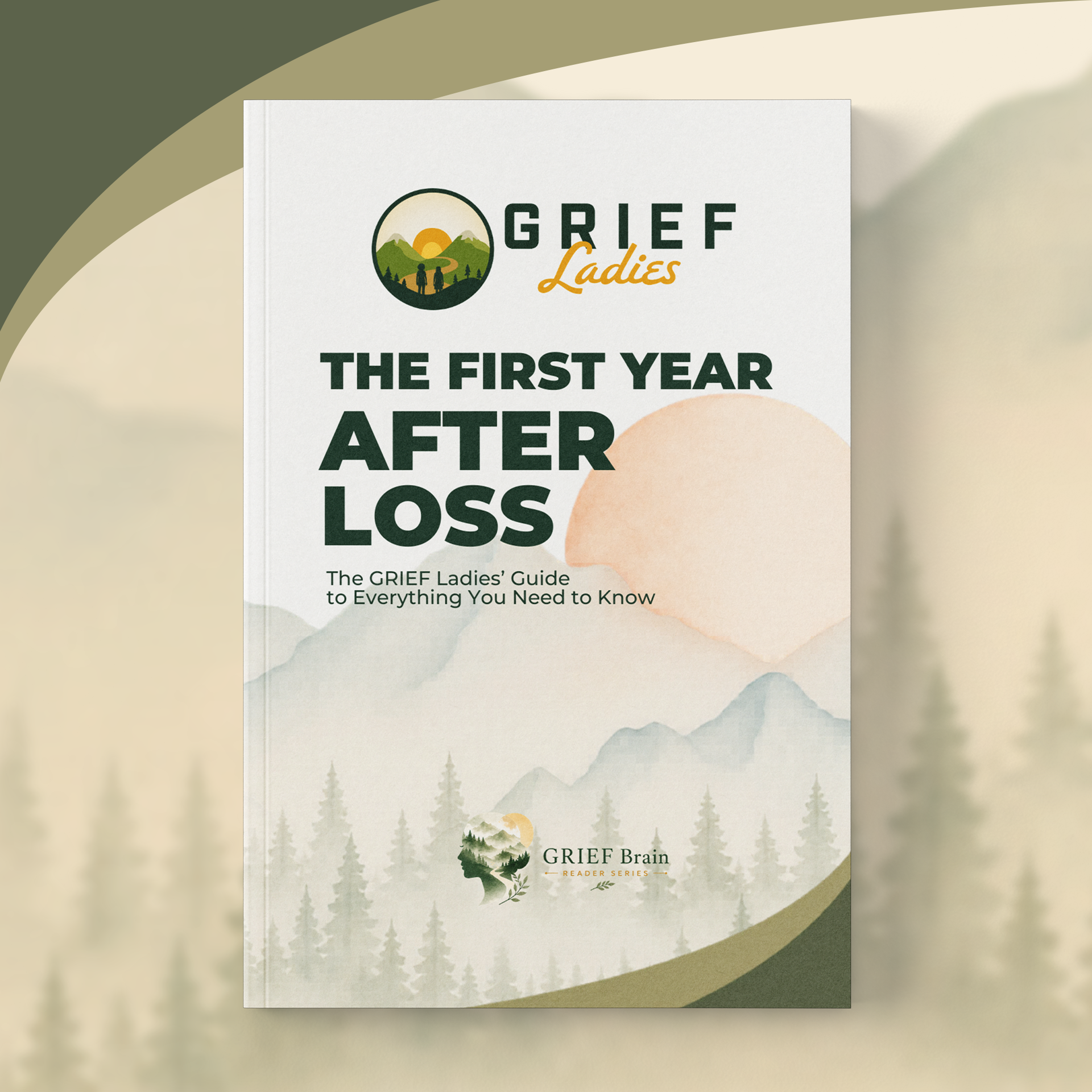
Why We Wrote The First Year After Loss
The First Year of Loss written by the GRIEF Ladies is scheduled for Tuesday, June 16th on Amazon.
When life knocks us down, most of us have ways of coping. We lean on the people we trust. We throw ourselves into work for a while. We exercise. We spend time with friends. We distract ourselves with hobbies. We remind ourselves of other difficult things we've survived and draw confidence from knowing we've gotten through hard times before. We rely on routines and familiar structures to create a sense of stability while life feels uncertain.
Then a significant loss occurs, and suddenly, the life we knew how to navigate no longer exists.
The person we would normally call may be the very person who died. Friends and family are often grieving too, leaving them with less capacity to support us in the ways they once did. The hobbies and interests that used to bring comfort can suddenly feel meaningless. Our routines change because the life those routines were built around no longer exists. Even our confidence in ourselves can take a hit as we struggle with forgetfulness, indecision, exhaustion, and a complete lack of motivation.
In other words, loss doesn't simply create pain. It destabilizes many of the systems we would normally rely upon to recover from pain.
We think this is one of the reasons the first year after loss feels so bewildering. People often come into grief believing they are mourning one person, only to discover they are also grieving a future they expected to have, a role they once occupied, a sense of security, familiar routines, important relationships, and even parts of themselves. They find themselves struggling with things that used to come naturally and wondering why they can't seem to "get it together." What they don't realize is that they are trying to adapt to an entirely new reality while many of the supports that would normally help them adapt have changed or disappeared.
This is also why so many grieving people ask the same questions. Why am I so tired? Why can't I concentrate? Why do I feel worse now than I did three months ago? Why don't I enjoy anything anymore? Why do I feel so disconnected from everyone around me? Beneath all of those questions is often a deeper one: Is this normal?
After hearing those questions for years, we began talking about how difficult it can be for grieving people to find straightforward, practical information during the time they need it most. The irony, of course, is that grief itself affects concentration, memory, motivation, and the ability to absorb information. People are desperate to understand what is happening to them at exactly the same time they are least able to read a dense book or sort through complicated explanations.
That realization became the foundation for our GRIEF Brain Reader Series, a collection of books on grief and life after loss designed specifically for people whose worlds have been forever changed. We wanted these books to be practical, accessible, and easy to return to—offering information, reassurance, and guidance without requiring the focus, energy, or emotional bandwidth that grief often takes away.
That conversation eventually became The First Year After Loss: A GRIEF Ladies Guide to Everything You Need to Know. We wanted to create the book we wished every grieving person had during those early months—the book that explains not only what grief is, but why it feels so hard. A book that helps people understand the exhaustion, the fog, the loneliness, the identity changes, the relationship challenges, and the countless secondary losses that often accompany the death of someone important.
No book can remove the pain of grief. No book can tell someone exactly what their experience will look like. But we do believe that understanding matters. There is comfort in learning that what feels frightening is often normal. There is relief in discovering that other people have struggled with the same thoughts, questions, and fears. There is tremendous value in realizing that the exhaustion, confusion, forgetfulness, loneliness, and sense of being completely unlike yourself are experiences shared by many grieving people.
The first year after loss asks an enormous amount of us. It asks us to carry heartbreak while adapting to change. It asks us to learn new routines, navigate unfamiliar emotions, and make sense of a world that no longer looks the way we expected it to. We hope this book helps people feel less confused, less alone, and better equipped to understand what is happening to them as they find their way through one of the most difficult years of their lives.
The First Year of Loss will be available on Amazon on Tuesday, June 16th. Want to hear more about why we are starting with this book, check out: https://youtu.be/Nfz8_vQbWck?si=qkVHy8ivBGEirpnS
What Actually Happens in the First Year of Grief and Why Nobody Warns You
The first year after a loss is full of things nobody prepares you for — grief brain, grief bursts, the exhaustion, the firsts. Grief specialists Kelly Daugherty and Karyn Arnold explain what's actually normal and what helps.
The first year after a loss is unlike anything else you will experience. And yet most people go into it completely unprepared because nobody talks honestly about what it actually feels like. That's not because people don't care. It's because grief is still one of the most underdiscussed experiences in our culture. We show up for the funeral. We bring the casseroles. And then, as Kelly Daugherty often says: "By the time the casseroles have been eaten, the phone has stopped ringing, and the funeral is over, then it really hits them." And when it hits, many people ask the same question: Am I grieving, or am I going crazy? The answer, almost always, is: you are grieving. And this is what grief actually looks like.
What Is "Grief Brain" and Is It Real?
Yes. Grief brain is real, and it affects more people than most realize. When you are in early grief, your nervous system is under enormous strain. Stress hormones are elevated. Sleep is disrupted. Your body and mind are working overtime to process something that has no quick resolution. As a result, many grieving people experience significant cognitive changes — including difficulty concentrating, forgetting things they would never normally forget, struggling to read or retain information, and feeling mentally foggy or scattered. This is why Kelly Daugherty and Karyn Arnold — co-hosts of the GRIEF Ladies Podcast and co-authors of The First Year After Loss — designed their new Grief Brain Reader series with the grief brain specifically in mind. The books are intentionally short and digestible. Because handing a grieving person a 300-page book isn't helpful. It's another complication. "Your grief brain can handle this" is the message behind the series. It was written for exactly where you are right now.
The Firsts Nobody Prepares You For
The first year of grief is filled with firsts you didn't ask for. The first birthday without them. The first holiday. The first time someone asks how you're doing and you genuinely don't know what to say. The first time you reach for your phone to call them — and remember. Each of these firsts carries its own weight. And many people are surprised to find that certain ones hit harder than they expected — sometimes months later, sometimes on a completely ordinary Tuesday with no obvious trigger. This is not unusual. This is grief doing exactly what grief does.
Grief Bursts: When It Comes Out of Nowhere
One of the most disorienting experiences in grief is what clinicians sometimes call a grief burst — a sudden, intense wave of grief that arrives without warning. You might be in the grocery store, driving to work, or sitting quietly at home when something — a smell, a song, a phrase — brings the loss rushing back with full force. Kelly Daugherty, an LCSW-R and grief specialist with over two decades of experience, is open about her own experience with this. Her mother has been gone for 32 years. And grief bursts still come. "I had a grief burst the other day about my mom. It's been 32 years. And it still hit me. Because grief doesn't have an expiration date." This is not a sign that something is wrong. It is a sign that you loved someone deeply. And it is completely normal.
What the First Year Actually Needs
The first year of grief deserves focused, intentional support. Not a timeline. Not a checklist. Not someone telling you that you should be further along by now. What helps, according to decades of combined clinical experience from Kelly and Karyn, is this: Finding your people. Co-regulation — the nervous-system science of being around safe, calm people — is one of the most powerful tools in early grief. You need people who can sit with you in it. Who don't need you to perform being okay. Normalizing what you're experiencing. Knowing that grief brain is real, that grief bursts are normal, that the first year is hard for a reason — this alone can reduce the shame and confusion that makes grief even heavier. Short, digestible resources. When you can't concentrate, when reading feels impossible, when your brain can't hold a lot — you need resources that meet you there. Not resources that add to the overwhelm.
The First Year After Loss — Coming Soon
The First Year After Loss, the first book in the Grief Brain Reader series by Kelly Daugherty and Karyn Arnold, will be available now on Amazon on June 16th. It is short. It is honest. It is written for the grief brain — on purpose. And it is for anyone in their first year of loss, anyone who loves someone in their first year, and anyone who has been carrying grief longer than a year and never had a resource that truly met them where they were.
Want to hear more about this book, check out the GRIEF Ladies Bonus Podcast Episode: https://open.spotify.com/episode/0VR2fwgmnguI6P3Yl9qGx2?si=L_jbfIT_Rw6pJymenTAn_g
Grief in the Body: Somatic Tools for Healing After Loss
Grief in the Body: Somatic Tools for Healing After Loss
Grief in the Body: Somatic Tools for Healing After Loss
Grief doesn’t stay in your thoughts — it often shows up in your body.
In this episode, we explore how loss can affect your identity, self-esteem, and physical health. Joined by somatic coach Jay Moon Fields, we talk about embodied grief, why physical symptoms like tension and stomach aches are common, and simple tools to help process emotions safely.
You’ll learn:
Why grief can impact your body
How loss reshapes self-identity
Practical somatic tools for emotional release
The “Of Course” validation technique
How to advocate for yourself during grief
Grief changes you — but it can also deepen your self-awareness.
As always, we close with one practical step you can try this week.
Listen here: https://open.spotify.com/episode/74gX1JHIFGFdE2arAVZAi2?si=0fec4b9a954649a2

Feeling Stuck in Grief? You Are Not Alone — and Here Is Why It Happens
Feeling stuck in your grief?
Recently, Karyn and I were doing a live for our GRIEF Ladies Facebook Community and we were asked this question:
“My husband died five years ago, but I feel stuck and frozen. I understand that grief doesn’t have a timeline, but I can’t seem to make any progress with moving forward. I don’t care about much. I have no motivation or interest in things. I’ve tried therapists and a grief group, but nothing seemed to help.”
If any part of that resonates with you, please know: what you are experiencing is real, it is common, and there are reasons it happens. Here is a summary of how we answered this question.
Why Grief Can Feel Harder as Time Goes On
It might seem counterintuitive, but many people find that grief becomes more difficult — not easier — after the first year or two. Early grief, while devastating, often comes with what we describe as a kind of “novelty.” There is a lot happening: practical decisions to make, people around you, rituals to attend to. You are in motion, even if that motion is painful.
As time passes, the busyness fades. The people around you may have moved on. And suddenly you are left with a quieter, heavier question: “What now? Is this it?” That stillness can strip away motivation and leave you feeling like nothing will ever change.
There is also the issue of comparison. When we look at our current life in grief, we often measure it against the life we had before our loss. That is an incredibly painful comparison to make, and it can quietly fuel a sense of hopelessness.
Your Nervous System May Be Keeping You Stuck
The word “frozen” is significant. It is not just a metaphor — it can be a physiological response. When we experience profound loss, our nervous system responds. For many people, especially those who lost someone who was their primary source of safety and connection, the nervous system can get locked into what is called a dorsal vagal response: collapse, shutdown, and numbness.
This is your body trying to protect you. It is not a weakness. It is not a character flaw. It is an old, hard-wired survival mechanism. Understanding this distinction matters, because the path forward is not about pushing harder or willing yourself to feel better — it is about gently and incrementally helping your nervous system feel safe enough to re-engage with life.
Roadblock Emotions That Keep Us From Moving Forward
Being stuck is often not just about sadness. Beneath the surface, other emotions frequently act as roadblocks:
• Guilt — for feeling better, for moving forward, for moments of joy
• Anger — at the loss, at circumstances, at the unfairness of it all
• Fear — of the future, of forgetting your loved one, of who you are without them
• Identity loss — “Who am I now?” is one of the most disorienting aspects of grief
One pattern we see frequently, particularly among widows and widowers: a deep-seated fear of feeling better. Many grieving people tell us they feel guilty when they experience happiness, as though moving forward is a betrayal of their loved one. We want to name this clearly — it is not. Moving forward is not leaving your person behind. It is learning to carry them with you.
Not All Therapy and Grief Support Is the Same
If you have tried therapy or a grief group and felt it did not help, please do not take that as evidence that nothing can help you. Consider this: only about 60% of therapists received any education in grief and loss during their training. That means a significant number of well-meaning clinicians simply are not equipped to support grieving clients effectively.
Finding the right therapeutic support is a bit like finding the right bathing suit — the first one you try might not be the right fit, but that does not mean the right one is not out there. We would encourage you to seek out a grief-informed therapist or coach, someone who offers practical tools and not just a space to talk.
The same applies to grief groups. Peer-led groups offer real value, but a group facilitated by a grief-informed professional — one that is action-oriented and gives you tools and frameworks — can be a different experience entirely.
You Grow Around Your Grief — Not Past It
We want to offer one more reframe that we find genuinely helpful: you do not “get over” grief. Your grief does not disappear. What is possible — and what we have seen in our work again and again — is that you grow bigger than your grief. It is still there. But you expand around it.
That expansion happens through small, incremental steps. It happens through connection with others who understand. It happens through the right support, and through learning to move forward with your loved one — not without them.
A Note to Anyone Who Is Stuck Right Now
If you are reading this and recognizing yourself, we want you to hear this: you are not broken. You are not failing at grief. Your nervous system is doing what it was designed to do. Your emotions are real and valid. And the fact that you are still asking questions, still looking for support, still reaching out — that matters.
We wish none of us had to navigate this. But we do know that you do not have to navigate it alone. Join our GRIEF Ladies Community to hear more answers to our group members questions. Join here: https://www.facebook.com/share/g/1AdC4voMEG/

The Guilt of Relief in Grief
Understanding the Guilt of Relief in Grief
When speaking with a person who has recently lost a loved one to a long illness, I often hear them say “I’m just relieved that she’s gone.”
And this statement is almost certainly followed with something like: “It’s just that she was suffering for such a long time. I love my mom, but for those last few years she wasn’t herself. She had no quality of life and I know she would not have wanted to live that way.…”
The fact is that relief is a complicated emotion when coupled with grieving.
Even people who have the ability to express relief out loud can’t do so without explaining how they could feel “relieved” that someone they love has died.
Watching someone we love get diagnosed with a disease, suffer with its symptoms and ultimately die is one of the most traumatic things we can experience.
As we watch a loved one lose every fundamental ability during an especially long illness, we may find ourselves wishing it would end.
And why is this “guilt of relief” such a strange concept? When we struggled at other points in our lives, didn’t we find we could freely express that we wanted the struggle to be over? Wasn’t voicing our relief almost always acceptable?
Understanding the Guilt of Relief
Finding relief on the other side of loss is nothing to feel guilty about, and certainly not something that should require an explanation.
Yet the guilt this conflict leaves is something few people find they are able to shake.
While so few parts of the grieving process could ever be considered simple, in this case a subtle shift in perspective could be what makes the difference.
When speaking to someone who reluctantly admits feeling this “guilt of relief” following the loss of a loved one, I offer one simple idea:
“You are not relieved that your loved one has died. You are relieved that a time in your life marked by stress, uncertainty and suffering is now over.”
Give it a try. See if this change in perspective can make a difference. Don’t make this process any harder than it has to be and let yourself off the hook when you can. You have been through one of the most difficult and challenging experiences a person can endure. If you are able to feel even a small sense of relief, it is not something to hide, but to embrace.
And remember that you aren’t alone in your grief, or in experiencing your guilt of relief. Our forums offer you a place to see and share stories of grieving with people who have gone through losses of their own.
There’s even a section called Life After Caregiving. If you feel like you can’t say the things you feel out loud, start there. Share your experience with those who have been where you’ve been.

Grief Making You Feel “Lazy”? Why It Happens & How To Help
Grief Making You Feel “Lazy”? Why It Happens & How To Help
Lazy. Such a strange word in the way that it can be used so differently throughout our lives. A lazy coworker or teenager can be a terrible source of frustration but a lazy Sunday can be one of our greatest joys.
In grief, I find it works a little differently. So often I speak with people who tell me they feel lazy or identify as this new lazy person that they don’t recognize – so new from the go go go that they were used to before.
In this respect these aren’t people enjoying the leisure of a well deserved break, but instead a frustrating new side of themselves that they don’t understand and can’t see a way out of.
So first and foremost, let’s start by changing the language. Because I don’t think lazy in any of the ways we’re used to saying it works for someone who has had a loss. The circumstances are too different, too extreme, and a change of our language and perspective may just be what we need to make the change.
Grief is exhausting. I say this all the time and EVERY griever I speak with quickly agrees, and yet…it’s this same person who doesn’t understand why they feel less motivated, interested, or energized.
I think it’s important that we start by recognizing and validating just HOW MUCH WORK it takes to grieve. Sure, it doesn’t look like much- from the outside it may not look like anything at all. Picture for a moment those cartoons where you can see the cogs and wheels inside a person’s brain, only imagine that the only thing turning around in there is grief.
And it’s not just sadness. It’s the questioning, the second guessing, the anger, regret, remorse, anxiety, worry and uncertainty. It’s the time travel of revisiting the past, unable to shake images of the last days, weeks or months. And the worry and uncertainty of the future. What now? Where do I go from here?
The quiet griever is actually quite busy in that head of theirs and unfortunately not too many of their thoughts can be viewed as anything close to positive.
So how do we help?
Start with the basics.
One of the first things I ask the people I’m working with is, “how have you been sleeping?”. The answers may vary but there’s no denying that whether a griever struggles to fall asleep, or has a hard time staying asleep, losing sleep in grief is a norm for many and it’s having a very big impact on their days.
How can we be expected to function during the day if we’re not sleeping at night? Grief brings with it such a deep sadness and sluggishness, we may not even recognize the role being tired is playing in our inability to heal. The exhaustion blends in so easily with the rest of the experiences of grieving.
So starting with the basics, we want to look at our sleep and make sure we’re getting enough of it. It takes time, it takes patience, and it takes practice but a good night’s sleep is well within your grasp. To learn more you can read our previous article on sleep here: HOW TO GET A BETTER NIGHT’S SLEEP WHEN GRIEVING.
“Are you eating right?”. That’s another another question I ask of the people I work with. And by right I mean, are you eating often enough? Is it at least somewhat healthy and not all fast food or food that comes out of a can? While food is really such a big part of our days, at least in earlier parts of our life, the healing nature of it is sadly overlooked and can make a real difference in the energy we need to grieve. Just as athletes fuel up for their physical performance – a griever needs real nourishment if they’re going to have what it takes to get through their own emotional marathon. This too has been addressed in an earlier article and if you’re interested in learning more you can find it here: FOOD AS FUEL FOR SELF CARE AND HEALING.
Next, let’s think about the personality changes that happen after loss. There is nothing more visible than the very huge void a loved one leaves in their passing. So while it’s so easy to see just how much has changed in our routine and in the landscape of our life following loss, we don’t always realize just how much has changed in us.
Take a moment to think, just off the top of your head, 3 personality traits that you have identified with, or labeled yourself as, for most of your adult life.
Organized? Patient? Optimistic? Creative? Productive? Caring? Focused?
Now think about how many of those traits feel within your grasp, right now, in the very depths of grief.
Most will say that the strengths so easily available to them in earlier parts of life seem so out of reach when grieving. And it’s this that also adds to that feeling of “lazy”. Because let’s face it….who cares and what does it matter?
I often hear people use the phrase “matter of life and death” – as in, “call me back when you get a moment- it’s not a matter of life and death”. Translation?
It’s not important.
So many things in life prior to loss seem sooooo important. There are deadlines, plans, and expectations, and the desire to do everything just right.
But after loss? Not so much. It doesn’t seem so important anymore. After loss we realize that geez – basically nothing is a matter of life and death and after the death of someone we love, everything else seems just really really small and insignificant.
So who cares? Why bother?
I’ve had this question in some way or another asked so many times from so many people that I think together we’ve actually come up with some idea of an answer.
If looking at any effort we make as an attempt to change our life in a way so that it no longer reflects things that have happened and can’t be undone (like the loss of someone we love) than we’ll always be right: it won’t make a difference.
Nothing can change the reality of loss, and that takes a really long time to adapt to that information.
So it’s true: getting a good night’s sleep doesn’t make a loved one come back. Eating well doesn’t make a loved one come back. Making a new friend, or engaging in a hobby, or working in the garden or fixing up the house doesn’t make a loved one come back.
So what difference does it make? Well, perhaps if we do a few things differently and slowly find our way to some part of ourselves and our lives that are somewhat familiar and recognizable maybe we can make this new reality just a little more tolerable.
We already know what inaction looks like. What becoming stagnant and stuck, and what feeling “lazy” looks like.
Doing a few things to make life better may possibly do just that – make this life a little better.
You’re NOT lazy. Have compassion for yourself. Give yourself some grace. Be patient with yourself and this process.
All of those things rattling around in your head that are causing so much stress will often seem so unreachable and hard to solve, no matter how many exhausting times we go over it. Why? Because they are unreachable and unfixable. At least today. Today you can’t fix it all.
So take all of this one step at a time and start with the basics.
Validate this experience by understanding why grief is so hard and lasts so long.
Improve your sleep – and do not expect anything else to improve until that does.
Make sure you’re eating well. Nourish yourself. Take care of yourself on this very basic level and remember – it matters, and you matter.
Be patient. Take this one day at a time, one hour at a time, and don’t let the overwhelming nature of it overwhelm you, make you stagnant or slow you down.
Change your perspective and consider the alternatives. We already know what this (current state of grief) looks like. What would one small change do and could it bring you even one step closer to healing?
No, this isn’t the life you planned for or expected and it’s not the one you wanted or asked for. But don’t give up on trying to make it better. Because it just may work.
Grief and Routine: Why Structure Matters After Loss with guest, Kat Farace
Grief and Routine: Why Structure Matters After Loss with guest, Kat Farace
If you’re wondering how to rebuild your life after someone dies, you’re not alone. Loss can shatter routines, disrupt your sense of identity, and make everyday tasks feel overwhelming.
In this episode (23) of The GRIEF Ladies Podcast, Karyn Arnold and Kelly Daugherty are joined by grief counselor and hospice expert Kat Farace to explore what “rebuilding” really means after loss. We talk about why routine matters in grief, how small daily structure can support your nervous system, and why rebuilding isn’t about “moving on” — it’s about learning how to live forward while carrying love with you.
In this conversation, you’ll learn:
Why grief disrupts your daily rhythms
How to gently reintroduce routine without pressure
The role of self-care in early and ongoing grief
Why community support matters when everything feels unstable
Practical coping tools to help you feel more steady
This episode connects to the Rebuilding trail marker in our G.R.I.E.F. Framework — focusing on structure, routine, and small steps that create stability in the midst of emotional upheaval.
If you’ve been feeling unmoored, exhausted, or unsure how to function after loss, this episode offers validation, realistic strategies, and encouragement for wherever you are in your grief journey.
Guest Bio:
Kat Farace is an author, speaker, and grief coach with over 25 years of experience in hospiceand end-of-life care, walking alongside individuals and families through life’s most profound moments of loss, love, and transition. Her work is grounded in compassion, honesty, and the deep belief that grief—while never chosen—can become one of our greatest teachers.
Through decades of hospice service, Kat has supported thousands of people as they navigated death, dying, and bereavement, gaining rare insight into the emotional, spiritual, and relational realities of grief. Her approach blends professional expertise with heartfelt presence, offering guidance that is both practical and deeply human.
Kat is the author of the upcoming book Grief the Teacher: The Teacher We Never
Wanted—With the Lessons Only Love and Loss Can Teach, to be released in Spring 2026. In
it, she explores grief not as something to “get over,” but as an experience that reshapes us,
challenges us, and ultimately invites growth, meaning, and connection.
Kat creates space for real conversations about loss—conversations that honor pain while also making room for hope, resilience, and love. Whether speaking to the newly grieving or those carrying loss for a lifetime, she brings a steady, compassionate presence that reminds listeners they are not alone.
Kat Farace’s work continues to reach audiences through coaching, speaking engagements, and storytelling that normalizes grief, dismantles shame, and gently illuminates the path
forward—one honest conversation at a time.
Connect with Kat:
Website: https://www.balanceingrief.com
Instagram: https://www.instagram.com/balanceingrief/
Facebook: https://www.facebook.com/balanceingriefcom
🎙 Listen to Episode 23: Grief and Routine: Why Structure Matters After Loss with guest, Kat Farace
Available now on YouTube and all podcast platforms.

Why am I still grieving so intensely months/years later?
Why am I still grieving so intensely months/years later?
Many people quietly wonder:
Why does this still hurt so much?
Shouldn’t I be feeling better by now?
Is something wrong with me?
Why am I still grieving years later?
There’s a lot of pressure in our culture to “be okay” after a certain amount of time. But grief doesn’t follow a calendar or timeline. Grief is not something you get over. It’s something you learn to live with.
Intensity Doesn’t Always Mean Something Is Wrong
Even months or years later, grief can feel intense. Grief waves can still show up unexpectedly. Certain dates, memories, or life events can bring everything back to the surface. This just means your loss mattered.
Grief can feel especially intense or long-lasting when:
The death was sudden or traumatic
There were complicated relationship dynamics
You didn’t get closure
You were very closely connected
The loss significantly changed your daily life or your identity
When a death was traumatic, some people don’t just miss the person, they relive aspects of how the death happened. They may experience intrusive memories, mental images, or a sense of being pulled back into the moment they found out. That kind of grief can feel more challenging and difficult to move forward with.
Over time, many people find that grief shifts. It may not dominate every hour of the day. But it doesn’t vanish.
You might function well most days and still have moments when it feels raw. You might laugh more and still miss them deeply. You may build a full life and still carry the absence.
Both things can be true.
Growing around grief doesn’t mean it’s gone. It means your life has expanded enough to hold it.
When to Consider Additional Support:
There is no “correct” timeline. But it may be helpful to seek professional support if:
The intensity feels constant with little relief
You are frequently reliving the death itself
Intrusive memories or images feel overwhelming
You feel stuck in guilt, anger, or despair
You are unable to function in daily life
You feel hopeless or unsafe
Seeking support is not about labeling your grief. It’s about helping you carry it in a way that feels more manageable. Check out Grief in Common with Karyn Arnold for additional resources, including grief groups or grief coaching.

What Does Grief Feel Like? (Emotionally & Physically)
What Does Grief Feel Like?
Grief is not just emotional. It affects your thoughts, your behaviors, your body, and sometimes your spiritual or existential beliefs. Many people are surprised by how physical grief feels. If you’re wondering whether what you’re experiencing is normal, you’re not alone.
Grief Is More Than Sadness
People often expect grief to feel like sadness. But many describe it as a bundled-up box of emotions, multiple feelings happening all at once.
You might experience:
Sadness and anger in the same hour
Relief and guilt together
Numbness followed by intense emotion
Anxiety, fear, or irritability
A sense of meaninglessness or questioning your beliefs
Grief is rarely one emotion at a time. It can feel layered and unpredictable.
The Cognitive Effects of Grief
Grief can impact how you think. Many people report:
Brain fog
Forgetfulness
Trouble concentrating
Difficulty making decisions
Re-reading the same sentence multiple times
This is often called “grief brain,” and it’s a common reaction after a significant loss.
The Physical Symptoms of Grief
Grief is stored in the body. It can feel heavy, almost like you’re physically carrying something.
Common physical symptoms of grief include:
Extreme exhaustion
Sleep disruption
Headaches
Stomachaches or digestive changes
Muscle tension or body aches
Tightness in the chest
Changes in appetite
Research shows that stress levels increase during grief, and inflammation in the body can rise. This can make you feel run down and more susceptible to illness. You’re not imagining it. Grief can truly be physical.
Behavioral and Spiritual Shifts
You may also notice changes in how you behave or see the world:
Withdrawing from others
Losing interest in activities you once enjoyed
Avoiding certain places or conversations
Questioning your faith or long-held beliefs
Feeling different from who you used to be
Loss has a way of shaking the foundation of how we understand life.
If this sounds familiar, it's because grief can feel overwhelming, as it impacts so many areas at once. It isn’t “just” emotional. It’s a full-body, full-life experience.
If you want to hear real conversations about what grief actually feels like, including grief brain, physical symptoms, and emotional waves, we talk openly about this on the GRIEF Ladies podcast, as well as tools to help you with these feelings and symptoms. New episodes come out every Wednesday as we go through our GRIEF Ladies Framework- Grieving, Rebuilding, Interacting, Evolving, and Finding.