
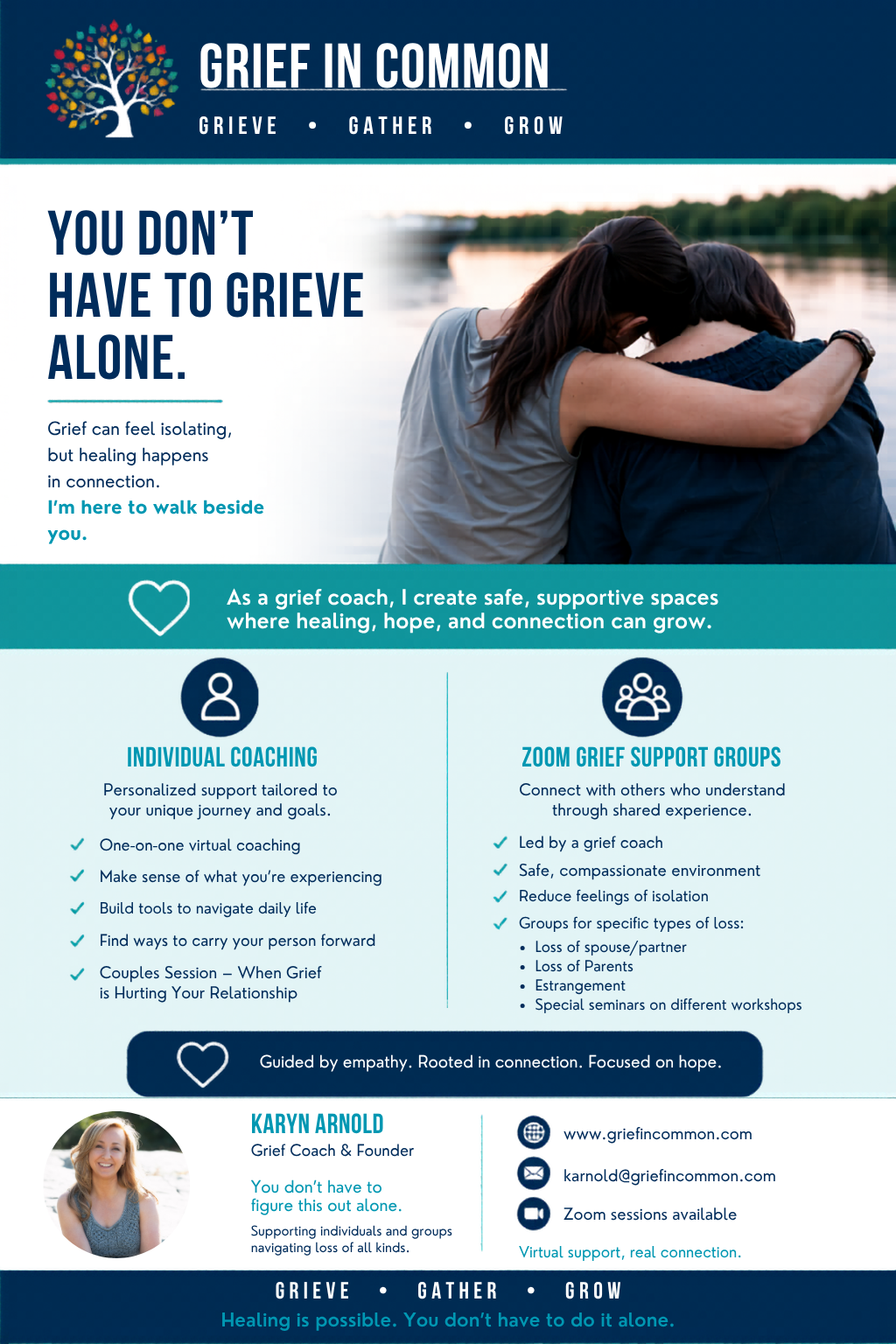
You Don't Have to Grieve Alone: How Grief Coaching Groups Can Help
Grief Coaching with Karyn Arnold of Grief in Common
After a loss, one of the hardest things isn't just the grief itself — it's the feeling that no one around you really gets it. Grief support groups exist for exactly that reason: to put you in a room (or a Zoom) with people who understand because they've been there too. Grief in Common, founded by grief coach Karyn Arnold, offers virtual group support designed around connection, compassion, and real conversation.
What Makes a Grief Support Group Different From Going It Alone?
Grief can shrink your world quickly. Friends may not know what to say. Family members are grieving too, often in different ways. A support group offers something most of us can't find elsewhere — people who don't need you to explain yourself, because they already understand. Research consistently shows that social support is one of the most significant factors in how people move through grief. A group gives you that support on a regular, structured basis.
A 2021 review published in Death Studies found that grief support group participation was associated with significant reductions in feelings of isolation and improvements in overall coping. For many, the group itself becomes a lifeline.
What Groups Does Grief in Common Offer?
Karyn's Zoom grief support groups are organized around specific types of loss, so you're not walking into a generic room — you're connecting with people who share your particular experience. Current groups include support for those who have experienced the death of a spouse or partner, the death of a parent, and estrangement. Special topic seminars are also available on a rotating basis. All groups are led by Karyn and held in a safe, compassionate virtual environment.
What If You're Not Ready for a Group?
Group support isn't the right fit for everyone — at least not right away. If you're looking for something more personal, Karyn also offers one-on-one virtual coaching sessions. Individual coaching is tailored to your unique experience and goals, and gives you dedicated space to make sense of what you're going through, build tools for navigating daily life, and find ways to carry your person forward. Couples sessions are also available for when grief is putting strain on a relationship. Whether you start with individual coaching and move into a group later, or do both at once, Karyn meets you where you are.
What Can You Expect in a Grief in Common Group?
These groups are coaching-based, not therapy — which means the focus is on connection, practical tools, and finding your footing going forward. Sessions are held via Zoom, so you can join from wherever you are. Whether you're newly bereaved or further along and still looking for community, there's space for you here.
Grief can feel isolating, but healing happens in connection."
— Karyn Arnold, Grief Coach & Founder, Grief in Common
Who Is Karyn Arnold?
Karyn Arnold is a grief coach and the founder of Grief in Common. She works with individuals and groups navigating loss of all kinds, guided by empathy, connection, and hope. Karyn is also the co-host of the GRIEF Ladies podcast, where she and I dig into what grief actually looks like — and what it means to keep living alongside it.
Visit Karyn’s website at www.griefincommon.com to sign up for one of her groups or individual coaching session.
Please note: Grief in Common offers coaching services, not therapy. If you are experiencing a mental health crisis or need clinical support, please reach out to a licensed mental health professional.

Grief Making You Feel “Lazy”? Why It Happens & How To Help
Grief Making You Feel “Lazy”? Why It Happens & How To Help
Lazy. Such a strange word in the way that it can be used so differently throughout our lives. A lazy coworker or teenager can be a terrible source of frustration but a lazy Sunday can be one of our greatest joys.
In grief, I find it works a little differently. So often I speak with people who tell me they feel lazy or identify as this new lazy person that they don’t recognize – so new from the go go go that they were used to before.
In this respect these aren’t people enjoying the leisure of a well deserved break, but instead a frustrating new side of themselves that they don’t understand and can’t see a way out of.
So first and foremost, let’s start by changing the language. Because I don’t think lazy in any of the ways we’re used to saying it works for someone who has had a loss. The circumstances are too different, too extreme, and a change of our language and perspective may just be what we need to make the change.
Grief is exhausting. I say this all the time and EVERY griever I speak with quickly agrees, and yet…it’s this same person who doesn’t understand why they feel less motivated, interested, or energized.
I think it’s important that we start by recognizing and validating just HOW MUCH WORK it takes to grieve. Sure, it doesn’t look like much- from the outside it may not look like anything at all. Picture for a moment those cartoons where you can see the cogs and wheels inside a person’s brain, only imagine that the only thing turning around in there is grief.
And it’s not just sadness. It’s the questioning, the second guessing, the anger, regret, remorse, anxiety, worry and uncertainty. It’s the time travel of revisiting the past, unable to shake images of the last days, weeks or months. And the worry and uncertainty of the future. What now? Where do I go from here?
The quiet griever is actually quite busy in that head of theirs and unfortunately not too many of their thoughts can be viewed as anything close to positive.
So how do we help?
Start with the basics.
One of the first things I ask the people I’m working with is, “how have you been sleeping?”. The answers may vary but there’s no denying that whether a griever struggles to fall asleep, or has a hard time staying asleep, losing sleep in grief is a norm for many and it’s having a very big impact on their days.
How can we be expected to function during the day if we’re not sleeping at night? Grief brings with it such a deep sadness and sluggishness, we may not even recognize the role being tired is playing in our inability to heal. The exhaustion blends in so easily with the rest of the experiences of grieving.
So starting with the basics, we want to look at our sleep and make sure we’re getting enough of it. It takes time, it takes patience, and it takes practice but a good night’s sleep is well within your grasp. To learn more you can read our previous article on sleep here: HOW TO GET A BETTER NIGHT’S SLEEP WHEN GRIEVING.
“Are you eating right?”. That’s another another question I ask of the people I work with. And by right I mean, are you eating often enough? Is it at least somewhat healthy and not all fast food or food that comes out of a can? While food is really such a big part of our days, at least in earlier parts of our life, the healing nature of it is sadly overlooked and can make a real difference in the energy we need to grieve. Just as athletes fuel up for their physical performance – a griever needs real nourishment if they’re going to have what it takes to get through their own emotional marathon. This too has been addressed in an earlier article and if you’re interested in learning more you can find it here: FOOD AS FUEL FOR SELF CARE AND HEALING.
Next, let’s think about the personality changes that happen after loss. There is nothing more visible than the very huge void a loved one leaves in their passing. So while it’s so easy to see just how much has changed in our routine and in the landscape of our life following loss, we don’t always realize just how much has changed in us.
Take a moment to think, just off the top of your head, 3 personality traits that you have identified with, or labeled yourself as, for most of your adult life.
Organized? Patient? Optimistic? Creative? Productive? Caring? Focused?
Now think about how many of those traits feel within your grasp, right now, in the very depths of grief.
Most will say that the strengths so easily available to them in earlier parts of life seem so out of reach when grieving. And it’s this that also adds to that feeling of “lazy”. Because let’s face it….who cares and what does it matter?
I often hear people use the phrase “matter of life and death” – as in, “call me back when you get a moment- it’s not a matter of life and death”. Translation?
It’s not important.
So many things in life prior to loss seem sooooo important. There are deadlines, plans, and expectations, and the desire to do everything just right.
But after loss? Not so much. It doesn’t seem so important anymore. After loss we realize that geez – basically nothing is a matter of life and death and after the death of someone we love, everything else seems just really really small and insignificant.
So who cares? Why bother?
I’ve had this question in some way or another asked so many times from so many people that I think together we’ve actually come up with some idea of an answer.
If looking at any effort we make as an attempt to change our life in a way so that it no longer reflects things that have happened and can’t be undone (like the loss of someone we love) than we’ll always be right: it won’t make a difference.
Nothing can change the reality of loss, and that takes a really long time to adapt to that information.
So it’s true: getting a good night’s sleep doesn’t make a loved one come back. Eating well doesn’t make a loved one come back. Making a new friend, or engaging in a hobby, or working in the garden or fixing up the house doesn’t make a loved one come back.
So what difference does it make? Well, perhaps if we do a few things differently and slowly find our way to some part of ourselves and our lives that are somewhat familiar and recognizable maybe we can make this new reality just a little more tolerable.
We already know what inaction looks like. What becoming stagnant and stuck, and what feeling “lazy” looks like.
Doing a few things to make life better may possibly do just that – make this life a little better.
You’re NOT lazy. Have compassion for yourself. Give yourself some grace. Be patient with yourself and this process.
All of those things rattling around in your head that are causing so much stress will often seem so unreachable and hard to solve, no matter how many exhausting times we go over it. Why? Because they are unreachable and unfixable. At least today. Today you can’t fix it all.
So take all of this one step at a time and start with the basics.
Validate this experience by understanding why grief is so hard and lasts so long.
Improve your sleep – and do not expect anything else to improve until that does.
Make sure you’re eating well. Nourish yourself. Take care of yourself on this very basic level and remember – it matters, and you matter.
Be patient. Take this one day at a time, one hour at a time, and don’t let the overwhelming nature of it overwhelm you, make you stagnant or slow you down.
Change your perspective and consider the alternatives. We already know what this (current state of grief) looks like. What would one small change do and could it bring you even one step closer to healing?
No, this isn’t the life you planned for or expected and it’s not the one you wanted or asked for. But don’t give up on trying to make it better. Because it just may work.

Self-Esteem & Grief: The Hidden Loss
Self-Esteem and Grief
Self-esteem. Insecurity. Doubt. Just the mention of these words can make us think of a very specific time in our life. Perhaps the teenage years or young adulthood – when how you feel about yourself and your place in the world can be so uncertain. But as time goes on and you settle into your adult life, self-esteem may not seem so important, and it’s not something you may have paid much attention to. In other words, if it’s not great, it’s at least good enough.
It’s also not something you hear spoken about in grief. And yet significant loss can completely drain and deplete any self-esteem you may have, making it feel impossible to move forward in a healthy or purposeful way.
So why does confidence take such a hit after loss, and how do we begin to improve this invisible symptom of grief?
Before we talk about why it’s so common to lose self-esteem in grief, perhaps it’s a good idea to explore why it’s important, and how it serves us in life.
Most of us think of self-esteem as just a set of (hopefully) good feelings that we have about ourselves. It can be confidence in a skill, talent, career, or perhaps the role we play in the lives of the people around us. We know that self-esteem should probably come from within. But it’s most likely to be raised by compliments from others, or lowered if we think someone doubts our character or abilities. It could be tempting to write off self-esteem as no more than shallow window-dressing, but the truth is it serves a much greater purpose than that.
Self-esteem is a motivator
Whether we are aware of it or not, we are quite regularly monitoring our own self-worth. Whatever conclusion we come to is going to determine the actions and steps we take. Before we embark on a task we’re deciding, can I do it? Will I succeed? Will it turn out okay? The less confident we feel, the less motivated we become.
So where does self-esteem come in and how does grief take it away?
Signs & Symptoms of Grief
For starters, let’s talk about the symptoms of grief. Loss of focus. Feeling exhausted. Feeling scattered. There’s so many changes that can happen after we’ve had a loss. When we add them all up we can be left thinking, “what happened to me? I used to have it so together”. While I talk about the individual signs and symptoms of grief quite a bit, it is the accumulation of these changes that leads to such a deep and significant dip in self-esteem. After all, we’re talking about a loss of almost every good adjective we would have used to describe ourselves in the past. Organized, motivated, optimistic. Our resume of emotional health may not seem to have a lot to offer anymore and a sudden dip in confidence can be attributed directly to it.
Who We Lost
This one may be easier to see. First, let’s think about the loss of our parents. The people who loved us unconditionally. Or the spouse or partner who had a way of making everything feel okay. Who loved us physically, intellectually, and provided a safe and intimate sense of security. Who am I without these people to tell me I’m good? Or beautiful? Or smart? Did I ever really believe it in the first place or did I just like the way I looked when reflected in their eyes? The level of confidence our loved ones may provide us isn’t something we necessarily recognize as acutely when they’re here. But there’s no doubt it’s something that we can feel the sharp and painful absence of when they’re not.
Feeling worthy
Most of our routine gets thrown off balance in the wake of loss, but the simple act of eating brings with it unseen complications. In loss a lot of grievers find they struggle to eat anything of substance. After all, they’ll say, “It’s just me”. Recently a widow I spoke with put it a little differently. “I just feel that I’m not really worth it”. I can’t tell you how much this statement surprised me. In the most matter-of-fact way, she simply stated that she just didn’t see the point. Cooking and eating well was worth it when her husband was alive. But now that it was “just” her, eating wasn’t a priority. She didn’t feel that she, or the actions it would take to nourish herself, were worth it.
Making decisions
EVERYTHING feels like a decision after loss, and often we’ve lost the person who helped us make them. Add to that the fact that we are feeling forgetful and scattered in grief. Can I really trust myself to be making the right decision? And what if I’ve made a mistake already like forgetting to pay a bill, or missing an important appointment? Suddenly we don’t trust ourselves the way we used to, and that can create a cycle of fear, indecision, and uncertainty that sends our confidence spiraling even further.
So how do we break the cycle of low self-esteem and insecurity in grief?
First (and this is my answer for a lot of things if I’m being honest) – by recognizing it. Recognize that on the very long list of things that have been lessened, depleted or stolen in grief, self-esteem needs to be added. And not only does it need to be recognized for the hit it’s taken, we need to realize that it’s worth bringing back. As I mentioned before, I am often educating people on the signs & symptoms of acute grief as I strongly believe it’s the validation that helps. To know that you’re not crazy. That you’re not alone. Your thoughts, feelings, and responses to this grief are “normal”, common, and to be expected.
Expectations count for a lot.
When expectations are too high, we get impatient, frustrated, and restless. When they’re too low, we feel hopeless, helpless and useless. It’s a terrible cycle to find yourself in and it will only cause self-esteem to be negatively impacted further.
Understanding and validating the experience of grief allows us to manage our expectations better. While the losses we face are permanent, the changes we see in ourselves don’t have to be.
Take a step back and re-enter this grief, ready to define the way you see yourself in a whole new way.
Feeling lazy?
Grief is exhausting. There is so much mental energy used to process loss and a griever can become immobilized by it. We can accomplish so much less than we’re used to, and still feel more tired than ever. Quite simply, you’re not lazy: you’re grieving.
Feeling forgetful?
Our memory has one very important requirement in order for it to work well: focus. If we want to remember something, we have to be able to focus and concentrate on it in the first place. Grief, and especially “new” grief takes all of our focus. As one griever once said to me, “focus isn’t my problem. The problem is I can ONLY focus on the person I lost”. That’s going to make it hard to be paying attention to (and therefore committing to memory) anything else.
Feeling like you’ve slipped in another important role in your life?
Let’s say you’ve lost your spouse, and no longer feel that you’re able to be the parent you want to be. Or someone who has lost a parent, who is struggling to be upbeat, or engaged with your spouse or kids. Or anyone who has a job or family or friends who has had a loss and feels they have nothing left to give to the work, life, and people who are still here. I really could go on and on. There’s just too many changes and we’re just too hard on ourselves to realize that we are expecting to be everything to everyone… even when everything has changed.
In the end, it’s not about excuses, it’s about forgiveness and altering our expectations of how we should be feeling, or how soon we should be getting better.
Raising self-esteem in grief can be as “simple” as being able to validate that GRIEF IS HARD.
We’ve never done this before, there’s no manual to get through it, and every day we’re trying to do just that: get through it. I often say that in grief, we are operating in crisis mode. And the rules are very different in crisis. For example – if someone is ever critically injured and brought to the emergency room, the nurses and doctors may use scissors to cut through their clothing to try and save them. No one cares about a piece of clothing in the middle of crisis. Getting this person better is the only thing that matters in that moment. But if we go to the doctor for our regular check up, we would be stunned and outraged if they pulled out a pair of scissors to cut through our shirt!
Our expectations for “normal” life are very different then they are in times of high stress and trauma. And I think every griever can agree that nothing feels normal after loss. Our expectations need to change to reflect that.
The rules of crisis are very different.
Allowing yourself to understand that should also help you know that the expectations should be different too. What we have to do to get through, get by and survive, especially in early grief – should not be an indication of who we are right now and it certainly doesn’t have to define us in the long term.
Be gentle to yourself. Be kind to yourself. Celebrate the small victories (like mowing the lawn for the first time or cooking a meal) by realizing that they’re not small at all. Congratulate yourself for every single thing you accomplish in grief, and forgive the times when you feel you’re not accomplishing enough.
The hope is to eventually string enough victories and good feelings together to restore and rebuild your spirit. And hopefully along with it…your self-esteem.

Perfectionists, People Pleasers & Grief
Perfectionists, People Pleasers & Grief
Perfectionists. People Pleasers.
Some will immediately relate to these labels, and some maybe not so much. Yet most people I work with exhibit at least some of these traits, whether they are consciously aware of it or not. For the perfectionists, it may come as an almost badge of honor. A commitment they’ve made to themselves to do everything the best they can, without fail, in every single category of their life. The people pleasers may not be as satisfied with that title. But they also understand it as a necessary skill to function in their lives, and as a way to get along with the people around them.
But what happens when life falls apart? Expectations for ourselves often remain the same, but how can they when EVERY SINGLE THING in life has changed? Do these old habits and old roles still work?
Let’s start by understanding what it really means to be a perfectionist or a people pleaser. While I work with (and know personally) plenty of people who possess both tendencies, there’s nothing saying that one has to go with the other. In order to understand where you may fit, it’s important to explore each on their own first.
There are a lot of perfectionists in this world.
It can show up in the way a person interacts with others, or how they keep themselves or their home. As a result, a standard and expectation becomes set and it can be very hard to do anything without having to do it really well, all the time.
People pleasers are a little different.
This behavior often comes from childhood, and is a learned response to safety and inclusivity with the world and people around us. People pleasers put others’ needs ahead of their own and for the most part, they’re doing this to the extreme.
So why does it matter in grief?
First: it’s not sustainable. The old habits and old ways of doing things only work when everything else in life is going okay. Next, competing with your “old self” will only create a greater contrast of who you are now, compared to who you used to be. This can add to the intense pressure, unfamiliarity, and uncertainty that a griever is feeling on a daily basis.
The problem with perfectionists and grief.
If you have always tried to do everything “right”, you may already be used to some of the pressure and stress that comes with it. But now you’ve had a significant loss, and you’re likely experiencing a level of stress that you never have before. You can barely think straight. How can you be expected to do the “right thing” when NOTHING feels right anymore?
In grief, being a perfectionist can actually equate to something that most would feel is far from perfect = procrastination. Decision making is a huge task in grief and if the old habits of perfectionism continue, a griever may find themselves making no decisions at all. The fear of doing the “wrong” thing may leave you feeling stuck, even hopeless.
Diminished self-esteem is also a huge concern for any griever, and if you feel that you are constantly falling short, your image and self worth will only sink lower.
The reason why people-pleasing tendencies can’t continue.
Unlike the perfectionists who are trying to make things just right in their own lives, people pleasers are trying to do it for everyone else instead. Here’s the problem when it comes to life after loss – a griever doesn’t even know what they need or how to make themselves feel any peace. So how can they be expected to anticipate the needs of anyone else?
It doesn’t help that some of the biggest challenges in grief come from those around you. Whether it’s in the form of real or perceived expectations, most people feel very disconnected from their loved ones following loss. Managing the emotions and needs of others takes the kind of higher-order thinking that a person in grief just doesn’t have access to. And for most it’s not a case of not wanting to be a help or support to others. They just may feel that they no longer can.
How to stop being a perfectionist or people pleaser today.
I often make comparisons to physical health when describing grief. When it comes to our physical health, we are much more understanding of what we can and can’t do. If you have a broken arm, you would never expect to be able to help a friend move their couch. And your friend wouldn’t ask you to.
But what about the brokenness that comes with grief? Can we take a more honest look at what we actually can and can’t do emotionally? And can we start reframing our interactions with ourselves and others accordingly?
This is where change begins.
First, in observation. Watch yourself and your thoughts. What are your expectations for yourself? Consider what old instincts are kicking in and how often you are telling yourself that you “should” be doing something. And then consider the reality of whether you really can (or want to).
Next, in practice. You’ve got to start somewhere. If you’re a perfectionist and worried about how clean the house is (or isn’t), consider changing your standards. For now. Maybe at some point you’ll decide to go back to having the cleanest house on the block. But for now that just may not be something you have the energy for. Grief is exhausting. Use your energy wisely.
What about my friends and family?
How will they react if I’m no longer a perfectionist or people pleaser? We all know what we expect from ourselves, but we can’t deny that the people in our lives are probably expecting a lot too. Especially with the passage of time. It’s all well and good for me to give you permission to put a greater focus on yourself and your needs, but will the people around you allow for the same grace? Especially with each day that passes since your loss?
Start by giving yourself permission and know that in a lot of ways, that will be the hardest part. Validate every single reason why you can’t or don’t want to hold yourself to the same expectations as before. And give yourself permission to only do or commit to what you can.
The people around you may need time to adapt, and that’s okay. Communicate. Don’t apologize. If they’re asking, let them know what this process is like for you. And why you need to make some changes in order to survive.
In the end, this grief is your business.
No one else gets to decide what you need in grief. It’s important to remind yourself (regularly!) that you’re doing the best you can. And when you’re feeling like that best isn’t so great, know that how you feel now isn’t how you’ll always feel. Grief is always changing and your needs, wants, limitations, and abilities will all change with it.
For all the perfectionists and people pleasers in this world, I leave you with this. If you’re going to please anyone right now, try pleasing yourself first. Find peace and comfort in little moments whenever you can. And remember that these tendencies were never good for you to begin with. There’s some real growth that can come out of the brokenness of loss. Start today by resetting the expectations you have for yourself, and find growth and perhaps a new strength, in the healing that follows.
Want to read more of Karyn’s blogs visit Grief in Common

Family Support While Grieving: Why It Can Feel So Complicated
Family Support While Grieving: Why It Can Feel So Complicated by Karyn Arnold
By Karyn Arnold, one of the GRIEF Ladies from Grief In Common
For many people, family support while grieving quickly becomes the hardest place to feel steady after loss — and that can come as a real surprise.
They knew the person. They loved them too. Surely this would be the place where support came most naturally. This was supposed to feel familiar, or at least steady. When that doesn’t happen, the disappointment can run deep. People are often left wondering why something they counted on no longer feels there.
What follows often goes beyond frustration. Loneliness sets in. A sense of safety disappears. A quiet worry creeps up: Is something broken in my family now? Is this how it’s always going to feel?
Family Support While Grieving Isn’t Shared in the Same Way
One of the biggest sources of tension in grieving families comes from the belief that everyone is mourning the same loss.
Even when the person is the same, the loss is not.
A partner loses the person they built daily life with.
A child loses a parent.
A sibling loses shared history.
The day-to-day impact also differs, especially for the family member(s) who shared living space with the person who is gone.
Grief becomes harder when we expect one another to cope, feel, or recover in similar ways — or on the same timeline. When no one names those expectations, misunderstandings grow quickly.
When the Struggle Isn’t Just With the Family You Were Born Into
For some, the strain shows up with parents or siblings. For others, it hits closer to home.
A spouse may want things to “get back to normal.” Children may feel uncomfortable with your sadness. Loved ones may rush, minimize, or avoid grief because they don’t know how to sit with it.
The sense of isolation can grow when you aren’t feeling supported or understood in your own home, and some of the disappointment can feel greatest with the family we chose.
When Support Comes From Somewhere Unexpected
Many grieving people feel surprised when they start leaning more on friends, coworkers, or people outside their family.
That shift can feel unsettling.
Often, it has less to do with love and more to do with capacity. Family members are grieving too. They may feel overwhelmed or emotionally flooded. Someone a step outside the inner circle may simply have more room to listen or stay steady.
This is why finding grief support outside the family matters so much.
When Grief Strains — or Breaks — the Family System
Sometimes these changes stay quiet. Other times, they explode.
Grief exposes old dynamics, unresolved conflicts, and long-standing family roles. Disagreements can escalate fast, especially around money, the estate, or decision-making. When that happens, it can feel like the loss fractured the family itself.
Here’s what matters: conflict during grief does not mean a family is permanently broken. It means the system is under extreme strain.
Why We Talk About Family Support While Grieving
This is one of many reasons Karyn Arnold and Kelly Daugherty came together to create the GRIEF Ladies.
Together, they bring nearly 50 years of professional grief experience, supporting people through the loss of spouses, parents, siblings, and complicated family relationships. The GRIEF Ladies includes a website, podcast, Facebook community, upcoming book series, and ongoing grief education.
Family strain is only one part of the work — but it is a deeply painful one.
Again and again, people ask the same question:
Why does this hurt so much with the people who matter most?
How the GRIEF Framework Helps When Family Support Falls Apart
Family conflict is just one way grief shows up, but it highlights something important. You cannot fix or change anyone else. You cannot undo what happened.
What you do have is the present — and yourself within it.
The GRIEF framework guides where your time, energy, and attention can go when everything feels out of control. It offers clear direction for caring for yourself in ways that actually help.
G — Grounding
Grief affects the nervous system and the body, not just emotions. When family support while grieving feels unreliable, many people ignore basic needs to hold everything together.
Grounding means caring for yourself as an individual, even during family stress.
Sleep, food, focus on breath, and movement matter more than most people expect. Supporting your body helps stabilize your emotions when everything else feels shaky.
R — Rebuilding
Loss disrupts routines, roles, and identity. Family systems once revolved around the person who is gone. Now everyone is adjusting.
Rebuilding structure and boundaries helps you stay steadier during difficult interactions. Even small routines create predictability when everything feels unfamiliar — including your family.
I — Interacting
Interacting focuses on how grief changes communication and connection.
It includes naming needs, understanding that everyone grieves differently, and keeping expectations realistic. It also means making space for hard conversations that help preserve relationships as they shift.
Sometimes a simple, “I’m having a hard time — how about you?” opens more ground than silence ever could.
E — Evolving
Grief brings emotions many people don’t expect: anger, guilt, regret, resentment. These feelings often show up in families, where history runs deep.
You may feel angry about decisions, resentful of behavior, or hurt by how your loved one was treated. These reactions can feel uncomfortable or even shameful.
They are also normal.
Anger often sits right beside sadness. These feelings need somewhere to go. Talking with a trusted friend, journaling, or joining a grief group helps release what builds up inside. You don’t have to act on every thought — but you don’t need to carry them alone.
F — Finding
Loss raises questions without quick answers: Who am I now? What does my family look like? Where do I find support?
Finding doesn’t mean resolving everything. It means noticing what supports you now and letting that be enough for the moment.
Rather than deciding what your family will look like forever, focus on what helps you get through today and this week. Support can take new forms without meaning something has been lost for good.
This Isn’t (or Doesn’t Have To Be) How It Will Always Be
That fear — that your family is broken or that things will always feel this strained — is common.
It also isn’t the full story.
Families change under the weight of grief. Sometimes painfully.
With understanding, realistic expectations, and support that doesn’t rely on one person to carry everything, those bonds can survive — and sometimes even strengthen.
Work With Us
If struggles with family support while grieving feel familiar, this is just one example of the challenges the GRIEF framework was built to help with.
In their work as the GRIEF Ladies, Karyn Arnold and Kelly Daugherty see grief show up in many ways — identity, routine, motivation, self-worth, relationships, and the question of how to live after loss.
The GRIEF framework offers structure when grief feels chaotic. It helps you put limited energy into places that support you, instead of trying to manage everything — or everyone — at once.
Through the GRIEF Ladies podcast, support offerings, video series, and upcoming book, the framework is explored in greater depth with practical tools you can return to as grief continues to change.
The goal is steady support — something to come back to when you feel overwhelmed, uncertain, or unsure what to do next.
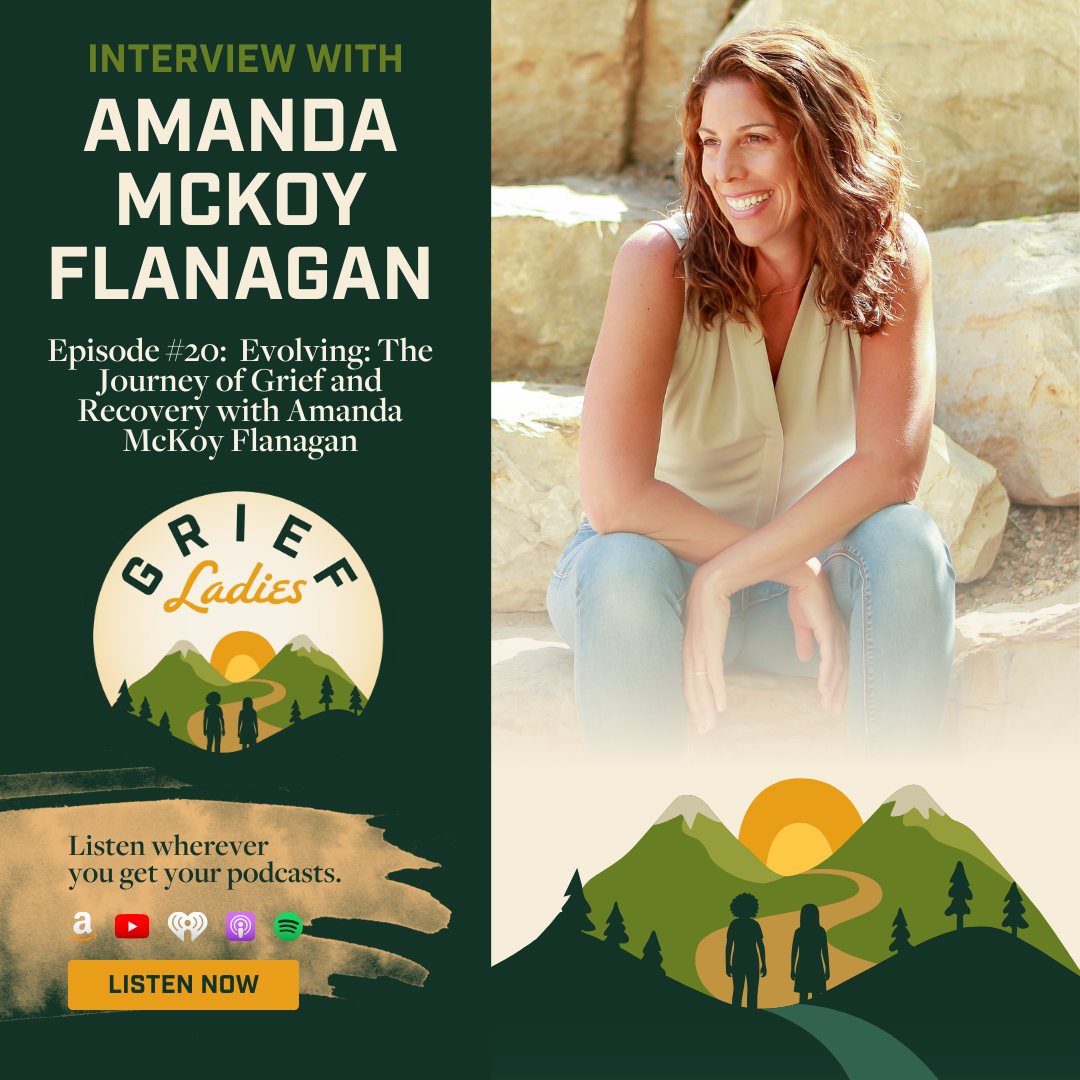
Evolving: The Journey of Grief and Recovery with Amanda McKoy Flanagan
Evolving with Amanda McKoy Flanagan
In this episode of the GRIEF Ladies podcast, Karyn Arnold and Kelly Daugherty engage with Amanda McKoy Flanagan, a certified intuitive loss and empowerment coach, to explore the complexities of grief and loss.
Amanda shares her personal journey through grief, including the impact of significant losses in her life and how she maintained her sobriety amidst these challenges.
The conversation delves into coping mechanisms, the importance of connection in recovery, and actionable steps for those navigating grief.
Amanda emphasizes the significance of celebrating the lives of loved ones and maintaining connections while also encouraging listeners to practice self-compassion and reach out to others
Listen here: https://open.spotify.com/episode/6IcWPY6BaHFCmFuatlRelE?si=64acefdeaa96451b