
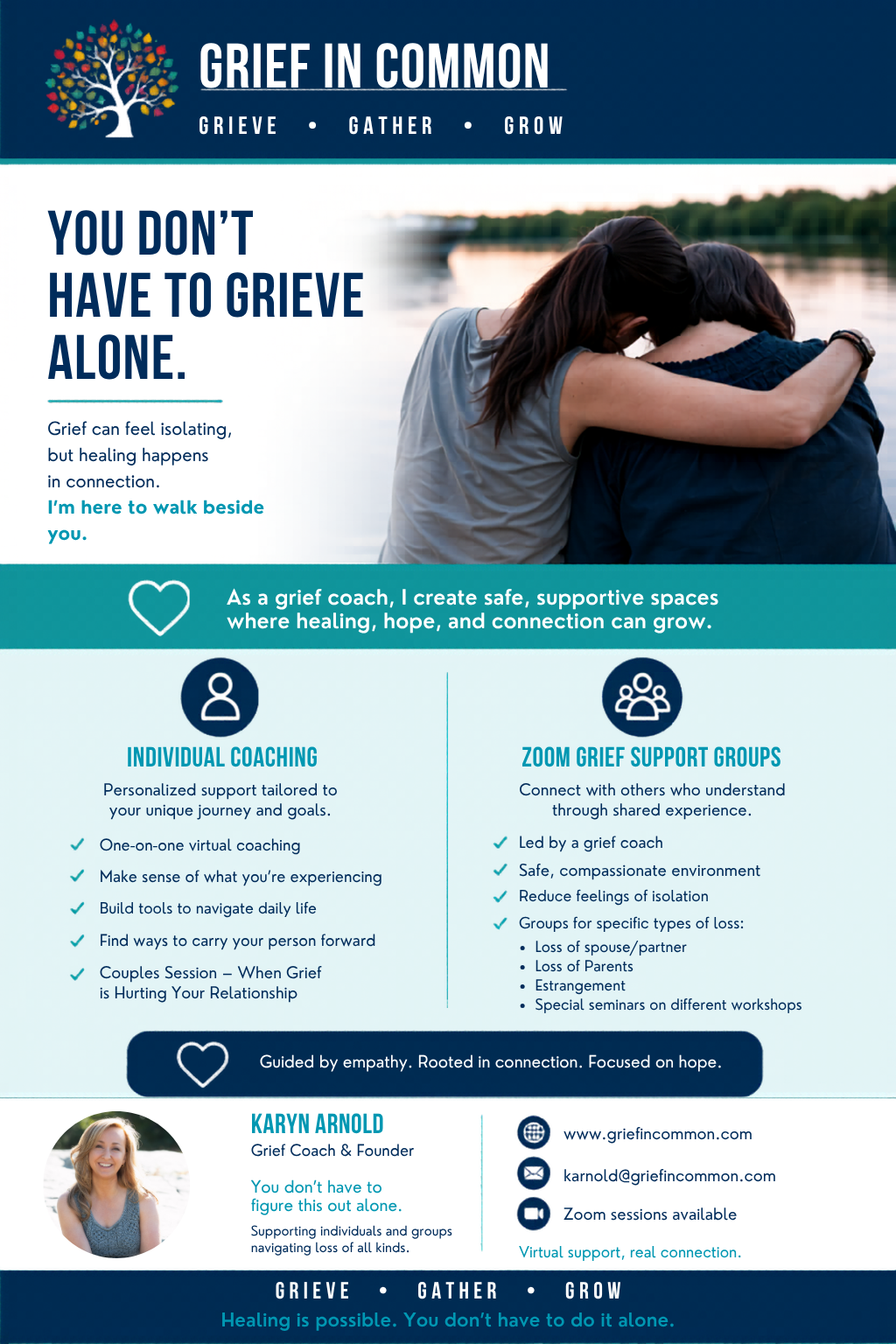
You Don't Have to Grieve Alone: How Grief Coaching Groups Can Help
Grief Coaching with Karyn Arnold of Grief in Common
After a loss, one of the hardest things isn't just the grief itself — it's the feeling that no one around you really gets it. Grief support groups exist for exactly that reason: to put you in a room (or a Zoom) with people who understand because they've been there too. Grief in Common, founded by grief coach Karyn Arnold, offers virtual group support designed around connection, compassion, and real conversation.
What Makes a Grief Support Group Different From Going It Alone?
Grief can shrink your world quickly. Friends may not know what to say. Family members are grieving too, often in different ways. A support group offers something most of us can't find elsewhere — people who don't need you to explain yourself, because they already understand. Research consistently shows that social support is one of the most significant factors in how people move through grief. A group gives you that support on a regular, structured basis.
A 2021 review published in Death Studies found that grief support group participation was associated with significant reductions in feelings of isolation and improvements in overall coping. For many, the group itself becomes a lifeline.
What Groups Does Grief in Common Offer?
Karyn's Zoom grief support groups are organized around specific types of loss, so you're not walking into a generic room — you're connecting with people who share your particular experience. Current groups include support for those who have experienced the death of a spouse or partner, the death of a parent, and estrangement. Special topic seminars are also available on a rotating basis. All groups are led by Karyn and held in a safe, compassionate virtual environment.
What If You're Not Ready for a Group?
Group support isn't the right fit for everyone — at least not right away. If you're looking for something more personal, Karyn also offers one-on-one virtual coaching sessions. Individual coaching is tailored to your unique experience and goals, and gives you dedicated space to make sense of what you're going through, build tools for navigating daily life, and find ways to carry your person forward. Couples sessions are also available for when grief is putting strain on a relationship. Whether you start with individual coaching and move into a group later, or do both at once, Karyn meets you where you are.
What Can You Expect in a Grief in Common Group?
These groups are coaching-based, not therapy — which means the focus is on connection, practical tools, and finding your footing going forward. Sessions are held via Zoom, so you can join from wherever you are. Whether you're newly bereaved or further along and still looking for community, there's space for you here.
Grief can feel isolating, but healing happens in connection."
— Karyn Arnold, Grief Coach & Founder, Grief in Common
Who Is Karyn Arnold?
Karyn Arnold is a grief coach and the founder of Grief in Common. She works with individuals and groups navigating loss of all kinds, guided by empathy, connection, and hope. Karyn is also the co-host of the GRIEF Ladies podcast, where she and I dig into what grief actually looks like — and what it means to keep living alongside it.
Visit Karyn’s website at www.griefincommon.com to sign up for one of her groups or individual coaching session.
Please note: Grief in Common offers coaching services, not therapy. If you are experiencing a mental health crisis or need clinical support, please reach out to a licensed mental health professional.

Feeling Stuck in Grief? You Are Not Alone — and Here Is Why It Happens
Feeling stuck in your grief?
Recently, Karyn and I were doing a live for our GRIEF Ladies Facebook Community and we were asked this question:
“My husband died five years ago, but I feel stuck and frozen. I understand that grief doesn’t have a timeline, but I can’t seem to make any progress with moving forward. I don’t care about much. I have no motivation or interest in things. I’ve tried therapists and a grief group, but nothing seemed to help.”
If any part of that resonates with you, please know: what you are experiencing is real, it is common, and there are reasons it happens. Here is a summary of how we answered this question.
Why Grief Can Feel Harder as Time Goes On
It might seem counterintuitive, but many people find that grief becomes more difficult — not easier — after the first year or two. Early grief, while devastating, often comes with what we describe as a kind of “novelty.” There is a lot happening: practical decisions to make, people around you, rituals to attend to. You are in motion, even if that motion is painful.
As time passes, the busyness fades. The people around you may have moved on. And suddenly you are left with a quieter, heavier question: “What now? Is this it?” That stillness can strip away motivation and leave you feeling like nothing will ever change.
There is also the issue of comparison. When we look at our current life in grief, we often measure it against the life we had before our loss. That is an incredibly painful comparison to make, and it can quietly fuel a sense of hopelessness.
Your Nervous System May Be Keeping You Stuck
The word “frozen” is significant. It is not just a metaphor — it can be a physiological response. When we experience profound loss, our nervous system responds. For many people, especially those who lost someone who was their primary source of safety and connection, the nervous system can get locked into what is called a dorsal vagal response: collapse, shutdown, and numbness.
This is your body trying to protect you. It is not a weakness. It is not a character flaw. It is an old, hard-wired survival mechanism. Understanding this distinction matters, because the path forward is not about pushing harder or willing yourself to feel better — it is about gently and incrementally helping your nervous system feel safe enough to re-engage with life.
Roadblock Emotions That Keep Us From Moving Forward
Being stuck is often not just about sadness. Beneath the surface, other emotions frequently act as roadblocks:
• Guilt — for feeling better, for moving forward, for moments of joy
• Anger — at the loss, at circumstances, at the unfairness of it all
• Fear — of the future, of forgetting your loved one, of who you are without them
• Identity loss — “Who am I now?” is one of the most disorienting aspects of grief
One pattern we see frequently, particularly among widows and widowers: a deep-seated fear of feeling better. Many grieving people tell us they feel guilty when they experience happiness, as though moving forward is a betrayal of their loved one. We want to name this clearly — it is not. Moving forward is not leaving your person behind. It is learning to carry them with you.
Not All Therapy and Grief Support Is the Same
If you have tried therapy or a grief group and felt it did not help, please do not take that as evidence that nothing can help you. Consider this: only about 60% of therapists received any education in grief and loss during their training. That means a significant number of well-meaning clinicians simply are not equipped to support grieving clients effectively.
Finding the right therapeutic support is a bit like finding the right bathing suit — the first one you try might not be the right fit, but that does not mean the right one is not out there. We would encourage you to seek out a grief-informed therapist or coach, someone who offers practical tools and not just a space to talk.
The same applies to grief groups. Peer-led groups offer real value, but a group facilitated by a grief-informed professional — one that is action-oriented and gives you tools and frameworks — can be a different experience entirely.
You Grow Around Your Grief — Not Past It
We want to offer one more reframe that we find genuinely helpful: you do not “get over” grief. Your grief does not disappear. What is possible — and what we have seen in our work again and again — is that you grow bigger than your grief. It is still there. But you expand around it.
That expansion happens through small, incremental steps. It happens through connection with others who understand. It happens through the right support, and through learning to move forward with your loved one — not without them.
A Note to Anyone Who Is Stuck Right Now
If you are reading this and recognizing yourself, we want you to hear this: you are not broken. You are not failing at grief. Your nervous system is doing what it was designed to do. Your emotions are real and valid. And the fact that you are still asking questions, still looking for support, still reaching out — that matters.
We wish none of us had to navigate this. But we do know that you do not have to navigate it alone. Join our GRIEF Ladies Community to hear more answers to our group members questions. Join here: https://www.facebook.com/share/g/1AdC4voMEG/