

What Should You Do When You're Grieving? 5 Experts Share One Action Step Each
5 Action Steps to Help You on Your Grief Journey
Grief can make it hard to know where to start. Each expert in this post is a guest from the GRIEF Ladies Podcast, and each one was asked a single question: what is one actionable step a grieving person can take right now? Their answers span every letter of the GRIEF Ladies framework — and together, they give you a place to begin.
G · Grounding: What can you do when grief is keeping you up at night?
Sleep is one of the first things grief disrupts — and one of the hardest to reclaim. Dr. Larissa Tate, a clinical psychologist specializing in sleep, anxiety, and trauma, shares that grief sleep disturbances are not a personal failing. They are a physiological response to loss, and there are evidence-based tools to address them.
Dr. Tate's action step: start with your sleep environment and your wind-down routine before reaching for medication. Small, consistent changes — what time you go to bed, how much light you're exposed to in the evening, what you do in the hour before sleep — can create meaningful shifts over time.
📊 Stat: Research shows that bereaved individuals are significantly more likely to experience insomnia than the general population, with some studies indicating rates as high as 40–50% among the newly bereaved. Sleep disruption can worsen emotional regulation, concentration, and physical health — making it one of the most important areas to address early in grief.
🎙️ Listen to the full episode with Dr. Larissa Tate on sleep and grief
R · Rebuilding: How do you support a child who is grieving?
Children grieve differently than adults, and they often need adults to help them rebuild a sense of safety and routine after a loss. Jennifer joined us to talk about what children actually need when someone they love has died — and what the adults around them can do to help.
Her action step: don't wait for a child to bring it up. Create space for the conversation by naming what happened directly and age-appropriately. Children take cues from the adults around them. When adults are willing to talk about death, children learn that their feelings are safe to share.
🎙️ Listen to the full episode with Jennifer on children and grief
I · Interacting: How does a funeral director help families communicate during grief?
Grief changes every relationship — and the days immediately following a death can bring out both the best and the most complicated parts of family dynamics. Brittany DeMarco-Furman, a fourth-generation licensed funeral director at Glenville Funeral Home, has guided hundreds of families through those first hours and days.
Her action step: have the conversation before you need to. Pre-planning a funeral — or even just talking openly about end-of-life wishes — is one of the most loving things a family can do for each other. It removes the burden of guessing during the hardest moments, and it opens a door for honest communication about what matters.
💬 Quote: "It's the last gift you can give your family." — Brittany DeMarco-Furman
🎙️ Listen to the full episode with Brittany DeMarco-Furman on family communication and grief
E · Evolving: What do you do when grief emotions feel impossible to sit with?
The emotions that show up in grief — anger, guilt, fear, regret — can feel like walls rather than doorways. Holly McNeill, known as The Mindfulness Architect, developed the P.E.R.L.O.V.E. Formula after her own experience of profound personal loss. Her work focuses on helping people understand how their minds function under stress so they can engage with pain more consciously.
Her action step: pause before you react to a difficult emotion. You don't have to fix the feeling or push it away — just notice it. Mindfulness isn't about becoming calm; it's about becoming curious. That small shift from reaction to observation can change your entire relationship to the emotion.
📊 Stat: Studies on mindfulness-based interventions for grief have found reductions in grief-related rumination and increases in psychological flexibility among bereaved participants. The ability to observe emotions without being consumed by them is a trainable skill — not a personality trait.
🎙️ Listen to the full episode with Holly McNeill on mindfulness and grief
F · Finding: How do you grieve a pet when no one around you understands?
Pet loss is one of the most common forms of disenfranchised grief — grief that isn't fully recognized or validated by others. Adam Greenbaum created Love Baxter, the world's largest pet end-of-life resource, after the death of his Boston Terrier, Baxter, in October 2024. His episode is a reminder that the grief you feel for an animal is not small, and you don't have to explain it to anyone.
His action step: find your people. Seek out communities — online or in person — where pet loss is taken seriously and your grief is welcome. Isolation makes grief harder. Connection, even with strangers who understand, makes it more bearable.
🎙️ Listen to the full episode with Adam Greenbaum on pet loss and finding connection
One framework. Five action steps. A place to begin.
The GRIEF Ladies framework — Grounding, Rebuilding, Interacting, Evolving, and Finding — was built on the understanding that grief touches every part of life. There is no single right place to start. But there is always somewhere. The five guests in this post each offer one small, real step you can take in the area of grief that feels most pressing for you right now.
we
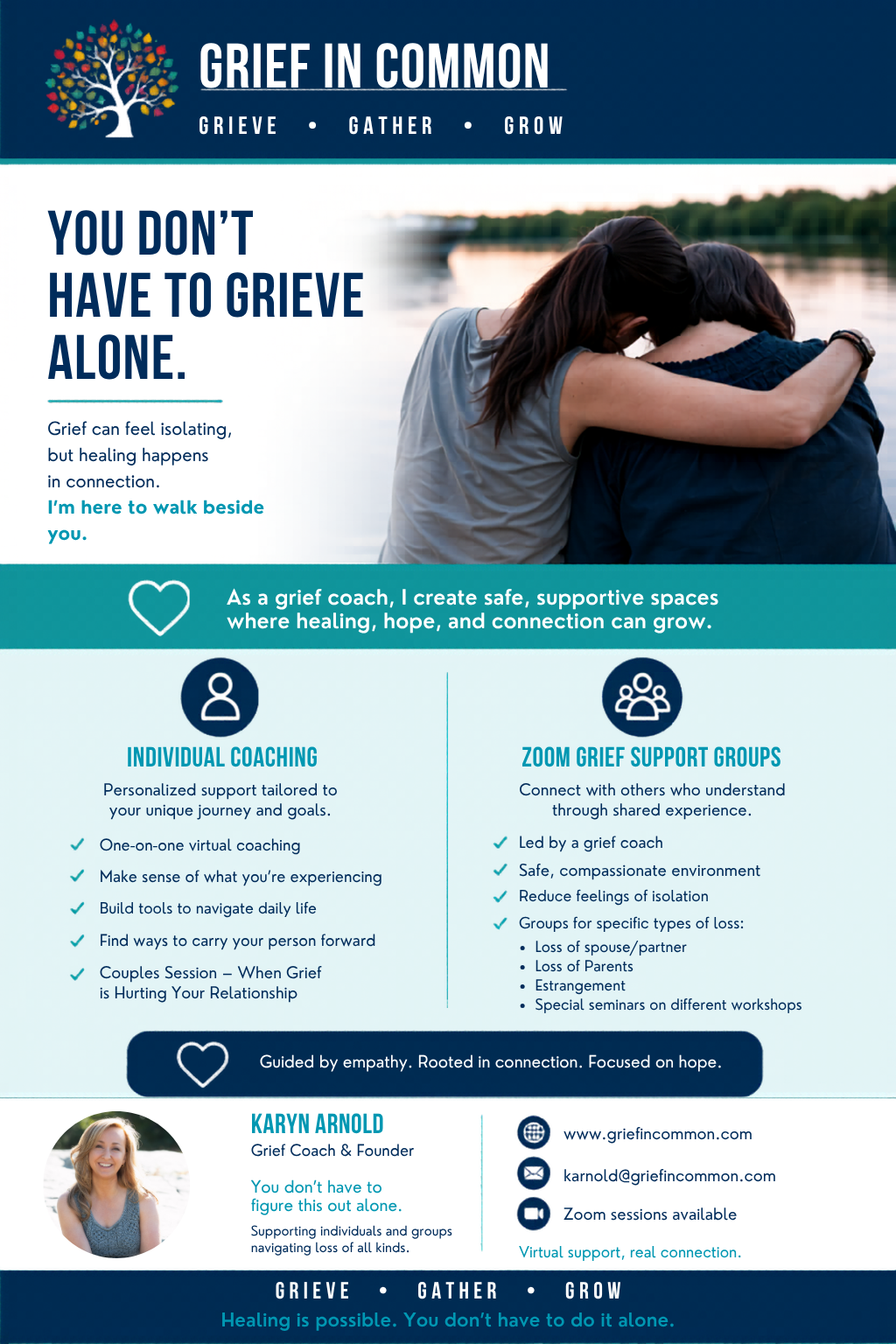
You Don't Have to Grieve Alone: How Grief Coaching Groups Can Help
Grief Coaching with Karyn Arnold of Grief in Common
After a loss, one of the hardest things isn't just the grief itself — it's the feeling that no one around you really gets it. Grief support groups exist for exactly that reason: to put you in a room (or a Zoom) with people who understand because they've been there too. Grief in Common, founded by grief coach Karyn Arnold, offers virtual group support designed around connection, compassion, and real conversation.
What Makes a Grief Support Group Different From Going It Alone?
Grief can shrink your world quickly. Friends may not know what to say. Family members are grieving too, often in different ways. A support group offers something most of us can't find elsewhere — people who don't need you to explain yourself, because they already understand. Research consistently shows that social support is one of the most significant factors in how people move through grief. A group gives you that support on a regular, structured basis.
A 2021 review published in Death Studies found that grief support group participation was associated with significant reductions in feelings of isolation and improvements in overall coping. For many, the group itself becomes a lifeline.
What Groups Does Grief in Common Offer?
Karyn's Zoom grief support groups are organized around specific types of loss, so you're not walking into a generic room — you're connecting with people who share your particular experience. Current groups include support for those who have experienced the death of a spouse or partner, the death of a parent, and estrangement. Special topic seminars are also available on a rotating basis. All groups are led by Karyn and held in a safe, compassionate virtual environment.
What If You're Not Ready for a Group?
Group support isn't the right fit for everyone — at least not right away. If you're looking for something more personal, Karyn also offers one-on-one virtual coaching sessions. Individual coaching is tailored to your unique experience and goals, and gives you dedicated space to make sense of what you're going through, build tools for navigating daily life, and find ways to carry your person forward. Couples sessions are also available for when grief is putting strain on a relationship. Whether you start with individual coaching and move into a group later, or do both at once, Karyn meets you where you are.
What Can You Expect in a Grief in Common Group?
These groups are coaching-based, not therapy — which means the focus is on connection, practical tools, and finding your footing going forward. Sessions are held via Zoom, so you can join from wherever you are. Whether you're newly bereaved or further along and still looking for community, there's space for you here.
Grief can feel isolating, but healing happens in connection."
— Karyn Arnold, Grief Coach & Founder, Grief in Common
Who Is Karyn Arnold?
Karyn Arnold is a grief coach and the founder of Grief in Common. She works with individuals and groups navigating loss of all kinds, guided by empathy, connection, and hope. Karyn is also the co-host of the GRIEF Ladies podcast, where she and I dig into what grief actually looks like — and what it means to keep living alongside it.
Visit Karyn’s website at www.griefincommon.com to sign up for one of her groups or individual coaching session.
Please note: Grief in Common offers coaching services, not therapy. If you are experiencing a mental health crisis or need clinical support, please reach out to a licensed mental health professional.