

Feeling Stuck in Grief? You Are Not Alone — and Here Is Why It Happens
Feeling stuck in your grief?
Recently, Karyn and I were doing a live for our GRIEF Ladies Facebook Community and we were asked this question:
“My husband died five years ago, but I feel stuck and frozen. I understand that grief doesn’t have a timeline, but I can’t seem to make any progress with moving forward. I don’t care about much. I have no motivation or interest in things. I’ve tried therapists and a grief group, but nothing seemed to help.”
If any part of that resonates with you, please know: what you are experiencing is real, it is common, and there are reasons it happens. Here is a summary of how we answered this question.
Why Grief Can Feel Harder as Time Goes On
It might seem counterintuitive, but many people find that grief becomes more difficult — not easier — after the first year or two. Early grief, while devastating, often comes with what we describe as a kind of “novelty.” There is a lot happening: practical decisions to make, people around you, rituals to attend to. You are in motion, even if that motion is painful.
As time passes, the busyness fades. The people around you may have moved on. And suddenly you are left with a quieter, heavier question: “What now? Is this it?” That stillness can strip away motivation and leave you feeling like nothing will ever change.
There is also the issue of comparison. When we look at our current life in grief, we often measure it against the life we had before our loss. That is an incredibly painful comparison to make, and it can quietly fuel a sense of hopelessness.
Your Nervous System May Be Keeping You Stuck
The word “frozen” is significant. It is not just a metaphor — it can be a physiological response. When we experience profound loss, our nervous system responds. For many people, especially those who lost someone who was their primary source of safety and connection, the nervous system can get locked into what is called a dorsal vagal response: collapse, shutdown, and numbness.
This is your body trying to protect you. It is not a weakness. It is not a character flaw. It is an old, hard-wired survival mechanism. Understanding this distinction matters, because the path forward is not about pushing harder or willing yourself to feel better — it is about gently and incrementally helping your nervous system feel safe enough to re-engage with life.
Roadblock Emotions That Keep Us From Moving Forward
Being stuck is often not just about sadness. Beneath the surface, other emotions frequently act as roadblocks:
• Guilt — for feeling better, for moving forward, for moments of joy
• Anger — at the loss, at circumstances, at the unfairness of it all
• Fear — of the future, of forgetting your loved one, of who you are without them
• Identity loss — “Who am I now?” is one of the most disorienting aspects of grief
One pattern we see frequently, particularly among widows and widowers: a deep-seated fear of feeling better. Many grieving people tell us they feel guilty when they experience happiness, as though moving forward is a betrayal of their loved one. We want to name this clearly — it is not. Moving forward is not leaving your person behind. It is learning to carry them with you.
Not All Therapy and Grief Support Is the Same
If you have tried therapy or a grief group and felt it did not help, please do not take that as evidence that nothing can help you. Consider this: only about 60% of therapists received any education in grief and loss during their training. That means a significant number of well-meaning clinicians simply are not equipped to support grieving clients effectively.
Finding the right therapeutic support is a bit like finding the right bathing suit — the first one you try might not be the right fit, but that does not mean the right one is not out there. We would encourage you to seek out a grief-informed therapist or coach, someone who offers practical tools and not just a space to talk.
The same applies to grief groups. Peer-led groups offer real value, but a group facilitated by a grief-informed professional — one that is action-oriented and gives you tools and frameworks — can be a different experience entirely.
You Grow Around Your Grief — Not Past It
We want to offer one more reframe that we find genuinely helpful: you do not “get over” grief. Your grief does not disappear. What is possible — and what we have seen in our work again and again — is that you grow bigger than your grief. It is still there. But you expand around it.
That expansion happens through small, incremental steps. It happens through connection with others who understand. It happens through the right support, and through learning to move forward with your loved one — not without them.
A Note to Anyone Who Is Stuck Right Now
If you are reading this and recognizing yourself, we want you to hear this: you are not broken. You are not failing at grief. Your nervous system is doing what it was designed to do. Your emotions are real and valid. And the fact that you are still asking questions, still looking for support, still reaching out — that matters.
We wish none of us had to navigate this. But we do know that you do not have to navigate it alone. Join our GRIEF Ladies Community to hear more answers to our group members questions. Join here: https://www.facebook.com/share/g/1AdC4voMEG/

Grieving in the Second Year After a Loss
Grieving in the Second Year After a Loss
There is a pretty well-accepted theory on grieving that the first year is the hardest. The loss is so new, the first months can be spent in a blur of shock and disbelief.
This can be especially true for a sudden loss, but can surprise people when they are in “shock” even after a loved one has died following a long and drawn out illness.
I’ve said it many times: nothing, and I mean NOTHING, can prepare us for the finality of death.
Navigating that first year, through anniversaries, birthdays and holidays can feel endless. But the assumption for most is that as long as they can get through that, it should be smoother sailing in the days ahead.
And then year 2 happens.
The second Mother’s Day without a mom. The second wedding anniversary without a spouse. A second Christmas without a child. And the griever may find themselves thinking, “this isn’t any easier”.
Some people have told me that the second year was actually more of a challenge. Perhaps because of expectation – expecting to feel better and then feeling even more disappointed and sad when they didn’t. Or maybe it’s because the more time passes, the longer we’ve had to live without that person. The longer it’s been since we’ve seen them or heard their voice.
This is a terrifying thought for the newly bereaved, to think that it’s not going to be a steady climb upwards in grieving and healing, and I don’t share this to scare those who are in their very early days.
But expectations are a big part of our mindset, even when we’re not in the stages of grief. How much more do we enjoy the movie or party that we thought was going to be terrible? How disappointed are we when a long planned vacation-of-a-lifetime turns out to be not all what we would have hoped?
If ever there was a time when we need to be setting realistic expectations for ourselves, then certainly our time of grieving is one of them.
Throw away the timelines.
Don’t compare yourself with those whom you know have had a loss. The coworker who was back to work smiling only a few days after her Dad died? She was crying every day on the way to and from work. The family member who thinks that 18 months after your husband died you should be dating again? She has no idea what this loss feels like, what your love felt like, or what is right for you.
Be patient with yourself. Be patient with those who don’t understand. Don’t expect today to be hard and tomorrow to be easy. Honor wherever you are right in this moment and know that even if it feels uncomfortable, unsettling and uneasy, that it’s probably exactly where you need to be.
Stay open to the idea of hope and optimism – but don’t set a timeline for its arrival.
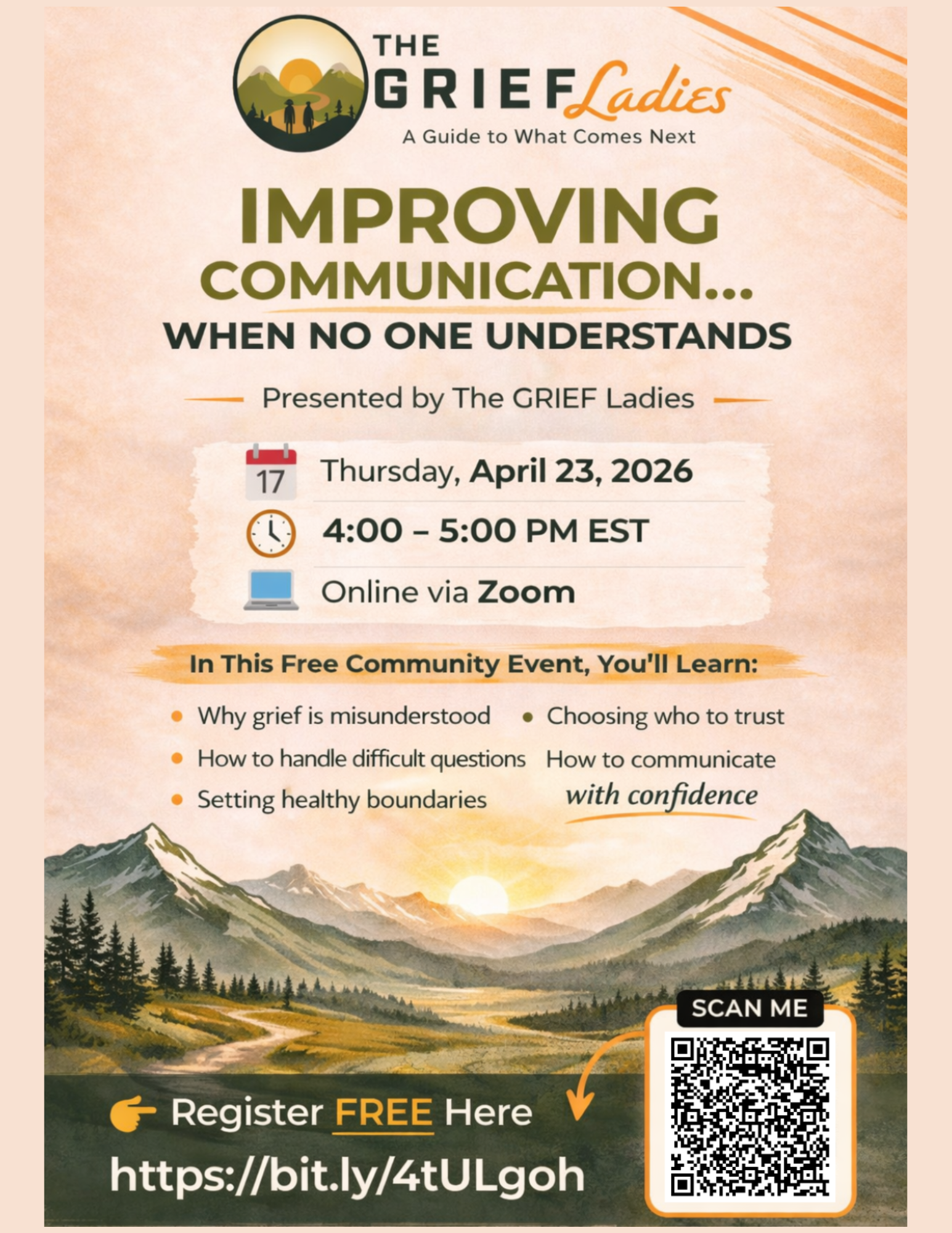
Improving Communication When No One Understands...
Improving Communication when Grieving
A Free Online Workshop from the GRIEF Ladies
You have people in your life who love you. And somehow, you still feel completely alone in your grief.
They say the wrong things. They move on too quickly. They ask how you are doing, and you say "I'm fine" — because what else are you supposed to say? Because explaining it feels exhausting. Because you're not sure they can really handle the honest answer.
If any of this sounds familiar, we want you to know: this is one of the most common and most painful parts of grief. And it is exactly what Kelly Daugherty and Karyn Arnold are tackling in their upcoming free workshop.
What This Workshop Is About
On Wednesday, April 23rd, from 4 to 5 PM EST, the GRIEF Ladies are hosting a free one-hour online event focused on one of the most frustrating parts of loss: communicating with the people around you when they just don't get it.
They will help you understand why the people who care about you still manage to say all the wrong things — and more importantly, what you can actually do about it.
What You Will Walk Away With
In just one hour, you will gain practical tools to help you:
Understand why grief makes communication so hard — and why that is not your fault
Know what to say (and what not to say) in the conversations that feel impossible
Figure out who is actually safe to confide in — and how to protect your energy with everyone else
Navigate the comments that sting, even when they come from a good place
Move forward in relationships that have felt strained or disconnected since your loss
You will leave with real tools you can use immediately — no matter how recent or long your grief has been.
Who This Is For
This event is open to anyone grieving any type of loss — a partner, parent, child, sibling, friend, or any meaningful relationship. Whether your grief is fresh or has been with you for years, this session is for you if you have ever thought:
"Why doesn't anyone understand what this is like?"
"I don't have the energy to explain myself anymore."
"I wish I knew what to say — or what not to say."
About the GRIEF Ladies
Karyn Arnold and Kelly Daugherty are the founders and facilitators of the GRIEF Ladies, and between them they have spent over 50 years walking alongside thousands of grieving individuals. Their approach is practical, direct, and built around one core belief: that grief is not something you just have to sit with. Actionable steps make all the difference.
Their GRIEF Framework — Grounding, Rebuilding, Interacting, Evolving, and Finding — is the guide they use to help people move from grieving with pain to grieving with love, while staying connected to the people they have lost.
This workshop focuses on the I: Interacting — because how we communicate after loss matters more than most people realize.
Event Details
Date: Wednesday, April 23, 2025
Time: 4:00 – 5:00 PM EST
Cost: Free
Register: https://app.acuityscheduling.com/schedule/85af7470/appointment/89553879/calendar/2617012
Reserve Your Free Spot
Space is limited. Register now to receive your link to join.
https://app.acuityscheduling.com/schedule/85af7470/appointment/89553879/calendar/2617012
Questions? Reach us at griefladies@gmail.com
More resources at www.griefladies.com

How to Honor and Celebrate a Loved One After Death: 5 Real Grief Stories
How to Honor and Celebrate a Loved One After Death: 5 Real Grief Stories
Grief often pulls our focus to the death, what happened, what was lost, and what we are missing.
But many grieving people wonder:
How can I stay connected to my loved one? I don't want to forget them- what should I do?
How do I honor my loved one?
How do I remember them in a way that feels meaningful?
How do I celebrate their life without ignoring the pain?
In this special video from The GRIEF Ladies Podcast, five of our first guests share how they honor and celebrate their loved one’s life after death. Through personal rituals, traditions, everyday habits, and small acts of remembrance, they show that grief can hold both sorrow and love.
At The GRIEF Ladies, we believe grief isn’t about “moving on.” It’s about learning how to carry love forward. We call this Celebrate Their Life, a gentle shift from focusing only on the loss to remembering what remains: the connection, the memories, and the impact that endures. If you are grieving and looking for ideas, comfort, or inspiration for honoring someone who died, this video offers real stories and compassionate support. You are not alone in your grief.
Watch the video at: https://youtu.be/C_f_Ub3DOqE
5 Actionable Steps to Cope With Grief (The GRIEF Ladies Framework)
5 Tools to Help you Cope with your Grief
Grief changes everything—but you don’t have to feel stuck or powerless.
In this video, The GRIEF Ladies share 5 actionable steps you can take after loss, based on our GRIEF framework:
Grounding • Rebuilding • Interacting • Evolving • Finding
This compilation features insights from five powerful guest conversations on the GRIEF Ladies Podcast, offering practical tools to help you:
Feel more grounded when grief feels overwhelming
Rebuild routines and structure after loss
Navigate relationships and communication while grieving
Work through difficult emotions like guilt, anger, and fear
Stay connected to your loved one while discovering who you are now
Whether you’re newly bereaved or living with ongoing grief, these steps are designed to help you feel better now—without letting go of love or connection.
✨ Grief is not something to “get over.”
✨ You’re allowed to want relief and connection.
✨ Small actions can create meaningful change.
To watch the video of these 5 tools to help you on your grief journey visit: https://youtu.be/EqLGul_LcFs

Why am I still grieving so intensely months/years later?
Why am I still grieving so intensely months/years later?
Many people quietly wonder:
Why does this still hurt so much?
Shouldn’t I be feeling better by now?
Is something wrong with me?
Why am I still grieving years later?
There’s a lot of pressure in our culture to “be okay” after a certain amount of time. But grief doesn’t follow a calendar or timeline. Grief is not something you get over. It’s something you learn to live with.
Intensity Doesn’t Always Mean Something Is Wrong
Even months or years later, grief can feel intense. Grief waves can still show up unexpectedly. Certain dates, memories, or life events can bring everything back to the surface. This just means your loss mattered.
Grief can feel especially intense or long-lasting when:
The death was sudden or traumatic
There were complicated relationship dynamics
You didn’t get closure
You were very closely connected
The loss significantly changed your daily life or your identity
When a death was traumatic, some people don’t just miss the person, they relive aspects of how the death happened. They may experience intrusive memories, mental images, or a sense of being pulled back into the moment they found out. That kind of grief can feel more challenging and difficult to move forward with.
Over time, many people find that grief shifts. It may not dominate every hour of the day. But it doesn’t vanish.
You might function well most days and still have moments when it feels raw. You might laugh more and still miss them deeply. You may build a full life and still carry the absence.
Both things can be true.
Growing around grief doesn’t mean it’s gone. It means your life has expanded enough to hold it.
When to Consider Additional Support:
There is no “correct” timeline. But it may be helpful to seek professional support if:
The intensity feels constant with little relief
You are frequently reliving the death itself
Intrusive memories or images feel overwhelming
You feel stuck in guilt, anger, or despair
You are unable to function in daily life
You feel hopeless or unsafe
Seeking support is not about labeling your grief. It’s about helping you carry it in a way that feels more manageable. Check out Grief in Common with Karyn Arnold for additional resources, including grief groups or grief coaching.