
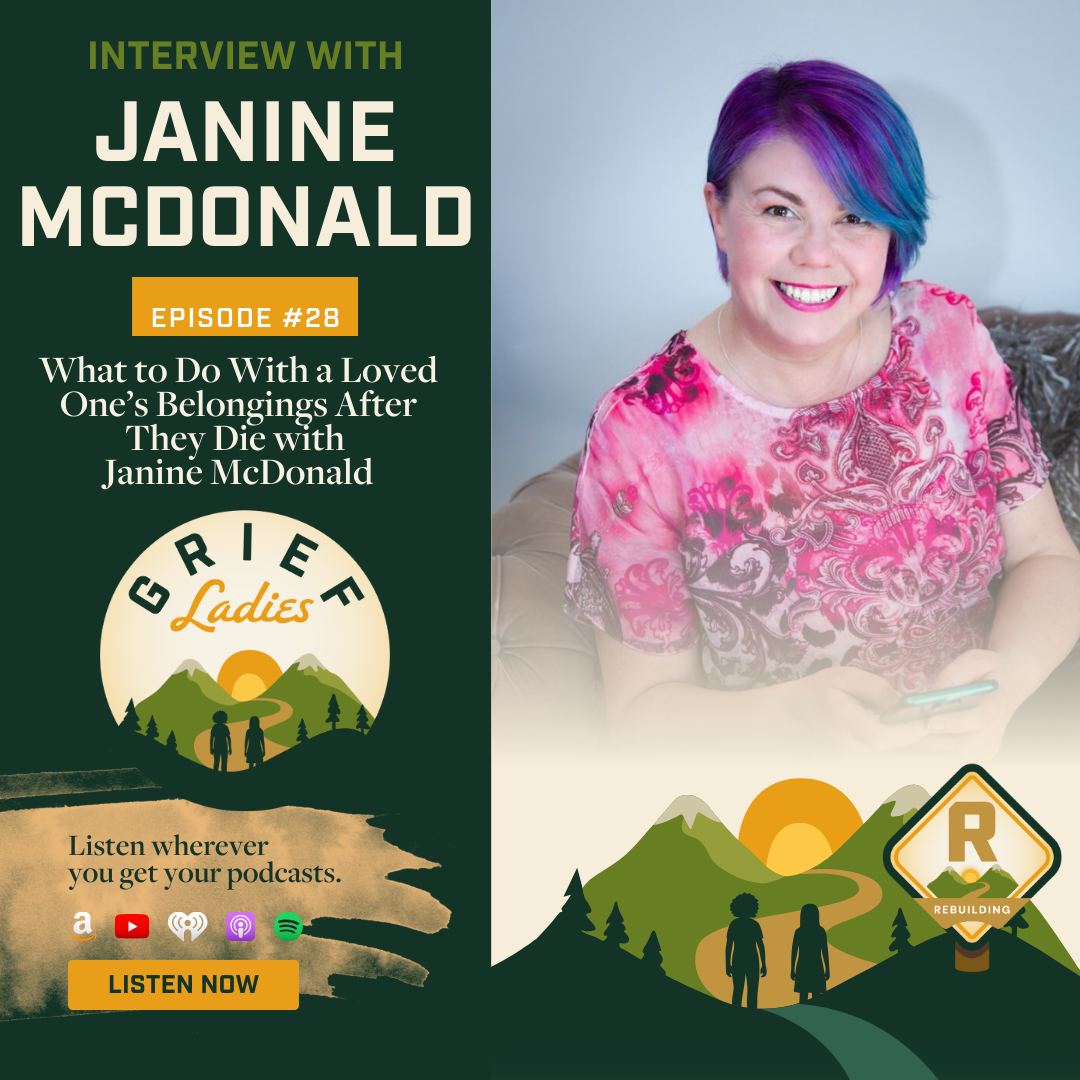
What Do You Do With a Loved One's Belongings After They Die?
What to do with a loved one’s belongings when they die?
Sorting through a loved one's belongings after they die is one of the hardest parts of grief — and one of the least talked about. The short answer: start with the stories behind the things, not the things themselves, and give yourself permission to go at whatever pace you need. In this episode of the GRIEF Ladies Podcast, Kelly and Karyn sit down with decluttering specialist Janine McDonald to explore the emotional and practical realities of going through someone's stuff.
Why Is This So Much Harder Than It Sounds?
It's rarely the furniture that stops people in their tracks. More often it's the small things — a pillbox, a well-worn hat, something that seems insignificant to everyone else but holds an entire relationship inside it. Janine explains that objects carry stories, and those stories are what make this process so emotionally complex. Her approach isn't about tidying up — it's about understanding what something meant before deciding what to do with it.
Research from the American Psychological Association identifies decision-making as one of the most cognitively taxing tasks during bereavement, as grief significantly affects attention, memory, and executive function — which helps explain why even small choices about belongings can feel impossible.
How Do You Move Forward Without Feeling Like You're Letting Go of the Person?
This is where the episode gets really good. Janine shares specific, compassionate strategies for when you want to keep everything, when family members disagree, when there's no sentimental meaning but releasing something still feels wrong, and how to repurpose items that can't be used the way they were intended. She also offers one practical gut-check question that Karyn said she'll be thinking about for a long time.
The through-line of everything Janine shares: the memories live in you, not in the objects.
Listen to the full episode (https://youtu.be/9OXwDgETf6E?si=Ky5BkdP1RfvObfWI) to hear Janine's step-by-step approach, her real client stories, and her advice for anyone who feels completely stuck on where to even begin.
What Actually Helps: 5 Practical Grief Coping Tools from Real People
What Actually Helps: 5 Practical Grief Coping Tools from Real People
Nobody hands you a manual when someone dies.
You're just supposed to figure it out. And most of the advice out there?
It's vague, it's generic, and honestly — it doesn't help.
That's why I love asking our GRIEF Ladies guests to share one practical
coping tool that has actually made a difference in their grief journey.
Not theory. Not platitudes. Just real, actionable steps from real people
who are living it.
5 Guests. 5 Real Coping Tools.
I pulled the actionable steps from five recent episodes and put them
together in one video — because sometimes you just need something
concrete to try.
💛 Featured guests:
- Kelly Myerson (Ep. 22)
- Kat Farace (Ep. 23)
- Charlotte Shuber (Ep. 24)
- Cori Myka (Ep. 25)
- April Hannah (Ep. 26)
Watch it here: https://youtu.be/qpig6OP0Uvk
Your Turn
After you watch, comment on the video. What is one coping tool that has helped you in your grief? Drop it in the comments — your answer
might be exactly what someone else in this community needs today.
And if you want to hear the full story behind each coping tool, the complete episodes are linked below.
🎙️ Full Episodes:
Watch the full episodes:
Link to Ep. 22: https://youtu.be/Oj5HF0xuHhU?si=MU5oBHHuILkhZt6
Link to Ep. 23: https://youtu.be/xRevq_ZcDYo?si=9Pl3DTUQXpJa20Ww
Link to Ep. 24: https://youtu.be/5OEe88S1Sk4?si=ZhPOnLbf6OJr0BXN
Link to Ep. 25: https://youtu.be/aiLqrtJuFI8?si=PuS0JThk4BY43s1m
Link to Ep. 26: https://youtu.be/bTayMPCvKYY?si=gMWPaAyvhobg_VJH
You're not alone in this. And you don't have to figure it out by yourself. Join the Facebook Community: https://www.facebook.com/share/g/1Ak2yus1cW/

Feeling Stuck in Grief? You Are Not Alone — and Here Is Why It Happens
Feeling stuck in your grief?
Recently, Karyn and I were doing a live for our GRIEF Ladies Facebook Community and we were asked this question:
“My husband died five years ago, but I feel stuck and frozen. I understand that grief doesn’t have a timeline, but I can’t seem to make any progress with moving forward. I don’t care about much. I have no motivation or interest in things. I’ve tried therapists and a grief group, but nothing seemed to help.”
If any part of that resonates with you, please know: what you are experiencing is real, it is common, and there are reasons it happens. Here is a summary of how we answered this question.
Why Grief Can Feel Harder as Time Goes On
It might seem counterintuitive, but many people find that grief becomes more difficult — not easier — after the first year or two. Early grief, while devastating, often comes with what we describe as a kind of “novelty.” There is a lot happening: practical decisions to make, people around you, rituals to attend to. You are in motion, even if that motion is painful.
As time passes, the busyness fades. The people around you may have moved on. And suddenly you are left with a quieter, heavier question: “What now? Is this it?” That stillness can strip away motivation and leave you feeling like nothing will ever change.
There is also the issue of comparison. When we look at our current life in grief, we often measure it against the life we had before our loss. That is an incredibly painful comparison to make, and it can quietly fuel a sense of hopelessness.
Your Nervous System May Be Keeping You Stuck
The word “frozen” is significant. It is not just a metaphor — it can be a physiological response. When we experience profound loss, our nervous system responds. For many people, especially those who lost someone who was their primary source of safety and connection, the nervous system can get locked into what is called a dorsal vagal response: collapse, shutdown, and numbness.
This is your body trying to protect you. It is not a weakness. It is not a character flaw. It is an old, hard-wired survival mechanism. Understanding this distinction matters, because the path forward is not about pushing harder or willing yourself to feel better — it is about gently and incrementally helping your nervous system feel safe enough to re-engage with life.
Roadblock Emotions That Keep Us From Moving Forward
Being stuck is often not just about sadness. Beneath the surface, other emotions frequently act as roadblocks:
• Guilt — for feeling better, for moving forward, for moments of joy
• Anger — at the loss, at circumstances, at the unfairness of it all
• Fear — of the future, of forgetting your loved one, of who you are without them
• Identity loss — “Who am I now?” is one of the most disorienting aspects of grief
One pattern we see frequently, particularly among widows and widowers: a deep-seated fear of feeling better. Many grieving people tell us they feel guilty when they experience happiness, as though moving forward is a betrayal of their loved one. We want to name this clearly — it is not. Moving forward is not leaving your person behind. It is learning to carry them with you.
Not All Therapy and Grief Support Is the Same
If you have tried therapy or a grief group and felt it did not help, please do not take that as evidence that nothing can help you. Consider this: only about 60% of therapists received any education in grief and loss during their training. That means a significant number of well-meaning clinicians simply are not equipped to support grieving clients effectively.
Finding the right therapeutic support is a bit like finding the right bathing suit — the first one you try might not be the right fit, but that does not mean the right one is not out there. We would encourage you to seek out a grief-informed therapist or coach, someone who offers practical tools and not just a space to talk.
The same applies to grief groups. Peer-led groups offer real value, but a group facilitated by a grief-informed professional — one that is action-oriented and gives you tools and frameworks — can be a different experience entirely.
You Grow Around Your Grief — Not Past It
We want to offer one more reframe that we find genuinely helpful: you do not “get over” grief. Your grief does not disappear. What is possible — and what we have seen in our work again and again — is that you grow bigger than your grief. It is still there. But you expand around it.
That expansion happens through small, incremental steps. It happens through connection with others who understand. It happens through the right support, and through learning to move forward with your loved one — not without them.
A Note to Anyone Who Is Stuck Right Now
If you are reading this and recognizing yourself, we want you to hear this: you are not broken. You are not failing at grief. Your nervous system is doing what it was designed to do. Your emotions are real and valid. And the fact that you are still asking questions, still looking for support, still reaching out — that matters.
We wish none of us had to navigate this. But we do know that you do not have to navigate it alone. Join our GRIEF Ladies Community to hear more answers to our group members questions. Join here: https://www.facebook.com/share/g/1AdC4voMEG/
How to Honor and Celebrate a Loved One After Death: 5 Real Grief Stories
How to Honor and Celebrate a Loved One After Death: 5 Real Grief Stories
Grief often pulls our focus to the death, what happened, what was lost, and what we are missing.
But many grieving people wonder:
How can I stay connected to my loved one? I don't want to forget them- what should I do?
How do I honor my loved one?
How do I remember them in a way that feels meaningful?
How do I celebrate their life without ignoring the pain?
In this special video from The GRIEF Ladies Podcast, five of our first guests share how they honor and celebrate their loved one’s life after death. Through personal rituals, traditions, everyday habits, and small acts of remembrance, they show that grief can hold both sorrow and love.
At The GRIEF Ladies, we believe grief isn’t about “moving on.” It’s about learning how to carry love forward. We call this Celebrate Their Life, a gentle shift from focusing only on the loss to remembering what remains: the connection, the memories, and the impact that endures. If you are grieving and looking for ideas, comfort, or inspiration for honoring someone who died, this video offers real stories and compassionate support. You are not alone in your grief.
Watch the video at: https://youtu.be/C_f_Ub3DOqE