
What Actually Helps: 5 Practical Grief Coping Tools from Real People
What Actually Helps: 5 Practical Grief Coping Tools from Real People
Nobody hands you a manual when someone dies.
You're just supposed to figure it out. And most of the advice out there?
It's vague, it's generic, and honestly — it doesn't help.
That's why I love asking our GRIEF Ladies guests to share one practical
coping tool that has actually made a difference in their grief journey.
Not theory. Not platitudes. Just real, actionable steps from real people
who are living it.
5 Guests. 5 Real Coping Tools.
I pulled the actionable steps from five recent episodes and put them
together in one video — because sometimes you just need something
concrete to try.
💛 Featured guests:
- Kelly Myerson (Ep. 22)
- Kat Farace (Ep. 23)
- Charlotte Shuber (Ep. 24)
- Cori Myka (Ep. 25)
- April Hannah (Ep. 26)
Watch it here: https://youtu.be/qpig6OP0Uvk
Your Turn
After you watch, comment on the video. What is one coping tool that has helped you in your grief? Drop it in the comments — your answer
might be exactly what someone else in this community needs today.
And if you want to hear the full story behind each coping tool, the complete episodes are linked below.
🎙️ Full Episodes:
Watch the full episodes:
Link to Ep. 22: https://youtu.be/Oj5HF0xuHhU?si=MU5oBHHuILkhZt6
Link to Ep. 23: https://youtu.be/xRevq_ZcDYo?si=9Pl3DTUQXpJa20Ww
Link to Ep. 24: https://youtu.be/5OEe88S1Sk4?si=ZhPOnLbf6OJr0BXN
Link to Ep. 25: https://youtu.be/aiLqrtJuFI8?si=PuS0JThk4BY43s1m
Link to Ep. 26: https://youtu.be/bTayMPCvKYY?si=gMWPaAyvhobg_VJH
You're not alone in this. And you don't have to figure it out by yourself. Join the Facebook Community: https://www.facebook.com/share/g/1Ak2yus1cW/
When the Person Who Helped You Feel Safe Dies
When the Person Who Helped You Feel Safe Dies
Grief is often described as heartbreak, sadness, or longing. But for many grieving individuals, one of the most confusing and distressing experiences is feeling emotionally unsafe after a loss.
People often say things like:
“I don’t feel like myself anymore. I don’t even know who I am.”
“Everything feels harder than it used to.”
“I don’t know how to calm myself down.”
“I feel anxious or numb all the time.”
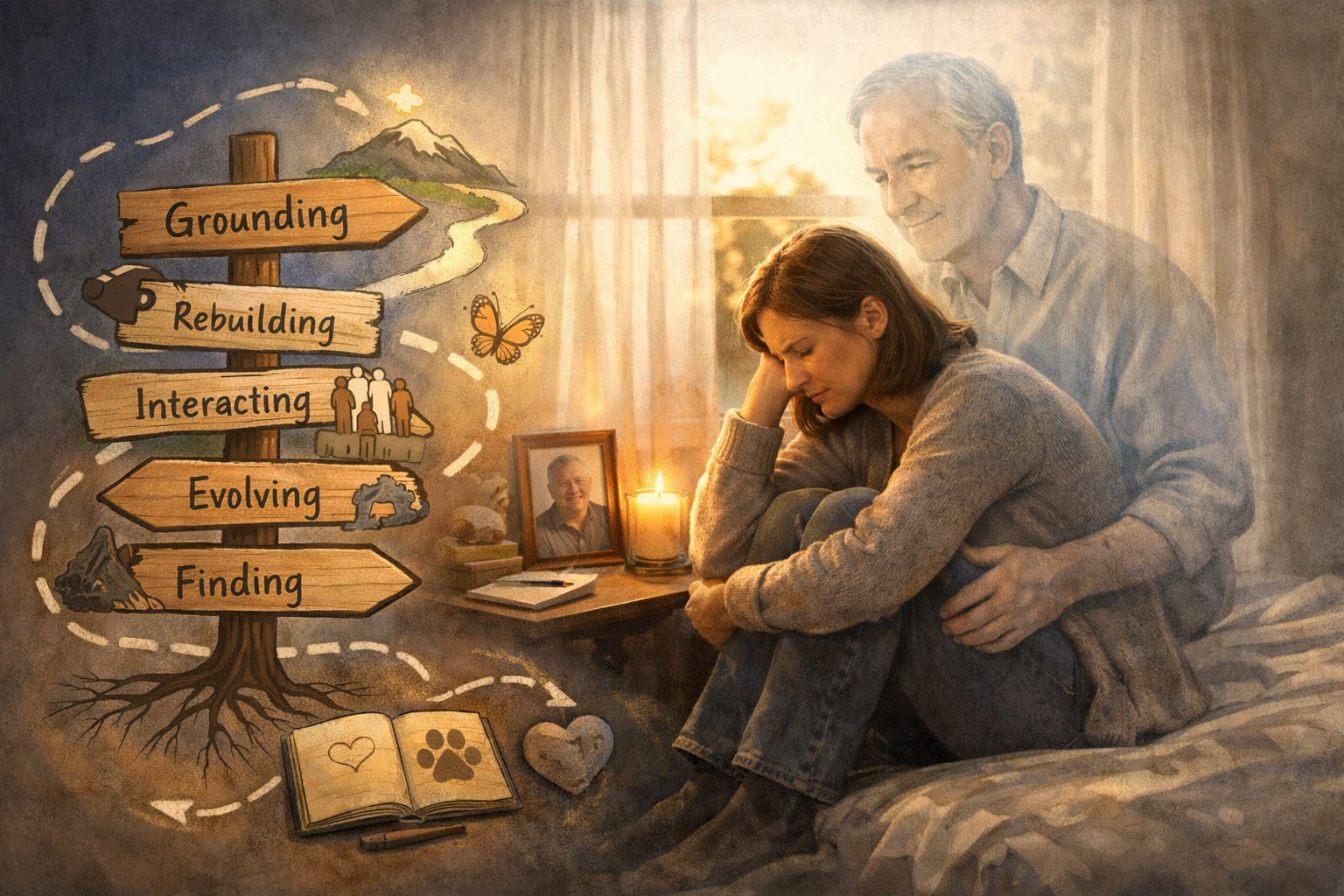
These reactions are deeply rooted in attachment and the loss of co-regulation. And within the GRIEF Ladies Framework: Grounding, Rebuilding, Interacting, Evolving, and Finding, this kind of loss often shakes the very first trail marker: Grounding.
Attachment and Emotional Safety
Attachment theory, originally developed by John Bowlby and expanded through decades of research, helps explain why certain losses feel especially destabilizing. Humans are biologically wired to seek safety through connection. From early childhood through adulthood, attachment relationships help us feel secure, regulated, and supported during times of stress.
Attachment figures, including parents, spouses, close friends, and even our children, are often the people we turn to when we are overwhelmed, worried, or distressed. They help us:
Calm our nervous system
Organize our emotions
Think through our decisions
Feel grounded
Help us feel safe
Over time, these relationships become part of how emotional regulation happens.
What Is Co-Regulation?
Co-regulation refers to the process by which our nervous systems are soothed, stabilized, and organized through connection with others.
A partner’s reassuring voice at the end of a stressful day.
A parent’s steady presence letting you know things will be okay.
A loved one helping you think clearly during a crisis.
These are examples of co-regulation in action. Often, we are not consciously aware of how much co-regulation a relationship provides until it is gone.
When someone who served as a primary source of emotional regulation dies, grief includes more than missing the person. It includes the loss of emotional safety and nervous system stability.
And that is why grief can feel so physically and emotionally disorienting.
When a co-regulator dies, many grieving individuals experience:
Increased anxiety or panic
Overwhelmed with emotions
Numbness or shutdown
Difficulty making decisions
Exhaustion, even after a full night of sleep
A sense of being “lost”
These reactions are not signs of weakness or pathology. They are common nervous system responses to the loss of a co-regulator. The body is adjusting to the absence of someone who helped it feel safe.
Within the GRIEF Ladies Framework, this often impacts more than just Grounding:
Rebuilding feels harder because routines were shared.
Interacting changes because the person you turned to is no longer physically present.
Evolving can bring roadblock emotions like anger, guilt, or fear.
Finding meaning may feel impossible in the early stages.
When someone functioned as your “safe base” or emotional anchor, their death disrupts not only daily life, but also your internal compass.
Staying Connected Without Staying Stuck
For many years, grief was framed as a process of “letting go.” We now know that this is not current. Research supports that maintaining a connection with the person who died can be healthy and adaptive.
In the GRIEF Ladies Framework, this connects closely with Finding.
Many grieving individuals continue to experience support through:
Talking about their loved one and asking, “What would they say to me in this situation?”
Carrying forward their loved one’s values
Rituals that honor the person’s life, such as lighting a candle on hard days
Moments of felt connection during stress
Staying connected to pets or safe people who offer comfort
Staying connected does not mean avoiding grief or refusing to move forward. For many, it is precisely what helps regulate the nervous system and create meaning after loss.
Rebuilding Emotional Safety After Loss
Healing after the death of an attachment figure is not about replacing the person who died. It is about rebuilding emotional safety in new ways. Within the GRIEF Ladies Framework, this often looks like walking through each trail marker intentionally:
Grounding
Learning nervous system regulation skills, including practicing breathing exercises, building body awareness, and making sure you are getting enough sleep.
Rebuilding
Energy mapping: identifying what drains you, what restores you, and how to pace yourself in grief and re-establishing small, predictable routines.
Interacting
Expanding safe sources of connection. Allowing others to support you, even if it feels different than before.
Evolving
Practicing self-compassion during emotional waves. Understanding that anger, guilt, fear, or jealousy are often protective emotions.
Finding
Engaging in ways to stay connected to your loved one and exploring how the relationship continues internally, even as life changes externally.
Over time, many grieving individuals learn to offer themselves some of the reassurance and compassion they once received from others while still honoring the ongoing bond with their loved one.
If grief has made you feel emotionally unsafe, anxious, or disconnected, it may not be because you are grieving incorrectly. It may be because your nervous system lost one of its primary sources of safety.
Grief is not only about losing someone you love. It is also about learning how to live and feel safe without the person who helped regulate your emotional world.

Family Support While Grieving: Why It Can Feel So Complicated
Family Support While Grieving: Why It Can Feel So Complicated by Karyn Arnold
By Karyn Arnold, one of the GRIEF Ladies from Grief In Common
For many people, family support while grieving quickly becomes the hardest place to feel steady after loss — and that can come as a real surprise.
They knew the person. They loved them too. Surely this would be the place where support came most naturally. This was supposed to feel familiar, or at least steady. When that doesn’t happen, the disappointment can run deep. People are often left wondering why something they counted on no longer feels there.
What follows often goes beyond frustration. Loneliness sets in. A sense of safety disappears. A quiet worry creeps up: Is something broken in my family now? Is this how it’s always going to feel?
Family Support While Grieving Isn’t Shared in the Same Way
One of the biggest sources of tension in grieving families comes from the belief that everyone is mourning the same loss.
Even when the person is the same, the loss is not.
A partner loses the person they built daily life with.
A child loses a parent.
A sibling loses shared history.
The day-to-day impact also differs, especially for the family member(s) who shared living space with the person who is gone.
Grief becomes harder when we expect one another to cope, feel, or recover in similar ways — or on the same timeline. When no one names those expectations, misunderstandings grow quickly.
When the Struggle Isn’t Just With the Family You Were Born Into
For some, the strain shows up with parents or siblings. For others, it hits closer to home.
A spouse may want things to “get back to normal.” Children may feel uncomfortable with your sadness. Loved ones may rush, minimize, or avoid grief because they don’t know how to sit with it.
The sense of isolation can grow when you aren’t feeling supported or understood in your own home, and some of the disappointment can feel greatest with the family we chose.
When Support Comes From Somewhere Unexpected
Many grieving people feel surprised when they start leaning more on friends, coworkers, or people outside their family.
That shift can feel unsettling.
Often, it has less to do with love and more to do with capacity. Family members are grieving too. They may feel overwhelmed or emotionally flooded. Someone a step outside the inner circle may simply have more room to listen or stay steady.
This is why finding grief support outside the family matters so much.
When Grief Strains — or Breaks — the Family System
Sometimes these changes stay quiet. Other times, they explode.
Grief exposes old dynamics, unresolved conflicts, and long-standing family roles. Disagreements can escalate fast, especially around money, the estate, or decision-making. When that happens, it can feel like the loss fractured the family itself.
Here’s what matters: conflict during grief does not mean a family is permanently broken. It means the system is under extreme strain.
Why We Talk About Family Support While Grieving
This is one of many reasons Karyn Arnold and Kelly Daugherty came together to create the GRIEF Ladies.
Together, they bring nearly 50 years of professional grief experience, supporting people through the loss of spouses, parents, siblings, and complicated family relationships. The GRIEF Ladies includes a website, podcast, Facebook community, upcoming book series, and ongoing grief education.
Family strain is only one part of the work — but it is a deeply painful one.
Again and again, people ask the same question:
Why does this hurt so much with the people who matter most?
How the GRIEF Framework Helps When Family Support Falls Apart
Family conflict is just one way grief shows up, but it highlights something important. You cannot fix or change anyone else. You cannot undo what happened.
What you do have is the present — and yourself within it.
The GRIEF framework guides where your time, energy, and attention can go when everything feels out of control. It offers clear direction for caring for yourself in ways that actually help.
G — Grounding
Grief affects the nervous system and the body, not just emotions. When family support while grieving feels unreliable, many people ignore basic needs to hold everything together.
Grounding means caring for yourself as an individual, even during family stress.
Sleep, food, focus on breath, and movement matter more than most people expect. Supporting your body helps stabilize your emotions when everything else feels shaky.
R — Rebuilding
Loss disrupts routines, roles, and identity. Family systems once revolved around the person who is gone. Now everyone is adjusting.
Rebuilding structure and boundaries helps you stay steadier during difficult interactions. Even small routines create predictability when everything feels unfamiliar — including your family.
I — Interacting
Interacting focuses on how grief changes communication and connection.
It includes naming needs, understanding that everyone grieves differently, and keeping expectations realistic. It also means making space for hard conversations that help preserve relationships as they shift.
Sometimes a simple, “I’m having a hard time — how about you?” opens more ground than silence ever could.
E — Evolving
Grief brings emotions many people don’t expect: anger, guilt, regret, resentment. These feelings often show up in families, where history runs deep.
You may feel angry about decisions, resentful of behavior, or hurt by how your loved one was treated. These reactions can feel uncomfortable or even shameful.
They are also normal.
Anger often sits right beside sadness. These feelings need somewhere to go. Talking with a trusted friend, journaling, or joining a grief group helps release what builds up inside. You don’t have to act on every thought — but you don’t need to carry them alone.
F — Finding
Loss raises questions without quick answers: Who am I now? What does my family look like? Where do I find support?
Finding doesn’t mean resolving everything. It means noticing what supports you now and letting that be enough for the moment.
Rather than deciding what your family will look like forever, focus on what helps you get through today and this week. Support can take new forms without meaning something has been lost for good.
This Isn’t (or Doesn’t Have To Be) How It Will Always Be
That fear — that your family is broken or that things will always feel this strained — is common.
It also isn’t the full story.
Families change under the weight of grief. Sometimes painfully.
With understanding, realistic expectations, and support that doesn’t rely on one person to carry everything, those bonds can survive — and sometimes even strengthen.
Work With Us
If struggles with family support while grieving feel familiar, this is just one example of the challenges the GRIEF framework was built to help with.
In their work as the GRIEF Ladies, Karyn Arnold and Kelly Daugherty see grief show up in many ways — identity, routine, motivation, self-worth, relationships, and the question of how to live after loss.
The GRIEF framework offers structure when grief feels chaotic. It helps you put limited energy into places that support you, instead of trying to manage everything — or everyone — at once.
Through the GRIEF Ladies podcast, support offerings, video series, and upcoming book, the framework is explored in greater depth with practical tools you can return to as grief continues to change.
The goal is steady support — something to come back to when you feel overwhelmed, uncertain, or unsure what to do next.