

Why We Called It "How to Grieve with Love Instead of Pain"
The GRIEF Ladies Guide: How to Grieve with Love Instead of Pain
The title came from something we see again and again - in our 50 years of combined experience supporting grieving individuals.
People come to us believing, sometimes without even realizing it, that the pain is the point. That suffering is proof of love. That if the grief isn't hurting, something is wrong. That moving forward means moving away from the person who died.
We wanted to write a book that gently pushed back on all of that.
Here's what we believe: your connection to the person you lost shouldn't have to live in suffering.
That doesn't mean grief isn't painful. It is. It will be. Nothing about loving someone and losing them makes that pain disappear. We're not here to tell you otherwise.
But pain and love are not the same thing. And while pain may always be part of your story, it doesn't have to be your last or lasting connection to the person you lost. We want that forever connection to be about love.
The book names something we see at the heart of why so many grieving people stay stuck:
"Sometimes we hold on to these roadblocks because of our sense of love and loyalty. To be a loving person is to suffer. What kind of person would I be if I didn't feel bad?"
That belief keeps people from moving forward more than almost anything else we see. And it makes complete sense. If the pain is how you stay connected, letting go of the pain can feel like letting go of them.
It isn't. And this book is our attempt to help you feel that.
This book is built for the people we wrote about in the dedication:
"The stuck ones. The terrified ones. The numb ones. The angry ones. The ones barely holding on. The ones doing it awkwardly. The ones questioning every instinct and second-guessing themselves at every turn. The people trying to rebuild a life that no longer feels familiar, while carrying more than anyone around them can see."
That's who this book is for.
Available Tuesday, September 29th on Amazon.
Growing Around Grief: Staying Connected While Moving Forward After Loss
Growing Around Grief: Staying Connected While Moving Forward After Loss with Guest Charlotte Shuber
Have you ever wondered if it's okay to still feel close to someone who has died? If holding onto their memory somehow means you're not healing — or moving on the "right" way?
You are not alone. And the answer might surprise you.
In this powerful episode (24) of the GRIEF Ladies Podcast, licensed clinical social worker Charlotte Shuber flips the script on what grief is supposed to look like — and gives grieving women permission to carry their loved ones with them, not leave them behind.
You Don't Have to Let Go to Move Forward
One of the most damaging myths about grief is that healing means detaching. That at some point, you pack up the memories, put them away, and "get back to normal."
Charlotte's message is the opposite: staying connected to someone who died is not only healthy — it's part of how we grow.
Rather than moving on, she invites us to move forward — with our loved ones woven into who we are becoming.
What You'll Take Away from This Episode
Why "letting go" is the wrong goal — and what to reach for instead
How to interact with your emotions and memories in ways that fuel healing, not avoidance
Charlotte's personal story of loss and how it shaped her clinical approach
Practical tools for maintaining a connection with a loved one while still fully living your life
Why grief is not a problem to solve — it's a relationship to tend
The GRIEF Framework: Interacting
This episode falls under the I — Interacting category of the GRIEF Framework, which focuses on how we engage with our inner world: our emotions, our memories, and the ongoing relationship we have with those we've lost.
Charlotte's approach reminds us that grief is not passive. It requires us to show up — to sit with what hurts, to speak the names of those we love, and to let that love continue to shape us.
About Charlotte Shuber
Charlotte Shuber is a licensed clinical social worker who specializes in grief and loss. She works with children, teens, and adults, combining professional expertise with her own lived experience of loss. Charlotte is passionate about creating a compassionate space where people can explore grief openly, adapt to life changes, and discover meaningful ways to stay connected—with loved ones who have died, with others, and with themselves.
Connect with Charlotte: https://www.creatingspacetherapy.com/charlotte-shuber-lcsw
Ready to Listen?
🎙️ Tune in to this episode of the GRIEF Ladies Podcast wherever you listen to podcasts or on YouTube— and share it with someone who needs to hear that staying connected is not a weakness. It's wisdom.
Because you don't have to choose between honoring them and living fully. You were never meant to.
The GRIEF Ladies Podcast is dedicated to supporting grieving individuals through loss with real conversations, expert guidance, and community.
Grief and Routine: Why Structure Matters After Loss with guest, Kat Farace
Grief and Routine: Why Structure Matters After Loss with guest, Kat Farace
If you’re wondering how to rebuild your life after someone dies, you’re not alone. Loss can shatter routines, disrupt your sense of identity, and make everyday tasks feel overwhelming.
In this episode (23) of The GRIEF Ladies Podcast, Karyn Arnold and Kelly Daugherty are joined by grief counselor and hospice expert Kat Farace to explore what “rebuilding” really means after loss. We talk about why routine matters in grief, how small daily structure can support your nervous system, and why rebuilding isn’t about “moving on” — it’s about learning how to live forward while carrying love with you.
In this conversation, you’ll learn:
Why grief disrupts your daily rhythms
How to gently reintroduce routine without pressure
The role of self-care in early and ongoing grief
Why community support matters when everything feels unstable
Practical coping tools to help you feel more steady
This episode connects to the Rebuilding trail marker in our G.R.I.E.F. Framework — focusing on structure, routine, and small steps that create stability in the midst of emotional upheaval.
If you’ve been feeling unmoored, exhausted, or unsure how to function after loss, this episode offers validation, realistic strategies, and encouragement for wherever you are in your grief journey.
Guest Bio:
Kat Farace is an author, speaker, and grief coach with over 25 years of experience in hospiceand end-of-life care, walking alongside individuals and families through life’s most profound moments of loss, love, and transition. Her work is grounded in compassion, honesty, and the deep belief that grief—while never chosen—can become one of our greatest teachers.
Through decades of hospice service, Kat has supported thousands of people as they navigated death, dying, and bereavement, gaining rare insight into the emotional, spiritual, and relational realities of grief. Her approach blends professional expertise with heartfelt presence, offering guidance that is both practical and deeply human.
Kat is the author of the upcoming book Grief the Teacher: The Teacher We Never
Wanted—With the Lessons Only Love and Loss Can Teach, to be released in Spring 2026. In
it, she explores grief not as something to “get over,” but as an experience that reshapes us,
challenges us, and ultimately invites growth, meaning, and connection.
Kat creates space for real conversations about loss—conversations that honor pain while also making room for hope, resilience, and love. Whether speaking to the newly grieving or those carrying loss for a lifetime, she brings a steady, compassionate presence that reminds listeners they are not alone.
Kat Farace’s work continues to reach audiences through coaching, speaking engagements, and storytelling that normalizes grief, dismantles shame, and gently illuminates the path
forward—one honest conversation at a time.
Connect with Kat:
Website: https://www.balanceingrief.com
Instagram: https://www.instagram.com/balanceingrief/
Facebook: https://www.facebook.com/balanceingriefcom
🎙 Listen to Episode 23: Grief and Routine: Why Structure Matters After Loss with guest, Kat Farace
Available now on YouTube and all podcast platforms.

Perfectionists, People Pleasers & Grief
Perfectionists, People Pleasers & Grief
Perfectionists. People Pleasers.
Some will immediately relate to these labels, and some maybe not so much. Yet most people I work with exhibit at least some of these traits, whether they are consciously aware of it or not. For the perfectionists, it may come as an almost badge of honor. A commitment they’ve made to themselves to do everything the best they can, without fail, in every single category of their life. The people pleasers may not be as satisfied with that title. But they also understand it as a necessary skill to function in their lives, and as a way to get along with the people around them.
But what happens when life falls apart? Expectations for ourselves often remain the same, but how can they when EVERY SINGLE THING in life has changed? Do these old habits and old roles still work?
Let’s start by understanding what it really means to be a perfectionist or a people pleaser. While I work with (and know personally) plenty of people who possess both tendencies, there’s nothing saying that one has to go with the other. In order to understand where you may fit, it’s important to explore each on their own first.
There are a lot of perfectionists in this world.
It can show up in the way a person interacts with others, or how they keep themselves or their home. As a result, a standard and expectation becomes set and it can be very hard to do anything without having to do it really well, all the time.
People pleasers are a little different.
This behavior often comes from childhood, and is a learned response to safety and inclusivity with the world and people around us. People pleasers put others’ needs ahead of their own and for the most part, they’re doing this to the extreme.
So why does it matter in grief?
First: it’s not sustainable. The old habits and old ways of doing things only work when everything else in life is going okay. Next, competing with your “old self” will only create a greater contrast of who you are now, compared to who you used to be. This can add to the intense pressure, unfamiliarity, and uncertainty that a griever is feeling on a daily basis.
The problem with perfectionists and grief.
If you have always tried to do everything “right”, you may already be used to some of the pressure and stress that comes with it. But now you’ve had a significant loss, and you’re likely experiencing a level of stress that you never have before. You can barely think straight. How can you be expected to do the “right thing” when NOTHING feels right anymore?
In grief, being a perfectionist can actually equate to something that most would feel is far from perfect = procrastination. Decision making is a huge task in grief and if the old habits of perfectionism continue, a griever may find themselves making no decisions at all. The fear of doing the “wrong” thing may leave you feeling stuck, even hopeless.
Diminished self-esteem is also a huge concern for any griever, and if you feel that you are constantly falling short, your image and self worth will only sink lower.
The reason why people-pleasing tendencies can’t continue.
Unlike the perfectionists who are trying to make things just right in their own lives, people pleasers are trying to do it for everyone else instead. Here’s the problem when it comes to life after loss – a griever doesn’t even know what they need or how to make themselves feel any peace. So how can they be expected to anticipate the needs of anyone else?
It doesn’t help that some of the biggest challenges in grief come from those around you. Whether it’s in the form of real or perceived expectations, most people feel very disconnected from their loved ones following loss. Managing the emotions and needs of others takes the kind of higher-order thinking that a person in grief just doesn’t have access to. And for most it’s not a case of not wanting to be a help or support to others. They just may feel that they no longer can.
How to stop being a perfectionist or people pleaser today.
I often make comparisons to physical health when describing grief. When it comes to our physical health, we are much more understanding of what we can and can’t do. If you have a broken arm, you would never expect to be able to help a friend move their couch. And your friend wouldn’t ask you to.
But what about the brokenness that comes with grief? Can we take a more honest look at what we actually can and can’t do emotionally? And can we start reframing our interactions with ourselves and others accordingly?
This is where change begins.
First, in observation. Watch yourself and your thoughts. What are your expectations for yourself? Consider what old instincts are kicking in and how often you are telling yourself that you “should” be doing something. And then consider the reality of whether you really can (or want to).
Next, in practice. You’ve got to start somewhere. If you’re a perfectionist and worried about how clean the house is (or isn’t), consider changing your standards. For now. Maybe at some point you’ll decide to go back to having the cleanest house on the block. But for now that just may not be something you have the energy for. Grief is exhausting. Use your energy wisely.
What about my friends and family?
How will they react if I’m no longer a perfectionist or people pleaser? We all know what we expect from ourselves, but we can’t deny that the people in our lives are probably expecting a lot too. Especially with the passage of time. It’s all well and good for me to give you permission to put a greater focus on yourself and your needs, but will the people around you allow for the same grace? Especially with each day that passes since your loss?
Start by giving yourself permission and know that in a lot of ways, that will be the hardest part. Validate every single reason why you can’t or don’t want to hold yourself to the same expectations as before. And give yourself permission to only do or commit to what you can.
The people around you may need time to adapt, and that’s okay. Communicate. Don’t apologize. If they’re asking, let them know what this process is like for you. And why you need to make some changes in order to survive.
In the end, this grief is your business.
No one else gets to decide what you need in grief. It’s important to remind yourself (regularly!) that you’re doing the best you can. And when you’re feeling like that best isn’t so great, know that how you feel now isn’t how you’ll always feel. Grief is always changing and your needs, wants, limitations, and abilities will all change with it.
For all the perfectionists and people pleasers in this world, I leave you with this. If you’re going to please anyone right now, try pleasing yourself first. Find peace and comfort in little moments whenever you can. And remember that these tendencies were never good for you to begin with. There’s some real growth that can come out of the brokenness of loss. Start today by resetting the expectations you have for yourself, and find growth and perhaps a new strength, in the healing that follows.
Want to read more of Karyn’s blogs visit Grief in Common
When the Person Who Helped You Feel Safe Dies
When the Person Who Helped You Feel Safe Dies
Grief is often described as heartbreak, sadness, or longing. But for many grieving individuals, one of the most confusing and distressing experiences is feeling emotionally unsafe after a loss.
People often say things like:
“I don’t feel like myself anymore. I don’t even know who I am.”
“Everything feels harder than it used to.”
“I don’t know how to calm myself down.”
“I feel anxious or numb all the time.”
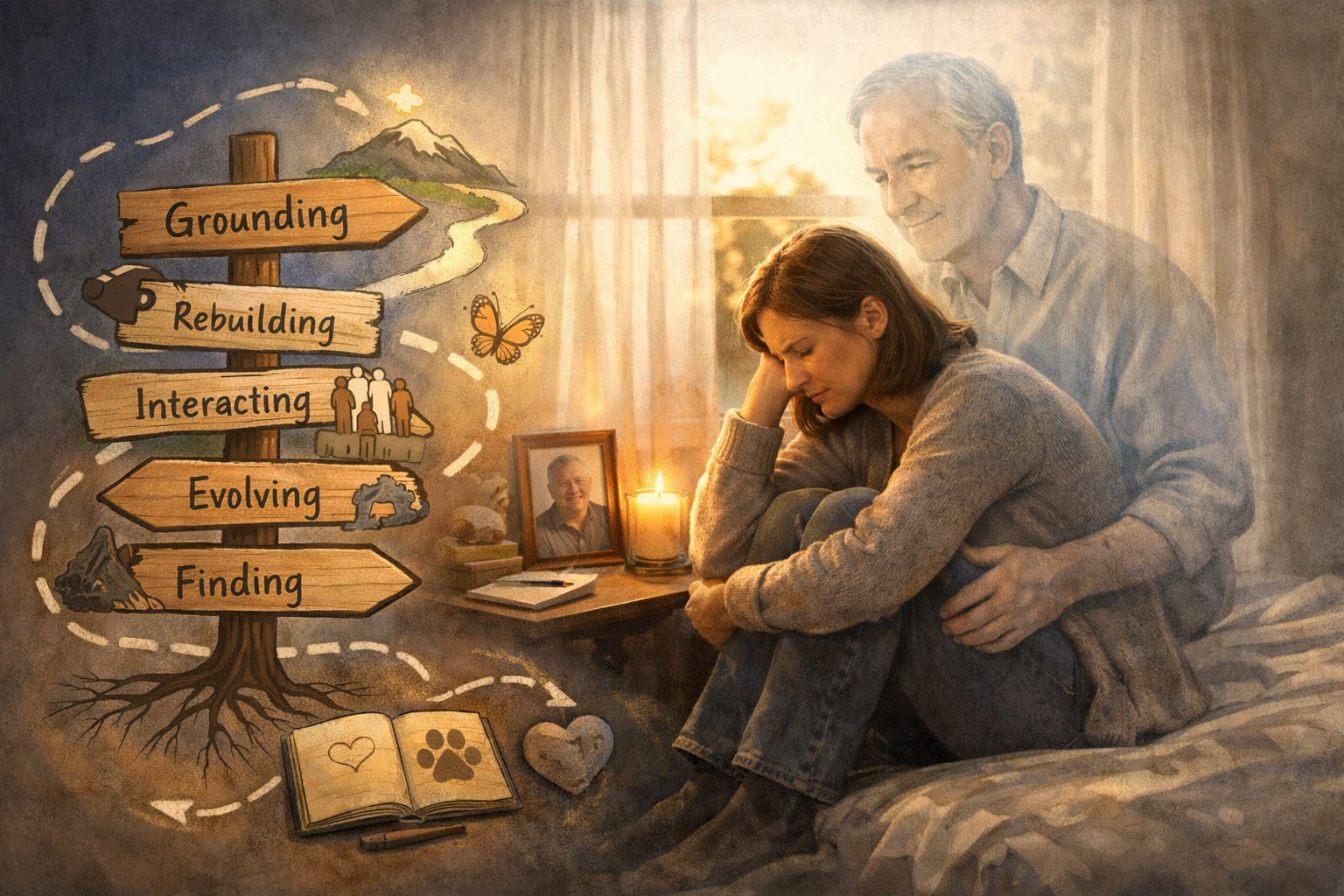
These reactions are deeply rooted in attachment and the loss of co-regulation. And within the GRIEF Ladies Framework: Grounding, Rebuilding, Interacting, Evolving, and Finding, this kind of loss often shakes the very first trail marker: Grounding.
Attachment and Emotional Safety
Attachment theory, originally developed by John Bowlby and expanded through decades of research, helps explain why certain losses feel especially destabilizing. Humans are biologically wired to seek safety through connection. From early childhood through adulthood, attachment relationships help us feel secure, regulated, and supported during times of stress.
Attachment figures, including parents, spouses, close friends, and even our children, are often the people we turn to when we are overwhelmed, worried, or distressed. They help us:
Calm our nervous system
Organize our emotions
Think through our decisions
Feel grounded
Help us feel safe
Over time, these relationships become part of how emotional regulation happens.
What Is Co-Regulation?
Co-regulation refers to the process by which our nervous systems are soothed, stabilized, and organized through connection with others.
A partner’s reassuring voice at the end of a stressful day.
A parent’s steady presence letting you know things will be okay.
A loved one helping you think clearly during a crisis.
These are examples of co-regulation in action. Often, we are not consciously aware of how much co-regulation a relationship provides until it is gone.
When someone who served as a primary source of emotional regulation dies, grief includes more than missing the person. It includes the loss of emotional safety and nervous system stability.
And that is why grief can feel so physically and emotionally disorienting.
When a co-regulator dies, many grieving individuals experience:
Increased anxiety or panic
Overwhelmed with emotions
Numbness or shutdown
Difficulty making decisions
Exhaustion, even after a full night of sleep
A sense of being “lost”
These reactions are not signs of weakness or pathology. They are common nervous system responses to the loss of a co-regulator. The body is adjusting to the absence of someone who helped it feel safe.
Within the GRIEF Ladies Framework, this often impacts more than just Grounding:
Rebuilding feels harder because routines were shared.
Interacting changes because the person you turned to is no longer physically present.
Evolving can bring roadblock emotions like anger, guilt, or fear.
Finding meaning may feel impossible in the early stages.
When someone functioned as your “safe base” or emotional anchor, their death disrupts not only daily life, but also your internal compass.
Staying Connected Without Staying Stuck
For many years, grief was framed as a process of “letting go.” We now know that this is not current. Research supports that maintaining a connection with the person who died can be healthy and adaptive.
In the GRIEF Ladies Framework, this connects closely with Finding.
Many grieving individuals continue to experience support through:
Talking about their loved one and asking, “What would they say to me in this situation?”
Carrying forward their loved one’s values
Rituals that honor the person’s life, such as lighting a candle on hard days
Moments of felt connection during stress
Staying connected to pets or safe people who offer comfort
Staying connected does not mean avoiding grief or refusing to move forward. For many, it is precisely what helps regulate the nervous system and create meaning after loss.
Rebuilding Emotional Safety After Loss
Healing after the death of an attachment figure is not about replacing the person who died. It is about rebuilding emotional safety in new ways. Within the GRIEF Ladies Framework, this often looks like walking through each trail marker intentionally:
Grounding
Learning nervous system regulation skills, including practicing breathing exercises, building body awareness, and making sure you are getting enough sleep.
Rebuilding
Energy mapping: identifying what drains you, what restores you, and how to pace yourself in grief and re-establishing small, predictable routines.
Interacting
Expanding safe sources of connection. Allowing others to support you, even if it feels different than before.
Evolving
Practicing self-compassion during emotional waves. Understanding that anger, guilt, fear, or jealousy are often protective emotions.
Finding
Engaging in ways to stay connected to your loved one and exploring how the relationship continues internally, even as life changes externally.
Over time, many grieving individuals learn to offer themselves some of the reassurance and compassion they once received from others while still honoring the ongoing bond with their loved one.
If grief has made you feel emotionally unsafe, anxious, or disconnected, it may not be because you are grieving incorrectly. It may be because your nervous system lost one of its primary sources of safety.
Grief is not only about losing someone you love. It is also about learning how to live and feel safe without the person who helped regulate your emotional world.

GRIEF & YOUR ENERGY
Grief and Your Energy
Why grief feels exhausting… and what helps
Have you noticed grief makes everyday tasks feel harder?
You may feel:
• Mentally drained
• Emotionally overwhelmed
• Socially exhausted
• Physically tired
You are not imagining this.
Grief requires a huge amount of nervous system energy.
Many grieving people worry:
“I should be able to handle more.”
But grief is heavy.
Imagine carrying an invisible backpack filled with memories, emotions, and change… all day long.
Of course you get tired.
This is where ENERGY MAPPING can help.
Energy mapping helps you notice:
✔ What drains your energy
✔ What restores your energy
✔ What feels meaningful but still exhausting
✔ How to pace yourself in grief
Some experiences have TWO types of energy cost:
Physical Energy: How much effort your body uses
Emotional Energy: How much grief or stress it activates
Both matter.
Examples:
Talking about your loved one
💛 Meaningful
⚡ Emotionally draining
Family gatherings
💛 Important
⚡ Physically and emotionally tiring
Resting afterward is not weakness.
It is support.
Try this simple reflection:
👉 After I do __________
👉 My body usually feels __________
Awareness helps you plan care instead of pushing through exhaustion.
One helpful strategy is called Recovery Pairing.
This means: Pair draining experiences with supportive ones.
Examples:
Grief ritual → quiet walk
Social event → alone time
Therapy session → calming music or journaling
Grief changes capacity.
Energy mapping helps you work WITH your capacity instead of fighting it.
Pacing grief is how many people survive it.
💬 Reflection Question:
What is one activity that drains your energy right now… and one that helps restore it?

What Does Grief Feel Like? (Emotionally & Physically)
What Does Grief Feel Like?
Grief is not just emotional. It affects your thoughts, your behaviors, your body, and sometimes your spiritual or existential beliefs. Many people are surprised by how physical grief feels. If you’re wondering whether what you’re experiencing is normal, you’re not alone.
Grief Is More Than Sadness
People often expect grief to feel like sadness. But many describe it as a bundled-up box of emotions, multiple feelings happening all at once.
You might experience:
Sadness and anger in the same hour
Relief and guilt together
Numbness followed by intense emotion
Anxiety, fear, or irritability
A sense of meaninglessness or questioning your beliefs
Grief is rarely one emotion at a time. It can feel layered and unpredictable.
The Cognitive Effects of Grief
Grief can impact how you think. Many people report:
Brain fog
Forgetfulness
Trouble concentrating
Difficulty making decisions
Re-reading the same sentence multiple times
This is often called “grief brain,” and it’s a common reaction after a significant loss.
The Physical Symptoms of Grief
Grief is stored in the body. It can feel heavy, almost like you’re physically carrying something.
Common physical symptoms of grief include:
Extreme exhaustion
Sleep disruption
Headaches
Stomachaches or digestive changes
Muscle tension or body aches
Tightness in the chest
Changes in appetite
Research shows that stress levels increase during grief, and inflammation in the body can rise. This can make you feel run down and more susceptible to illness. You’re not imagining it. Grief can truly be physical.
Behavioral and Spiritual Shifts
You may also notice changes in how you behave or see the world:
Withdrawing from others
Losing interest in activities you once enjoyed
Avoiding certain places or conversations
Questioning your faith or long-held beliefs
Feeling different from who you used to be
Loss has a way of shaking the foundation of how we understand life.
If this sounds familiar, it's because grief can feel overwhelming, as it impacts so many areas at once. It isn’t “just” emotional. It’s a full-body, full-life experience.
If you want to hear real conversations about what grief actually feels like, including grief brain, physical symptoms, and emotional waves, we talk openly about this on the GRIEF Ladies podcast, as well as tools to help you with these feelings and symptoms. New episodes come out every Wednesday as we go through our GRIEF Ladies Framework- Grieving, Rebuilding, Interacting, Evolving, and Finding.

Is My Grief Normal?
Is My Grief Normal?
Many grieving individuals worry if what they are feeling is normal, or if what they’re feeling is too much, not enough, or somehow wrong. This is one of the most common questions people ask after the death of someone they love.
In grief groups, we constantly hear:
“I am going to say something that might sound crazy, but…”
“I feel like I’m losing my mind.”
And almost every time, heads nod around the room in agreement
The reality is that while grief is unique, many grieving individuals experience similar reactions.
Common and normal grief symptoms include:
Grief brain (forgetfulness, brain fog, difficulty concentrating)
Grief Bursts: sudden waves of emotion or tears “out of nowhere.”
Physical symptoms like headaches, stomach aches, a tight chest, or extreme exhaustion
Sleep changes- extreme exhaustion, trouble falling or staying asleep
Increased anxiety or irritability
Feeling disconnected from friends and family
Deep loneliness
Questioning your faith or worldview
Feeling okay one moment and a complete mess the next
These are all very normal reactions, and this list could go on and on. Grief does not move through predictable stages. It does not follow a straight timeline. It often comes in waves, and there is no timeline for how long this will last.
If you want to hear real conversations about what grief actually feels like, including grief brain, triggers, and why waves happen, we talk openly about this on the GRIEF Ladies podcast, where we normalize the parts of grief people are often afraid to say out loud. Check out new episodes every Wednesday, which is available on all major podcast platforms and YouTube at: GRIEF Ladies - YouTube

Family Support While Grieving: Why It Can Feel So Complicated
Family Support While Grieving: Why It Can Feel So Complicated by Karyn Arnold
By Karyn Arnold, one of the GRIEF Ladies from Grief In Common
For many people, family support while grieving quickly becomes the hardest place to feel steady after loss — and that can come as a real surprise.
They knew the person. They loved them too. Surely this would be the place where support came most naturally. This was supposed to feel familiar, or at least steady. When that doesn’t happen, the disappointment can run deep. People are often left wondering why something they counted on no longer feels there.
What follows often goes beyond frustration. Loneliness sets in. A sense of safety disappears. A quiet worry creeps up: Is something broken in my family now? Is this how it’s always going to feel?
Family Support While Grieving Isn’t Shared in the Same Way
One of the biggest sources of tension in grieving families comes from the belief that everyone is mourning the same loss.
Even when the person is the same, the loss is not.
A partner loses the person they built daily life with.
A child loses a parent.
A sibling loses shared history.
The day-to-day impact also differs, especially for the family member(s) who shared living space with the person who is gone.
Grief becomes harder when we expect one another to cope, feel, or recover in similar ways — or on the same timeline. When no one names those expectations, misunderstandings grow quickly.
When the Struggle Isn’t Just With the Family You Were Born Into
For some, the strain shows up with parents or siblings. For others, it hits closer to home.
A spouse may want things to “get back to normal.” Children may feel uncomfortable with your sadness. Loved ones may rush, minimize, or avoid grief because they don’t know how to sit with it.
The sense of isolation can grow when you aren’t feeling supported or understood in your own home, and some of the disappointment can feel greatest with the family we chose.
When Support Comes From Somewhere Unexpected
Many grieving people feel surprised when they start leaning more on friends, coworkers, or people outside their family.
That shift can feel unsettling.
Often, it has less to do with love and more to do with capacity. Family members are grieving too. They may feel overwhelmed or emotionally flooded. Someone a step outside the inner circle may simply have more room to listen or stay steady.
This is why finding grief support outside the family matters so much.
When Grief Strains — or Breaks — the Family System
Sometimes these changes stay quiet. Other times, they explode.
Grief exposes old dynamics, unresolved conflicts, and long-standing family roles. Disagreements can escalate fast, especially around money, the estate, or decision-making. When that happens, it can feel like the loss fractured the family itself.
Here’s what matters: conflict during grief does not mean a family is permanently broken. It means the system is under extreme strain.
Why We Talk About Family Support While Grieving
This is one of many reasons Karyn Arnold and Kelly Daugherty came together to create the GRIEF Ladies.
Together, they bring nearly 50 years of professional grief experience, supporting people through the loss of spouses, parents, siblings, and complicated family relationships. The GRIEF Ladies includes a website, podcast, Facebook community, upcoming book series, and ongoing grief education.
Family strain is only one part of the work — but it is a deeply painful one.
Again and again, people ask the same question:
Why does this hurt so much with the people who matter most?
How the GRIEF Framework Helps When Family Support Falls Apart
Family conflict is just one way grief shows up, but it highlights something important. You cannot fix or change anyone else. You cannot undo what happened.
What you do have is the present — and yourself within it.
The GRIEF framework guides where your time, energy, and attention can go when everything feels out of control. It offers clear direction for caring for yourself in ways that actually help.
G — Grounding
Grief affects the nervous system and the body, not just emotions. When family support while grieving feels unreliable, many people ignore basic needs to hold everything together.
Grounding means caring for yourself as an individual, even during family stress.
Sleep, food, focus on breath, and movement matter more than most people expect. Supporting your body helps stabilize your emotions when everything else feels shaky.
R — Rebuilding
Loss disrupts routines, roles, and identity. Family systems once revolved around the person who is gone. Now everyone is adjusting.
Rebuilding structure and boundaries helps you stay steadier during difficult interactions. Even small routines create predictability when everything feels unfamiliar — including your family.
I — Interacting
Interacting focuses on how grief changes communication and connection.
It includes naming needs, understanding that everyone grieves differently, and keeping expectations realistic. It also means making space for hard conversations that help preserve relationships as they shift.
Sometimes a simple, “I’m having a hard time — how about you?” opens more ground than silence ever could.
E — Evolving
Grief brings emotions many people don’t expect: anger, guilt, regret, resentment. These feelings often show up in families, where history runs deep.
You may feel angry about decisions, resentful of behavior, or hurt by how your loved one was treated. These reactions can feel uncomfortable or even shameful.
They are also normal.
Anger often sits right beside sadness. These feelings need somewhere to go. Talking with a trusted friend, journaling, or joining a grief group helps release what builds up inside. You don’t have to act on every thought — but you don’t need to carry them alone.
F — Finding
Loss raises questions without quick answers: Who am I now? What does my family look like? Where do I find support?
Finding doesn’t mean resolving everything. It means noticing what supports you now and letting that be enough for the moment.
Rather than deciding what your family will look like forever, focus on what helps you get through today and this week. Support can take new forms without meaning something has been lost for good.
This Isn’t (or Doesn’t Have To Be) How It Will Always Be
That fear — that your family is broken or that things will always feel this strained — is common.
It also isn’t the full story.
Families change under the weight of grief. Sometimes painfully.
With understanding, realistic expectations, and support that doesn’t rely on one person to carry everything, those bonds can survive — and sometimes even strengthen.
Work With Us
If struggles with family support while grieving feel familiar, this is just one example of the challenges the GRIEF framework was built to help with.
In their work as the GRIEF Ladies, Karyn Arnold and Kelly Daugherty see grief show up in many ways — identity, routine, motivation, self-worth, relationships, and the question of how to live after loss.
The GRIEF framework offers structure when grief feels chaotic. It helps you put limited energy into places that support you, instead of trying to manage everything — or everyone — at once.
Through the GRIEF Ladies podcast, support offerings, video series, and upcoming book, the framework is explored in greater depth with practical tools you can return to as grief continues to change.
The goal is steady support — something to come back to when you feel overwhelmed, uncertain, or unsure what to do next.