

Why We Called It "How to Grieve with Love Instead of Pain"
The GRIEF Ladies Guide: How to Grieve with Love Instead of Pain
The title came from something we see again and again - in our 50 years of combined experience supporting grieving individuals.
People come to us believing, sometimes without even realizing it, that the pain is the point. That suffering is proof of love. That if the grief isn't hurting, something is wrong. That moving forward means moving away from the person who died.
We wanted to write a book that gently pushed back on all of that.
Here's what we believe: your connection to the person you lost shouldn't have to live in suffering.
That doesn't mean grief isn't painful. It is. It will be. Nothing about loving someone and losing them makes that pain disappear. We're not here to tell you otherwise.
But pain and love are not the same thing. And while pain may always be part of your story, it doesn't have to be your last or lasting connection to the person you lost. We want that forever connection to be about love.
The book names something we see at the heart of why so many grieving people stay stuck:
"Sometimes we hold on to these roadblocks because of our sense of love and loyalty. To be a loving person is to suffer. What kind of person would I be if I didn't feel bad?"
That belief keeps people from moving forward more than almost anything else we see. And it makes complete sense. If the pain is how you stay connected, letting go of the pain can feel like letting go of them.
It isn't. And this book is our attempt to help you feel that.
This book is built for the people we wrote about in the dedication:
"The stuck ones. The terrified ones. The numb ones. The angry ones. The ones barely holding on. The ones doing it awkwardly. The ones questioning every instinct and second-guessing themselves at every turn. The people trying to rebuild a life that no longer feels familiar, while carrying more than anyone around them can see."
That's who this book is for.
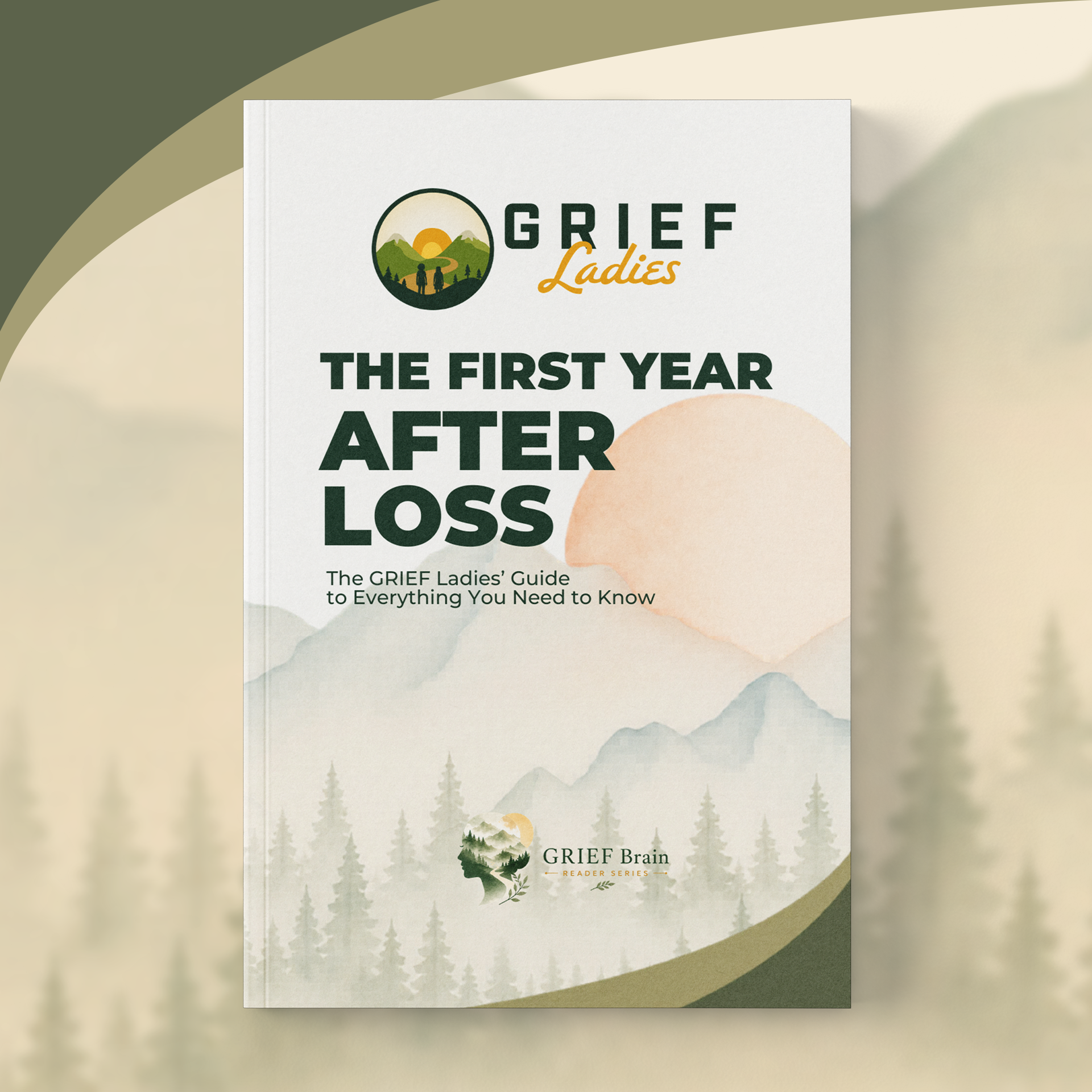
Available Tuesday, September 29th on Amazon.
Why We Wrote The First Year After Loss
The First Year of Loss written by the GRIEF Ladies is scheduled for Tuesday, June 16th on Amazon.
When life knocks us down, most of us have ways of coping. We lean on the people we trust. We throw ourselves into work for a while. We exercise. We spend time with friends. We distract ourselves with hobbies. We remind ourselves of other difficult things we've survived and draw confidence from knowing we've gotten through hard times before. We rely on routines and familiar structures to create a sense of stability while life feels uncertain.
Then a significant loss occurs, and suddenly, the life we knew how to navigate no longer exists.
The person we would normally call may be the very person who died. Friends and family are often grieving too, leaving them with less capacity to support us in the ways they once did. The hobbies and interests that used to bring comfort can suddenly feel meaningless. Our routines change because the life those routines were built around no longer exists. Even our confidence in ourselves can take a hit as we struggle with forgetfulness, indecision, exhaustion, and a complete lack of motivation.
In other words, loss doesn't simply create pain. It destabilizes many of the systems we would normally rely upon to recover from pain.
We think this is one of the reasons the first year after loss feels so bewildering. People often come into grief believing they are mourning one person, only to discover they are also grieving a future they expected to have, a role they once occupied, a sense of security, familiar routines, important relationships, and even parts of themselves. They find themselves struggling with things that used to come naturally and wondering why they can't seem to "get it together." What they don't realize is that they are trying to adapt to an entirely new reality while many of the supports that would normally help them adapt have changed or disappeared.
This is also why so many grieving people ask the same questions. Why am I so tired? Why can't I concentrate? Why do I feel worse now than I did three months ago? Why don't I enjoy anything anymore? Why do I feel so disconnected from everyone around me? Beneath all of those questions is often a deeper one: Is this normal?
After hearing those questions for years, we began talking about how difficult it can be for grieving people to find straightforward, practical information during the time they need it most. The irony, of course, is that grief itself affects concentration, memory, motivation, and the ability to absorb information. People are desperate to understand what is happening to them at exactly the same time they are least able to read a dense book or sort through complicated explanations.
That realization became the foundation for our GRIEF Brain Reader Series, a collection of books on grief and life after loss designed specifically for people whose worlds have been forever changed. We wanted these books to be practical, accessible, and easy to return to—offering information, reassurance, and guidance without requiring the focus, energy, or emotional bandwidth that grief often takes away.
That conversation eventually became The First Year After Loss: A GRIEF Ladies Guide to Everything You Need to Know. We wanted to create the book we wished every grieving person had during those early months—the book that explains not only what grief is, but why it feels so hard. A book that helps people understand the exhaustion, the fog, the loneliness, the identity changes, the relationship challenges, and the countless secondary losses that often accompany the death of someone important.
No book can remove the pain of grief. No book can tell someone exactly what their experience will look like. But we do believe that understanding matters. There is comfort in learning that what feels frightening is often normal. There is relief in discovering that other people have struggled with the same thoughts, questions, and fears. There is tremendous value in realizing that the exhaustion, confusion, forgetfulness, loneliness, and sense of being completely unlike yourself are experiences shared by many grieving people.
The first year after loss asks an enormous amount of us. It asks us to carry heartbreak while adapting to change. It asks us to learn new routines, navigate unfamiliar emotions, and make sense of a world that no longer looks the way we expected it to. We hope this book helps people feel less confused, less alone, and better equipped to understand what is happening to them as they find their way through one of the most difficult years of their lives.
The First Year of Loss will be available on Amazon on Tuesday, June 16th. Want to hear more about why we are starting with this book, check out: https://youtu.be/Nfz8_vQbWck?si=qkVHy8ivBGEirpnS
What Actually Happens in the First Year of Grief and Why Nobody Warns You
The first year after a loss is full of things nobody prepares you for — grief brain, grief bursts, the exhaustion, the firsts. Grief specialists Kelly Daugherty and Karyn Arnold explain what's actually normal and what helps.
The first year after a loss is unlike anything else you will experience. And yet most people go into it completely unprepared because nobody talks honestly about what it actually feels like. That's not because people don't care. It's because grief is still one of the most underdiscussed experiences in our culture. We show up for the funeral. We bring the casseroles. And then, as Kelly Daugherty often says: "By the time the casseroles have been eaten, the phone has stopped ringing, and the funeral is over, then it really hits them." And when it hits, many people ask the same question: Am I grieving, or am I going crazy? The answer, almost always, is: you are grieving. And this is what grief actually looks like.
What Is "Grief Brain" and Is It Real?
Yes. Grief brain is real, and it affects more people than most realize. When you are in early grief, your nervous system is under enormous strain. Stress hormones are elevated. Sleep is disrupted. Your body and mind are working overtime to process something that has no quick resolution. As a result, many grieving people experience significant cognitive changes — including difficulty concentrating, forgetting things they would never normally forget, struggling to read or retain information, and feeling mentally foggy or scattered. This is why Kelly Daugherty and Karyn Arnold — co-hosts of the GRIEF Ladies Podcast and co-authors of The First Year After Loss — designed their new Grief Brain Reader series with the grief brain specifically in mind. The books are intentionally short and digestible. Because handing a grieving person a 300-page book isn't helpful. It's another complication. "Your grief brain can handle this" is the message behind the series. It was written for exactly where you are right now.
The Firsts Nobody Prepares You For
The first year of grief is filled with firsts you didn't ask for. The first birthday without them. The first holiday. The first time someone asks how you're doing and you genuinely don't know what to say. The first time you reach for your phone to call them — and remember. Each of these firsts carries its own weight. And many people are surprised to find that certain ones hit harder than they expected — sometimes months later, sometimes on a completely ordinary Tuesday with no obvious trigger. This is not unusual. This is grief doing exactly what grief does.
Grief Bursts: When It Comes Out of Nowhere
One of the most disorienting experiences in grief is what clinicians sometimes call a grief burst — a sudden, intense wave of grief that arrives without warning. You might be in the grocery store, driving to work, or sitting quietly at home when something — a smell, a song, a phrase — brings the loss rushing back with full force. Kelly Daugherty, an LCSW-R and grief specialist with over two decades of experience, is open about her own experience with this. Her mother has been gone for 32 years. And grief bursts still come. "I had a grief burst the other day about my mom. It's been 32 years. And it still hit me. Because grief doesn't have an expiration date." This is not a sign that something is wrong. It is a sign that you loved someone deeply. And it is completely normal.
What the First Year Actually Needs
The first year of grief deserves focused, intentional support. Not a timeline. Not a checklist. Not someone telling you that you should be further along by now. What helps, according to decades of combined clinical experience from Kelly and Karyn, is this: Finding your people. Co-regulation — the nervous-system science of being around safe, calm people — is one of the most powerful tools in early grief. You need people who can sit with you in it. Who don't need you to perform being okay. Normalizing what you're experiencing. Knowing that grief brain is real, that grief bursts are normal, that the first year is hard for a reason — this alone can reduce the shame and confusion that makes grief even heavier. Short, digestible resources. When you can't concentrate, when reading feels impossible, when your brain can't hold a lot — you need resources that meet you there. Not resources that add to the overwhelm.
The First Year After Loss — Coming Soon
The First Year After Loss, the first book in the Grief Brain Reader series by Kelly Daugherty and Karyn Arnold, will be available now on Amazon on June 16th. It is short. It is honest. It is written for the grief brain — on purpose. And it is for anyone in their first year of loss, anyone who loves someone in their first year, and anyone who has been carrying grief longer than a year and never had a resource that truly met them where they were.
Want to hear more about this book, check out the GRIEF Ladies Bonus Podcast Episode: https://open.spotify.com/episode/0VR2fwgmnguI6P3Yl9qGx2?si=L_jbfIT_Rw6pJymenTAn_g