
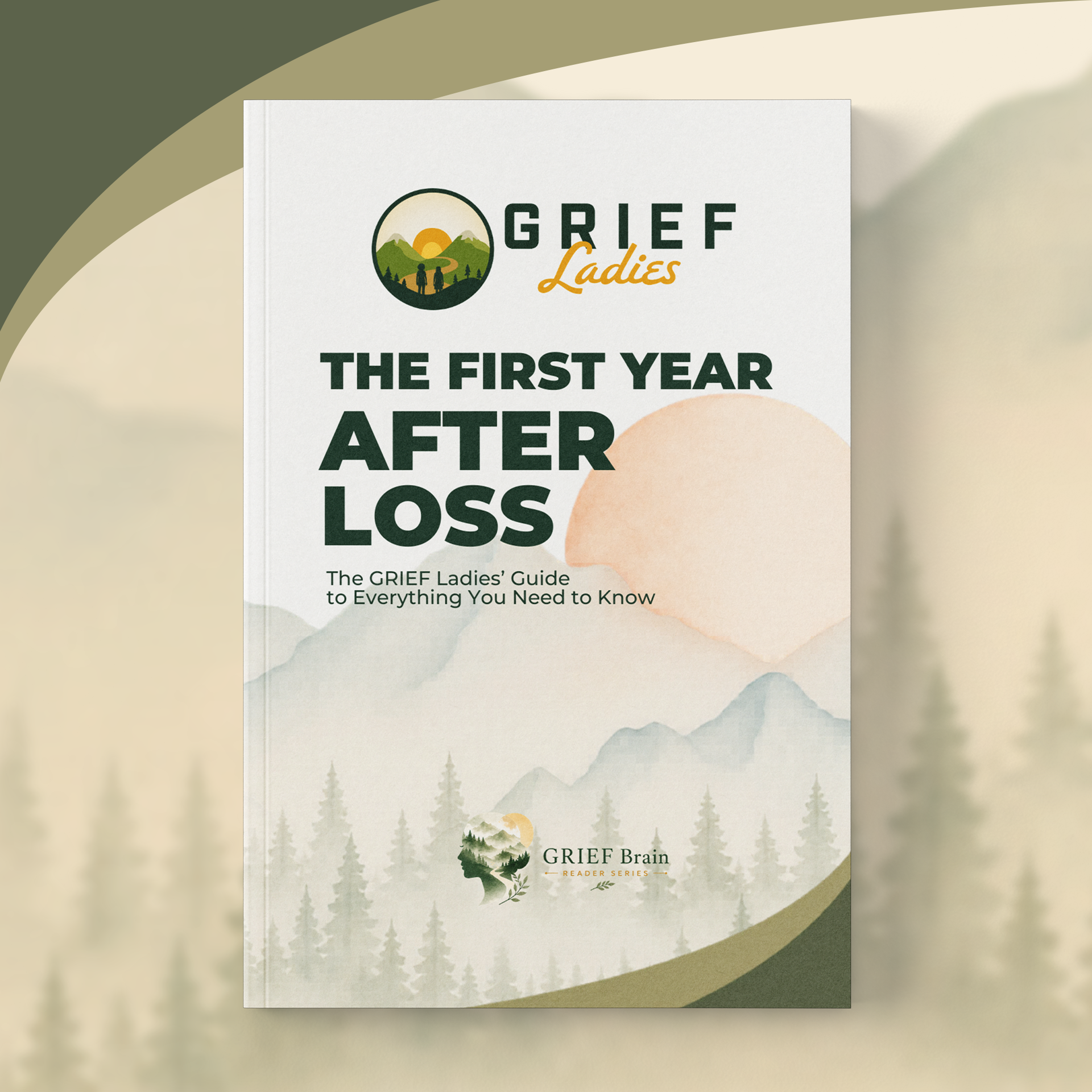
Why We Wrote The First Year After Loss
The First Year of Loss written by the GRIEF Ladies is scheduled for Tuesday, June 16th on Amazon.
When life knocks us down, most of us have ways of coping. We lean on the people we trust. We throw ourselves into work for a while. We exercise. We spend time with friends. We distract ourselves with hobbies. We remind ourselves of other difficult things we've survived and draw confidence from knowing we've gotten through hard times before. We rely on routines and familiar structures to create a sense of stability while life feels uncertain.
Then a significant loss occurs, and suddenly, the life we knew how to navigate no longer exists.
The person we would normally call may be the very person who died. Friends and family are often grieving too, leaving them with less capacity to support us in the ways they once did. The hobbies and interests that used to bring comfort can suddenly feel meaningless. Our routines change because the life those routines were built around no longer exists. Even our confidence in ourselves can take a hit as we struggle with forgetfulness, indecision, exhaustion, and a complete lack of motivation.
In other words, loss doesn't simply create pain. It destabilizes many of the systems we would normally rely upon to recover from pain.
We think this is one of the reasons the first year after loss feels so bewildering. People often come into grief believing they are mourning one person, only to discover they are also grieving a future they expected to have, a role they once occupied, a sense of security, familiar routines, important relationships, and even parts of themselves. They find themselves struggling with things that used to come naturally and wondering why they can't seem to "get it together." What they don't realize is that they are trying to adapt to an entirely new reality while many of the supports that would normally help them adapt have changed or disappeared.
This is also why so many grieving people ask the same questions. Why am I so tired? Why can't I concentrate? Why do I feel worse now than I did three months ago? Why don't I enjoy anything anymore? Why do I feel so disconnected from everyone around me? Beneath all of those questions is often a deeper one: Is this normal?
After hearing those questions for years, we began talking about how difficult it can be for grieving people to find straightforward, practical information during the time they need it most. The irony, of course, is that grief itself affects concentration, memory, motivation, and the ability to absorb information. People are desperate to understand what is happening to them at exactly the same time they are least able to read a dense book or sort through complicated explanations.
That realization became the foundation for our GRIEF Brain Reader Series, a collection of books on grief and life after loss designed specifically for people whose worlds have been forever changed. We wanted these books to be practical, accessible, and easy to return to—offering information, reassurance, and guidance without requiring the focus, energy, or emotional bandwidth that grief often takes away.
That conversation eventually became The First Year After Loss: A GRIEF Ladies Guide to Everything You Need to Know. We wanted to create the book we wished every grieving person had during those early months—the book that explains not only what grief is, but why it feels so hard. A book that helps people understand the exhaustion, the fog, the loneliness, the identity changes, the relationship challenges, and the countless secondary losses that often accompany the death of someone important.
No book can remove the pain of grief. No book can tell someone exactly what their experience will look like. But we do believe that understanding matters. There is comfort in learning that what feels frightening is often normal. There is relief in discovering that other people have struggled with the same thoughts, questions, and fears. There is tremendous value in realizing that the exhaustion, confusion, forgetfulness, loneliness, and sense of being completely unlike yourself are experiences shared by many grieving people.
The first year after loss asks an enormous amount of us. It asks us to carry heartbreak while adapting to change. It asks us to learn new routines, navigate unfamiliar emotions, and make sense of a world that no longer looks the way we expected it to. We hope this book helps people feel less confused, less alone, and better equipped to understand what is happening to them as they find their way through one of the most difficult years of their lives.
The First Year of Loss will be available on Amazon on Tuesday, June 16th. Want to hear more about why we are starting with this book, check out: https://youtu.be/Nfz8_vQbWck?si=qkVHy8ivBGEirpnS

How Do You Celebrate the Life of Someone Who Died?
Because the love doesn't end.
We asked five of our recent guests to share how they encourage people to celebrate the life of someone they love. This video brings all five "Celebrate Their Life" segments together in one place — one for every letter of the GRIEF Ladies framework.
Honoring the person you loved doesn't have to follow a script. Five guests from the GRIEF Ladies Podcast — one for every letter of the GRIEF framework — share how they encourage grieving people to celebrate a life, keep a memory alive, and carry love forward in ways that feel true to them.
G · Grounding: How can honoring someone help you feel connected when grief feels physical?
Grief lives in the body as much as the mind. Dr. Larissa Tate, clinical psychologist and sleep specialist, understands that the early days of grief are often about survival — eating, sleeping, getting through. But even within that survival mode, small acts of honoring can provide comfort and grounding.
Her approach to celebrating a life focuses on the sensory and the simple — the things that bring someone's presence back in a way the body can feel. A favorite meal. A song. A walk somewhere they loved. These aren't small gestures. They are anchors.
📊 Stat: Research on continuing bonds — the idea that maintaining a connection to someone who has died supports healthy grief — shows that meaningful rituals and sensory reminders can reduce grief-related distress and increase feelings of closeness to the person who died. This isn't about staying stuck. It's about staying connected.
🎙️ Listen to the full episode with Dr. Larissa Tate
R · Rebuilding: How do you help a child celebrate the life of someone they loved?
Children need permission to remember. When someone dies, the adults around them are often so focused on protecting them from pain that they forget to invite them into the celebration of a life. Jennifer's work with children in grief centers on exactly this — creating space for children to remember, honor, and stay connected.
Her approach to celebrating a life with children involves making it tangible and age-appropriate: a memory box, a drawing, a special place in the home where a photo lives. When children have a way to participate in honoring someone, they learn that grief and love belong together.
🎙️ Listen to the full episode with Jennifer on children and grief
I · Interacting: How does a meaningful funeral celebration change the way families grieve together?
The way a life is honored at the end shapes how a family grieves together going forward. Brittany DeMarco-Furman, a fourth-generation licensed funeral director, has witnessed this firsthand across hundreds of families. When a service is personal, intentional, and reflective of who someone truly was, it gives the people left behind something to hold onto.
Her approach to celebrating a life is rooted in storytelling and personalization — music that mattered, objects that tell a story, space for people to share memories out loud. A funeral, in Brittany's view, is not an obligation. It is an opportunity.
🎙️ Listen to the full episode with Brittany DeMarco-Furman
E · Evolving: How do you celebrate a life when your grief is complicated?
Not every relationship was simple. Not every death comes with clean emotions. Holly McNeill, mindfulness educator and creator of the P.E.R.L.O.V.E. Formula, works with people whose grief is layered with things that are hard to name — guilt, anger, relief, regret. Her approach to celebrating a life makes room for all of it.
Holly encourages grieving people to honor the full truth of who someone was — not a perfect version, not a painful version, but the real one. Celebration doesn't require that everything was good. It requires that something was real.
📊 Stat: Studies on complicated grief and ambivalent relationships suggest that finding ways to honor what was meaningful — even within difficult relationships — can support grief integration and reduce prolonged grief symptoms. Acknowledgment of complexity is not a barrier to honoring a life. It is part of it.
🎙️ Listen to the full episode with Holly McNeill
F · Finding: How do you celebrate the life of a pet?
Pets are companions, witnesses, and family. When they die, the grief is real and the need to honor them is just as real. Adam Greenbaum created Love Baxter after the death of his Boston Terrier Baxter, and his work is built on one simple belief: every animal deserves to be celebrated.
His approach to celebrating a pet's life includes memorializing in ways that feel personal — a paw print, a dedicated space in the home, a donation in their name, or simply telling their story out loud to someone who will listen. The love was real. The celebration should be too.
🎙️ Listen to the full episode with Adam Greenbaum on pet loss
The love doesn't end. The celebration is how you carry it.
Celebrating a life isn't something that happens once at a funeral and then stops. It's ongoing — woven into the routines you rebuild, the conversations you have with your children, the rituals you return to, the memories you let yourself feel. Every guest in this post reminds us that honoring someone is not about holding on. It's about carrying them forward.
Watch the video: https://youtu.be/FKsc27itlOY

What Actually Happens in the First Year of Grief and Why Nobody Warns You
The first year after a loss is full of things nobody prepares you for — grief brain, grief bursts, the exhaustion, the firsts. Grief specialists Kelly Daugherty and Karyn Arnold explain what's actually normal and what helps.
The first year after a loss is unlike anything else you will experience. And yet most people go into it completely unprepared because nobody talks honestly about what it actually feels like. That's not because people don't care. It's because grief is still one of the most underdiscussed experiences in our culture. We show up for the funeral. We bring the casseroles. And then, as Kelly Daugherty often says: "By the time the casseroles have been eaten, the phone has stopped ringing, and the funeral is over, then it really hits them." And when it hits, many people ask the same question: Am I grieving, or am I going crazy? The answer, almost always, is: you are grieving. And this is what grief actually looks like.
What Is "Grief Brain" and Is It Real?
Yes. Grief brain is real, and it affects more people than most realize. When you are in early grief, your nervous system is under enormous strain. Stress hormones are elevated. Sleep is disrupted. Your body and mind are working overtime to process something that has no quick resolution. As a result, many grieving people experience significant cognitive changes — including difficulty concentrating, forgetting things they would never normally forget, struggling to read or retain information, and feeling mentally foggy or scattered. This is why Kelly Daugherty and Karyn Arnold — co-hosts of the GRIEF Ladies Podcast and co-authors of The First Year After Loss — designed their new Grief Brain Reader series with the grief brain specifically in mind. The books are intentionally short and digestible. Because handing a grieving person a 300-page book isn't helpful. It's another complication. "Your grief brain can handle this" is the message behind the series. It was written for exactly where you are right now.
The Firsts Nobody Prepares You For
The first year of grief is filled with firsts you didn't ask for. The first birthday without them. The first holiday. The first time someone asks how you're doing and you genuinely don't know what to say. The first time you reach for your phone to call them — and remember. Each of these firsts carries its own weight. And many people are surprised to find that certain ones hit harder than they expected — sometimes months later, sometimes on a completely ordinary Tuesday with no obvious trigger. This is not unusual. This is grief doing exactly what grief does.
Grief Bursts: When It Comes Out of Nowhere
One of the most disorienting experiences in grief is what clinicians sometimes call a grief burst — a sudden, intense wave of grief that arrives without warning. You might be in the grocery store, driving to work, or sitting quietly at home when something — a smell, a song, a phrase — brings the loss rushing back with full force. Kelly Daugherty, an LCSW-R and grief specialist with over two decades of experience, is open about her own experience with this. Her mother has been gone for 32 years. And grief bursts still come. "I had a grief burst the other day about my mom. It's been 32 years. And it still hit me. Because grief doesn't have an expiration date." This is not a sign that something is wrong. It is a sign that you loved someone deeply. And it is completely normal.
What the First Year Actually Needs
The first year of grief deserves focused, intentional support. Not a timeline. Not a checklist. Not someone telling you that you should be further along by now. What helps, according to decades of combined clinical experience from Kelly and Karyn, is this: Finding your people. Co-regulation — the nervous-system science of being around safe, calm people — is one of the most powerful tools in early grief. You need people who can sit with you in it. Who don't need you to perform being okay. Normalizing what you're experiencing. Knowing that grief brain is real, that grief bursts are normal, that the first year is hard for a reason — this alone can reduce the shame and confusion that makes grief even heavier. Short, digestible resources. When you can't concentrate, when reading feels impossible, when your brain can't hold a lot — you need resources that meet you there. Not resources that add to the overwhelm.
The First Year After Loss — Coming Soon
The First Year After Loss, the first book in the Grief Brain Reader series by Kelly Daugherty and Karyn Arnold, will be available now on Amazon on June 16th. It is short. It is honest. It is written for the grief brain — on purpose. And it is for anyone in their first year of loss, anyone who loves someone in their first year, and anyone who has been carrying grief longer than a year and never had a resource that truly met them where they were.
Want to hear more about this book, check out the GRIEF Ladies Bonus Podcast Episode: https://open.spotify.com/episode/0VR2fwgmnguI6P3Yl9qGx2?si=L_jbfIT_Rw6pJymenTAn_g

What Should You Do When You're Grieving? 5 Experts Share One Action Step Each
5 Action Steps to Help You on Your Grief Journey
Grief can make it hard to know where to start. Each expert in this post is a guest from the GRIEF Ladies Podcast, and each one was asked a single question: what is one actionable step a grieving person can take right now? Their answers span every letter of the GRIEF Ladies framework — and together, they give you a place to begin.
G · Grounding: What can you do when grief is keeping you up at night?
Sleep is one of the first things grief disrupts — and one of the hardest to reclaim. Dr. Larissa Tate, a clinical psychologist specializing in sleep, anxiety, and trauma, shares that grief sleep disturbances are not a personal failing. They are a physiological response to loss, and there are evidence-based tools to address them.
Dr. Tate's action step: start with your sleep environment and your wind-down routine before reaching for medication. Small, consistent changes — what time you go to bed, how much light you're exposed to in the evening, what you do in the hour before sleep — can create meaningful shifts over time.
📊 Stat: Research shows that bereaved individuals are significantly more likely to experience insomnia than the general population, with some studies indicating rates as high as 40–50% among the newly bereaved. Sleep disruption can worsen emotional regulation, concentration, and physical health — making it one of the most important areas to address early in grief.
🎙️ Listen to the full episode with Dr. Larissa Tate on sleep and grief
R · Rebuilding: How do you support a child who is grieving?
Children grieve differently than adults, and they often need adults to help them rebuild a sense of safety and routine after a loss. Jennifer joined us to talk about what children actually need when someone they love has died — and what the adults around them can do to help.
Her action step: don't wait for a child to bring it up. Create space for the conversation by naming what happened directly and age-appropriately. Children take cues from the adults around them. When adults are willing to talk about death, children learn that their feelings are safe to share.
🎙️ Listen to the full episode with Jennifer on children and grief
I · Interacting: How does a funeral director help families communicate during grief?
Grief changes every relationship — and the days immediately following a death can bring out both the best and the most complicated parts of family dynamics. Brittany DeMarco-Furman, a fourth-generation licensed funeral director at Glenville Funeral Home, has guided hundreds of families through those first hours and days.
Her action step: have the conversation before you need to. Pre-planning a funeral — or even just talking openly about end-of-life wishes — is one of the most loving things a family can do for each other. It removes the burden of guessing during the hardest moments, and it opens a door for honest communication about what matters.
💬 Quote: "It's the last gift you can give your family." — Brittany DeMarco-Furman
🎙️ Listen to the full episode with Brittany DeMarco-Furman on family communication and grief
E · Evolving: What do you do when grief emotions feel impossible to sit with?
The emotions that show up in grief — anger, guilt, fear, regret — can feel like walls rather than doorways. Holly McNeill, known as The Mindfulness Architect, developed the P.E.R.L.O.V.E. Formula after her own experience of profound personal loss. Her work focuses on helping people understand how their minds function under stress so they can engage with pain more consciously.
Her action step: pause before you react to a difficult emotion. You don't have to fix the feeling or push it away — just notice it. Mindfulness isn't about becoming calm; it's about becoming curious. That small shift from reaction to observation can change your entire relationship to the emotion.
📊 Stat: Studies on mindfulness-based interventions for grief have found reductions in grief-related rumination and increases in psychological flexibility among bereaved participants. The ability to observe emotions without being consumed by them is a trainable skill — not a personality trait.
🎙️ Listen to the full episode with Holly McNeill on mindfulness and grief
F · Finding: How do you grieve a pet when no one around you understands?
Pet loss is one of the most common forms of disenfranchised grief — grief that isn't fully recognized or validated by others. Adam Greenbaum created Love Baxter, the world's largest pet end-of-life resource, after the death of his Boston Terrier, Baxter, in October 2024. His episode is a reminder that the grief you feel for an animal is not small, and you don't have to explain it to anyone.
His action step: find your people. Seek out communities — online or in person — where pet loss is taken seriously and your grief is welcome. Isolation makes grief harder. Connection, even with strangers who understand, makes it more bearable.
🎙️ Listen to the full episode with Adam Greenbaum on pet loss and finding connection
One framework. Five action steps. A place to begin.
The GRIEF Ladies framework — Grounding, Rebuilding, Interacting, Evolving, and Finding — was built on the understanding that grief touches every part of life. There is no single right place to start. But there is always somewhere. The five guests in this post each offer one small, real step you can take in the area of grief that feels most pressing for you right now.
we
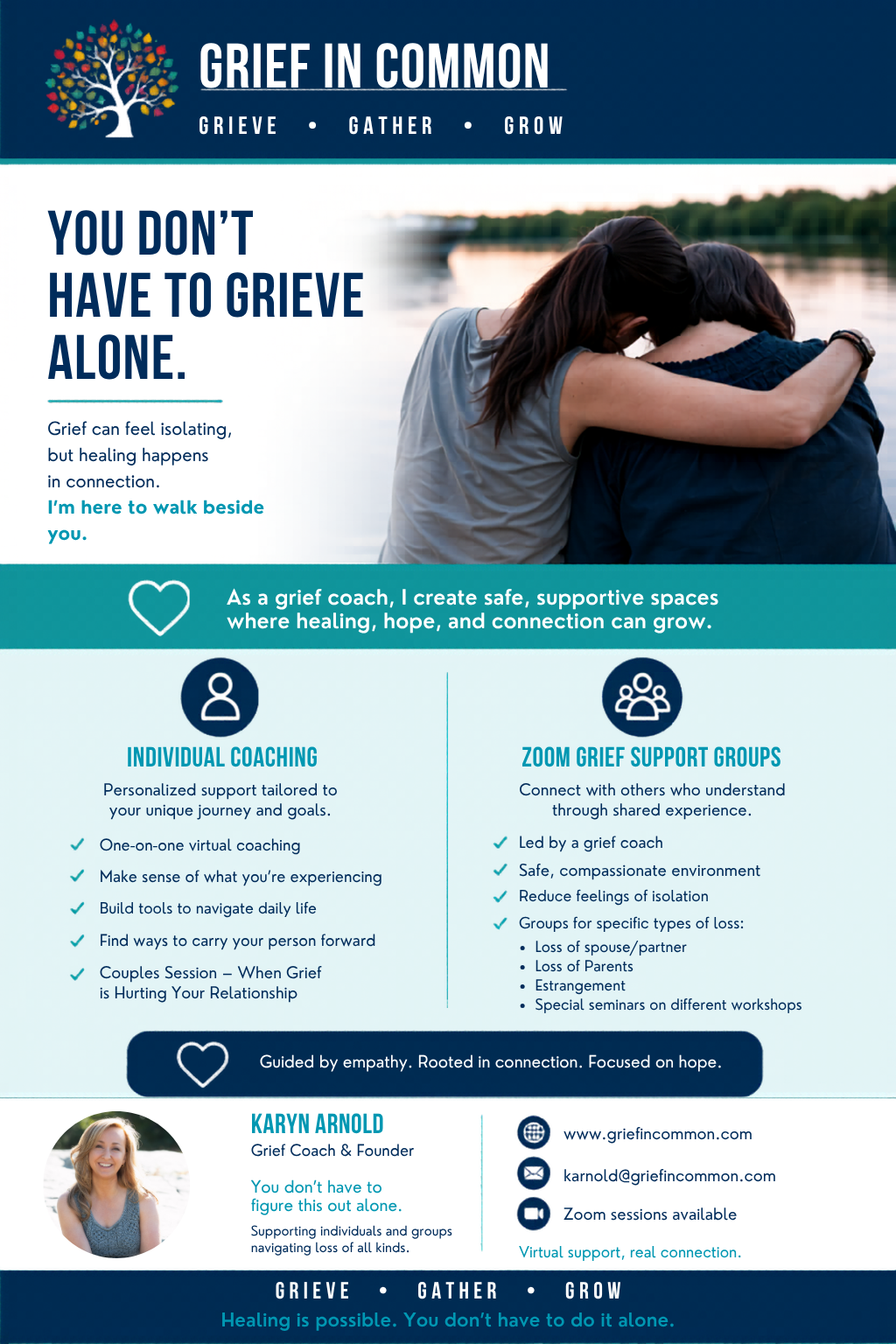
You Don't Have to Grieve Alone: How Grief Coaching Groups Can Help
Grief Coaching with Karyn Arnold of Grief in Common
After a loss, one of the hardest things isn't just the grief itself — it's the feeling that no one around you really gets it. Grief support groups exist for exactly that reason: to put you in a room (or a Zoom) with people who understand because they've been there too. Grief in Common, founded by grief coach Karyn Arnold, offers virtual group support designed around connection, compassion, and real conversation.
What Makes a Grief Support Group Different From Going It Alone?
Grief can shrink your world quickly. Friends may not know what to say. Family members are grieving too, often in different ways. A support group offers something most of us can't find elsewhere — people who don't need you to explain yourself, because they already understand. Research consistently shows that social support is one of the most significant factors in how people move through grief. A group gives you that support on a regular, structured basis.
A 2021 review published in Death Studies found that grief support group participation was associated with significant reductions in feelings of isolation and improvements in overall coping. For many, the group itself becomes a lifeline.
What Groups Does Grief in Common Offer?
Karyn's Zoom grief support groups are organized around specific types of loss, so you're not walking into a generic room — you're connecting with people who share your particular experience. Current groups include support for those who have experienced the death of a spouse or partner, the death of a parent, and estrangement. Special topic seminars are also available on a rotating basis. All groups are led by Karyn and held in a safe, compassionate virtual environment.
What If You're Not Ready for a Group?
Group support isn't the right fit for everyone — at least not right away. If you're looking for something more personal, Karyn also offers one-on-one virtual coaching sessions. Individual coaching is tailored to your unique experience and goals, and gives you dedicated space to make sense of what you're going through, build tools for navigating daily life, and find ways to carry your person forward. Couples sessions are also available for when grief is putting strain on a relationship. Whether you start with individual coaching and move into a group later, or do both at once, Karyn meets you where you are.
What Can You Expect in a Grief in Common Group?
These groups are coaching-based, not therapy — which means the focus is on connection, practical tools, and finding your footing going forward. Sessions are held via Zoom, so you can join from wherever you are. Whether you're newly bereaved or further along and still looking for community, there's space for you here.
Grief can feel isolating, but healing happens in connection."
— Karyn Arnold, Grief Coach & Founder, Grief in Common
Who Is Karyn Arnold?
Karyn Arnold is a grief coach and the founder of Grief in Common. She works with individuals and groups navigating loss of all kinds, guided by empathy, connection, and hope. Karyn is also the co-host of the GRIEF Ladies podcast, where she and I dig into what grief actually looks like — and what it means to keep living alongside it.
Visit Karyn’s website at www.griefincommon.com to sign up for one of her groups or individual coaching session.
Please note: Grief in Common offers coaching services, not therapy. If you are experiencing a mental health crisis or need clinical support, please reach out to a licensed mental health professional.
What Do You Do With a Loved One's Belongings After They Die?
What to do with a loved one’s belongings when they die?
Sorting through a loved one's belongings after they die is one of the hardest parts of grief — and one of the least talked about. The short answer: start with the stories behind the things, not the things themselves, and give yourself permission to go at whatever pace you need. In this episode of the GRIEF Ladies Podcast, Kelly and Karyn sit down with decluttering specialist Janine McDonald to explore the emotional and practical realities of going through someone's stuff.
Why Is This So Much Harder Than It Sounds?
It's rarely the furniture that stops people in their tracks. More often it's the small things — a pillbox, a well-worn hat, something that seems insignificant to everyone else but holds an entire relationship inside it. Janine explains that objects carry stories, and those stories are what make this process so emotionally complex. Her approach isn't about tidying up — it's about understanding what something meant before deciding what to do with it.
Research from the American Psychological Association identifies decision-making as one of the most cognitively taxing tasks during bereavement, as grief significantly affects attention, memory, and executive function — which helps explain why even small choices about belongings can feel impossible.
How Do You Move Forward Without Feeling Like You're Letting Go of the Person?
This is where the episode gets really good. Janine shares specific, compassionate strategies for when you want to keep everything, when family members disagree, when there's no sentimental meaning but releasing something still feels wrong, and how to repurpose items that can't be used the way they were intended. She also offers one practical gut-check question that Karyn said she'll be thinking about for a long time.
The through-line of everything Janine shares: the memories live in you, not in the objects.
Listen to the full episode (https://youtu.be/9OXwDgETf6E?si=Ky5BkdP1RfvObfWI) to hear Janine's step-by-step approach, her real client stories, and her advice for anyone who feels completely stuck on where to even begin.
What Learning to Swim Taught Us About Grief — with Cori Myka | GRIEF Ladies Ep. 25
what-learning-to-swim-taught-us-about-grief-cori-myka
What could learning to swim possibly have to do with grief?
More than you'd think.
In Episode 25 of GRIEF Ladies: A Guide to What Comes Next, we welcomed Cori Myka, founder of Calm Within Adult Swim, and the conversation took
a turn we didn't expect — in the best possible way.
Fear. Overwhelm. Not Knowing What Comes Next.
Cori works with adults who are terrified of the water. And as she started describing what her clients experience — the fear, the overwhelm,
the pressure to get it right — we couldn't help but notice how much it sounded like grief.
Because grief puts you in a whole new world too. One where you don't know the rules, you don't know what's coming, and everyone around you
seems to expect you to just figure it out.
Cori shared a powerful framework for slowing all of that down — and it turns out it works whether you're standing at the edge of a pool or
standing at the edge of a whole new life without someone you love.
The Takeaway You Can Try Right Now
One of our favorite moments in this episode was when Cori shared a simple, practical tool you can use anywhere — in a meeting, in a grocery
store line, at a family gathering — when a grief wave hits and you need to come back to yourself.
It's small. It's tangible. And it just might help.
You'll have to listen to get the full details. 🎧
Plus — Cori Shares Something Personal
We also asked Cori how she celebrates those who have died in her own life. Her answer was beautiful, unexpected, and something that stuck
with us long after we stopped recording.
Listen to Episode 25 here: https://youtu.be/aiLqrtJuFI8
Connect with Cori:
📲 @CalmWithinAdultSwim
Have you ever found an unexpected connection between something in your life and your grief? Tell us in the comments of the video — we'd love to hear it.

Grieving in the Second Year After a Loss
Grieving in the Second Year After a Loss
There is a pretty well-accepted theory on grieving that the first year is the hardest. The loss is so new, the first months can be spent in a blur of shock and disbelief.
This can be especially true for a sudden loss, but can surprise people when they are in “shock” even after a loved one has died following a long and drawn out illness.
I’ve said it many times: nothing, and I mean NOTHING, can prepare us for the finality of death.
Navigating that first year, through anniversaries, birthdays and holidays can feel endless. But the assumption for most is that as long as they can get through that, it should be smoother sailing in the days ahead.
And then year 2 happens.
The second Mother’s Day without a mom. The second wedding anniversary without a spouse. A second Christmas without a child. And the griever may find themselves thinking, “this isn’t any easier”.
Some people have told me that the second year was actually more of a challenge. Perhaps because of expectation – expecting to feel better and then feeling even more disappointed and sad when they didn’t. Or maybe it’s because the more time passes, the longer we’ve had to live without that person. The longer it’s been since we’ve seen them or heard their voice.
This is a terrifying thought for the newly bereaved, to think that it’s not going to be a steady climb upwards in grieving and healing, and I don’t share this to scare those who are in their very early days.
But expectations are a big part of our mindset, even when we’re not in the stages of grief. How much more do we enjoy the movie or party that we thought was going to be terrible? How disappointed are we when a long planned vacation-of-a-lifetime turns out to be not all what we would have hoped?
If ever there was a time when we need to be setting realistic expectations for ourselves, then certainly our time of grieving is one of them.
Throw away the timelines.
Don’t compare yourself with those whom you know have had a loss. The coworker who was back to work smiling only a few days after her Dad died? She was crying every day on the way to and from work. The family member who thinks that 18 months after your husband died you should be dating again? She has no idea what this loss feels like, what your love felt like, or what is right for you.
Be patient with yourself. Be patient with those who don’t understand. Don’t expect today to be hard and tomorrow to be easy. Honor wherever you are right in this moment and know that even if it feels uncomfortable, unsettling and uneasy, that it’s probably exactly where you need to be.
Stay open to the idea of hope and optimism – but don’t set a timeline for its arrival.
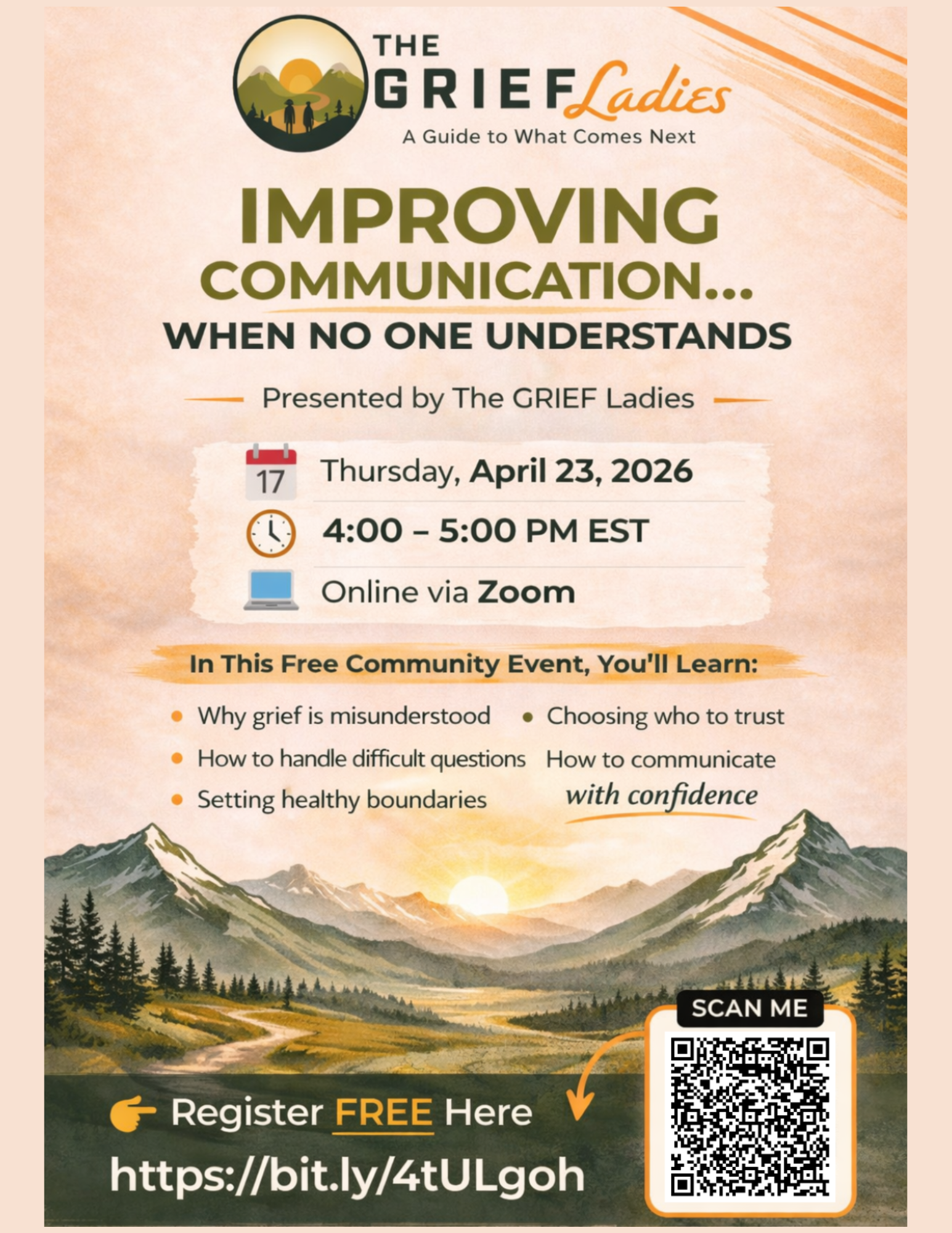
Improving Communication When No One Understands...
Improving Communication when Grieving
A Free Online Workshop from the GRIEF Ladies
You have people in your life who love you. And somehow, you still feel completely alone in your grief.
They say the wrong things. They move on too quickly. They ask how you are doing, and you say "I'm fine" — because what else are you supposed to say? Because explaining it feels exhausting. Because you're not sure they can really handle the honest answer.
If any of this sounds familiar, we want you to know: this is one of the most common and most painful parts of grief. And it is exactly what Kelly Daugherty and Karyn Arnold are tackling in their upcoming free workshop.
What This Workshop Is About
On Wednesday, April 23rd, from 4 to 5 PM EST, the GRIEF Ladies are hosting a free one-hour online event focused on one of the most frustrating parts of loss: communicating with the people around you when they just don't get it.
They will help you understand why the people who care about you still manage to say all the wrong things — and more importantly, what you can actually do about it.
What You Will Walk Away With
In just one hour, you will gain practical tools to help you:
Understand why grief makes communication so hard — and why that is not your fault
Know what to say (and what not to say) in the conversations that feel impossible
Figure out who is actually safe to confide in — and how to protect your energy with everyone else
Navigate the comments that sting, even when they come from a good place
Move forward in relationships that have felt strained or disconnected since your loss
You will leave with real tools you can use immediately — no matter how recent or long your grief has been.
Who This Is For
This event is open to anyone grieving any type of loss — a partner, parent, child, sibling, friend, or any meaningful relationship. Whether your grief is fresh or has been with you for years, this session is for you if you have ever thought:
"Why doesn't anyone understand what this is like?"
"I don't have the energy to explain myself anymore."
"I wish I knew what to say — or what not to say."
About the GRIEF Ladies
Karyn Arnold and Kelly Daugherty are the founders and facilitators of the GRIEF Ladies, and between them they have spent over 50 years walking alongside thousands of grieving individuals. Their approach is practical, direct, and built around one core belief: that grief is not something you just have to sit with. Actionable steps make all the difference.
Their GRIEF Framework — Grounding, Rebuilding, Interacting, Evolving, and Finding — is the guide they use to help people move from grieving with pain to grieving with love, while staying connected to the people they have lost.
This workshop focuses on the I: Interacting — because how we communicate after loss matters more than most people realize.
Event Details
Date: Wednesday, April 23, 2025
Time: 4:00 – 5:00 PM EST
Cost: Free
Register: https://app.acuityscheduling.com/schedule/85af7470/appointment/89553879/calendar/2617012
Reserve Your Free Spot
Space is limited. Register now to receive your link to join.
https://app.acuityscheduling.com/schedule/85af7470/appointment/89553879/calendar/2617012
Questions? Reach us at griefladies@gmail.com
More resources at www.griefladies.com

The Guilt of Relief in Grief
Understanding the Guilt of Relief in Grief
When speaking with a person who has recently lost a loved one to a long illness, I often hear them say “I’m just relieved that she’s gone.”
And this statement is almost certainly followed with something like: “It’s just that she was suffering for such a long time. I love my mom, but for those last few years she wasn’t herself. She had no quality of life and I know she would not have wanted to live that way.…”
The fact is that relief is a complicated emotion when coupled with grieving.
Even people who have the ability to express relief out loud can’t do so without explaining how they could feel “relieved” that someone they love has died.
Watching someone we love get diagnosed with a disease, suffer with its symptoms and ultimately die is one of the most traumatic things we can experience.
As we watch a loved one lose every fundamental ability during an especially long illness, we may find ourselves wishing it would end.
And why is this “guilt of relief” such a strange concept? When we struggled at other points in our lives, didn’t we find we could freely express that we wanted the struggle to be over? Wasn’t voicing our relief almost always acceptable?
Understanding the Guilt of Relief
Finding relief on the other side of loss is nothing to feel guilty about, and certainly not something that should require an explanation.
Yet the guilt this conflict leaves is something few people find they are able to shake.
While so few parts of the grieving process could ever be considered simple, in this case a subtle shift in perspective could be what makes the difference.
When speaking to someone who reluctantly admits feeling this “guilt of relief” following the loss of a loved one, I offer one simple idea:
“You are not relieved that your loved one has died. You are relieved that a time in your life marked by stress, uncertainty and suffering is now over.”
Give it a try. See if this change in perspective can make a difference. Don’t make this process any harder than it has to be and let yourself off the hook when you can. You have been through one of the most difficult and challenging experiences a person can endure. If you are able to feel even a small sense of relief, it is not something to hide, but to embrace.
And remember that you aren’t alone in your grief, or in experiencing your guilt of relief. Our forums offer you a place to see and share stories of grieving with people who have gone through losses of their own.
There’s even a section called Life After Caregiving. If you feel like you can’t say the things you feel out loud, start there. Share your experience with those who have been where you’ve been.
When the Person Who Helped You Feel Safe Dies
When the Person Who Helped You Feel Safe Dies
Grief is often described as heartbreak, sadness, or longing. But for many grieving individuals, one of the most confusing and distressing experiences is feeling emotionally unsafe after a loss.
People often say things like:
“I don’t feel like myself anymore. I don’t even know who I am.”
“Everything feels harder than it used to.”
“I don’t know how to calm myself down.”
“I feel anxious or numb all the time.”
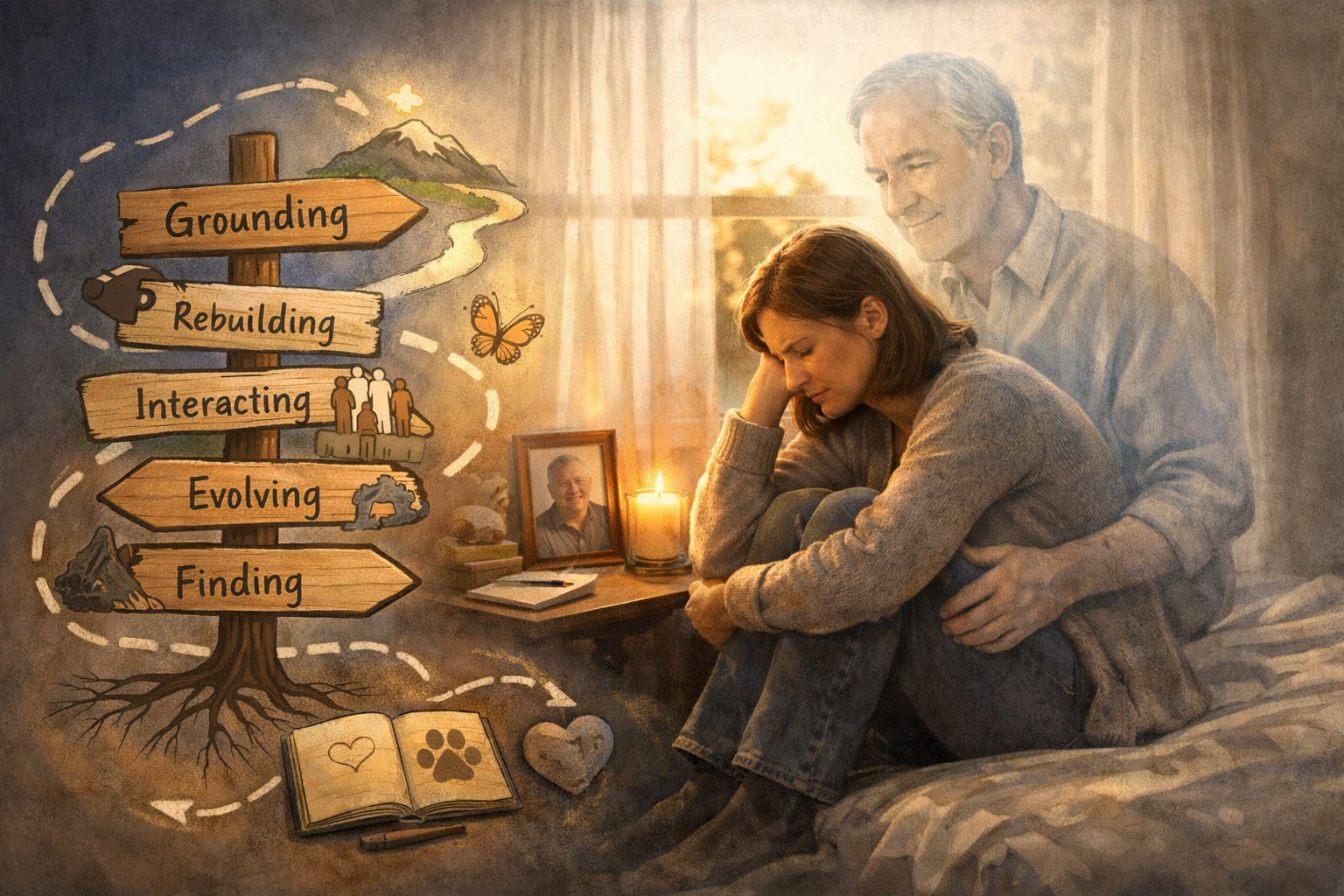
These reactions are deeply rooted in attachment and the loss of co-regulation. And within the GRIEF Ladies Framework: Grounding, Rebuilding, Interacting, Evolving, and Finding, this kind of loss often shakes the very first trail marker: Grounding.
Attachment and Emotional Safety
Attachment theory, originally developed by John Bowlby and expanded through decades of research, helps explain why certain losses feel especially destabilizing. Humans are biologically wired to seek safety through connection. From early childhood through adulthood, attachment relationships help us feel secure, regulated, and supported during times of stress.
Attachment figures, including parents, spouses, close friends, and even our children, are often the people we turn to when we are overwhelmed, worried, or distressed. They help us:
Calm our nervous system
Organize our emotions
Think through our decisions
Feel grounded
Help us feel safe
Over time, these relationships become part of how emotional regulation happens.
What Is Co-Regulation?
Co-regulation refers to the process by which our nervous systems are soothed, stabilized, and organized through connection with others.
A partner’s reassuring voice at the end of a stressful day.
A parent’s steady presence letting you know things will be okay.
A loved one helping you think clearly during a crisis.
These are examples of co-regulation in action. Often, we are not consciously aware of how much co-regulation a relationship provides until it is gone.
When someone who served as a primary source of emotional regulation dies, grief includes more than missing the person. It includes the loss of emotional safety and nervous system stability.
And that is why grief can feel so physically and emotionally disorienting.
When a co-regulator dies, many grieving individuals experience:
Increased anxiety or panic
Overwhelmed with emotions
Numbness or shutdown
Difficulty making decisions
Exhaustion, even after a full night of sleep
A sense of being “lost”
These reactions are not signs of weakness or pathology. They are common nervous system responses to the loss of a co-regulator. The body is adjusting to the absence of someone who helped it feel safe.
Within the GRIEF Ladies Framework, this often impacts more than just Grounding:
Rebuilding feels harder because routines were shared.
Interacting changes because the person you turned to is no longer physically present.
Evolving can bring roadblock emotions like anger, guilt, or fear.
Finding meaning may feel impossible in the early stages.
When someone functioned as your “safe base” or emotional anchor, their death disrupts not only daily life, but also your internal compass.
Staying Connected Without Staying Stuck
For many years, grief was framed as a process of “letting go.” We now know that this is not current. Research supports that maintaining a connection with the person who died can be healthy and adaptive.
In the GRIEF Ladies Framework, this connects closely with Finding.
Many grieving individuals continue to experience support through:
Talking about their loved one and asking, “What would they say to me in this situation?”
Carrying forward their loved one’s values
Rituals that honor the person’s life, such as lighting a candle on hard days
Moments of felt connection during stress
Staying connected to pets or safe people who offer comfort
Staying connected does not mean avoiding grief or refusing to move forward. For many, it is precisely what helps regulate the nervous system and create meaning after loss.
Rebuilding Emotional Safety After Loss
Healing after the death of an attachment figure is not about replacing the person who died. It is about rebuilding emotional safety in new ways. Within the GRIEF Ladies Framework, this often looks like walking through each trail marker intentionally:
Grounding
Learning nervous system regulation skills, including practicing breathing exercises, building body awareness, and making sure you are getting enough sleep.
Rebuilding
Energy mapping: identifying what drains you, what restores you, and how to pace yourself in grief and re-establishing small, predictable routines.
Interacting
Expanding safe sources of connection. Allowing others to support you, even if it feels different than before.
Evolving
Practicing self-compassion during emotional waves. Understanding that anger, guilt, fear, or jealousy are often protective emotions.
Finding
Engaging in ways to stay connected to your loved one and exploring how the relationship continues internally, even as life changes externally.
Over time, many grieving individuals learn to offer themselves some of the reassurance and compassion they once received from others while still honoring the ongoing bond with their loved one.
If grief has made you feel emotionally unsafe, anxious, or disconnected, it may not be because you are grieving incorrectly. It may be because your nervous system lost one of its primary sources of safety.
Grief is not only about losing someone you love. It is also about learning how to live and feel safe without the person who helped regulate your emotional world.

GRIEF & YOUR ENERGY
Grief and Your Energy
Why grief feels exhausting… and what helps
Have you noticed grief makes everyday tasks feel harder?
You may feel:
• Mentally drained
• Emotionally overwhelmed
• Socially exhausted
• Physically tired
You are not imagining this.
Grief requires a huge amount of nervous system energy.
Many grieving people worry:
“I should be able to handle more.”
But grief is heavy.
Imagine carrying an invisible backpack filled with memories, emotions, and change… all day long.
Of course you get tired.
This is where ENERGY MAPPING can help.
Energy mapping helps you notice:
✔ What drains your energy
✔ What restores your energy
✔ What feels meaningful but still exhausting
✔ How to pace yourself in grief
Some experiences have TWO types of energy cost:
Physical Energy: How much effort your body uses
Emotional Energy: How much grief or stress it activates
Both matter.
Examples:
Talking about your loved one
💛 Meaningful
⚡ Emotionally draining
Family gatherings
💛 Important
⚡ Physically and emotionally tiring
Resting afterward is not weakness.
It is support.
Try this simple reflection:
👉 After I do __________
👉 My body usually feels __________
Awareness helps you plan care instead of pushing through exhaustion.
One helpful strategy is called Recovery Pairing.
This means: Pair draining experiences with supportive ones.
Examples:
Grief ritual → quiet walk
Social event → alone time
Therapy session → calming music or journaling
Grief changes capacity.
Energy mapping helps you work WITH your capacity instead of fighting it.
Pacing grief is how many people survive it.
💬 Reflection Question:
What is one activity that drains your energy right now… and one that helps restore it?
5 Actionable Steps to Cope With Grief (The GRIEF Ladies Framework)
5 Tools to Help you Cope with your Grief
Grief changes everything—but you don’t have to feel stuck or powerless.
In this video, The GRIEF Ladies share 5 actionable steps you can take after loss, based on our GRIEF framework:
Grounding • Rebuilding • Interacting • Evolving • Finding
This compilation features insights from five powerful guest conversations on the GRIEF Ladies Podcast, offering practical tools to help you:
Feel more grounded when grief feels overwhelming
Rebuild routines and structure after loss
Navigate relationships and communication while grieving
Work through difficult emotions like guilt, anger, and fear
Stay connected to your loved one while discovering who you are now
Whether you’re newly bereaved or living with ongoing grief, these steps are designed to help you feel better now—without letting go of love or connection.
✨ Grief is not something to “get over.”
✨ You’re allowed to want relief and connection.
✨ Small actions can create meaningful change.
To watch the video of these 5 tools to help you on your grief journey visit: https://youtu.be/EqLGul_LcFs

How to Live with Loss
How to Live with Loss from the death of a loved one
Many people search for this in the middle of the night:
How do I get over this?
How do I move on?
How do I make this stop hurting?
The truth is, grief is not something you get over. It’s something you learn to live with.
In the Beginning, Grief Can Take Over Everything
In the first few days, weeks, and even months following the death of a loved one, grief often feels overwhelming. It can impact:
Your sleep
Your focus
Your relationships
Your work
Your sense of identity
Your ability to plan for the future
It can feel like grief is touching every part of your life at once. When you're feeling that it’s common to want relief and fast.
As you move forward, grief often looks and feels different. It may not dominate every moment of your day. The waves may become less constant. You may find ways to function, to laugh again, to engage in life. That doesn’t mean the grief is gone.
It means you are growing around it.
Some people describe it this way: your grief doesn’t necessarily shrink, but your life begins to expand. You grow bigger than your grief. There is more room inside you for joy, connection, purpose, and memory alongside the pain.
The love is still there. The loss is still real. But it isn’t consuming every breath.
So What Actually Helps?
You don’t “get over” a loss by forcing yourself to move on. You learn to live with it by:
Developing coping skills for when waves hit
Rebuilding routines and structure
Learning how to talk about your grief
Finding ways to stay connected to the person who died
Allowing both hard emotions and moments of relief
This is the kind of practical, real-life approach we focus on inside the GRIEF Ladies Facebook Community, a place where people share what it’s really like to live with loss and support one another through it.
There is no deadline for healing. There is no requirement to “be done” with your grief. Learning to live with loss is a gradual process. And it’s okay if you’re still in the part where it feels heavy. You are not behind. You are grieving.

Is My Grief Normal?
Is My Grief Normal?
Many grieving individuals worry if what they are feeling is normal, or if what they’re feeling is too much, not enough, or somehow wrong. This is one of the most common questions people ask after the death of someone they love.
In grief groups, we constantly hear:
“I am going to say something that might sound crazy, but…”
“I feel like I’m losing my mind.”
And almost every time, heads nod around the room in agreement
The reality is that while grief is unique, many grieving individuals experience similar reactions.
Common and normal grief symptoms include:
Grief brain (forgetfulness, brain fog, difficulty concentrating)
Grief Bursts: sudden waves of emotion or tears “out of nowhere.”
Physical symptoms like headaches, stomach aches, a tight chest, or extreme exhaustion
Sleep changes- extreme exhaustion, trouble falling or staying asleep
Increased anxiety or irritability
Feeling disconnected from friends and family
Deep loneliness
Questioning your faith or worldview
Feeling okay one moment and a complete mess the next
These are all very normal reactions, and this list could go on and on. Grief does not move through predictable stages. It does not follow a straight timeline. It often comes in waves, and there is no timeline for how long this will last.
If you want to hear real conversations about what grief actually feels like, including grief brain, triggers, and why waves happen, we talk openly about this on the GRIEF Ladies podcast, where we normalize the parts of grief people are often afraid to say out loud. Check out new episodes every Wednesday, which is available on all major podcast platforms and YouTube at: GRIEF Ladies - YouTube